Day: 14 July 2026

  • How to Price Your Services with Confidence and Increase Revenue

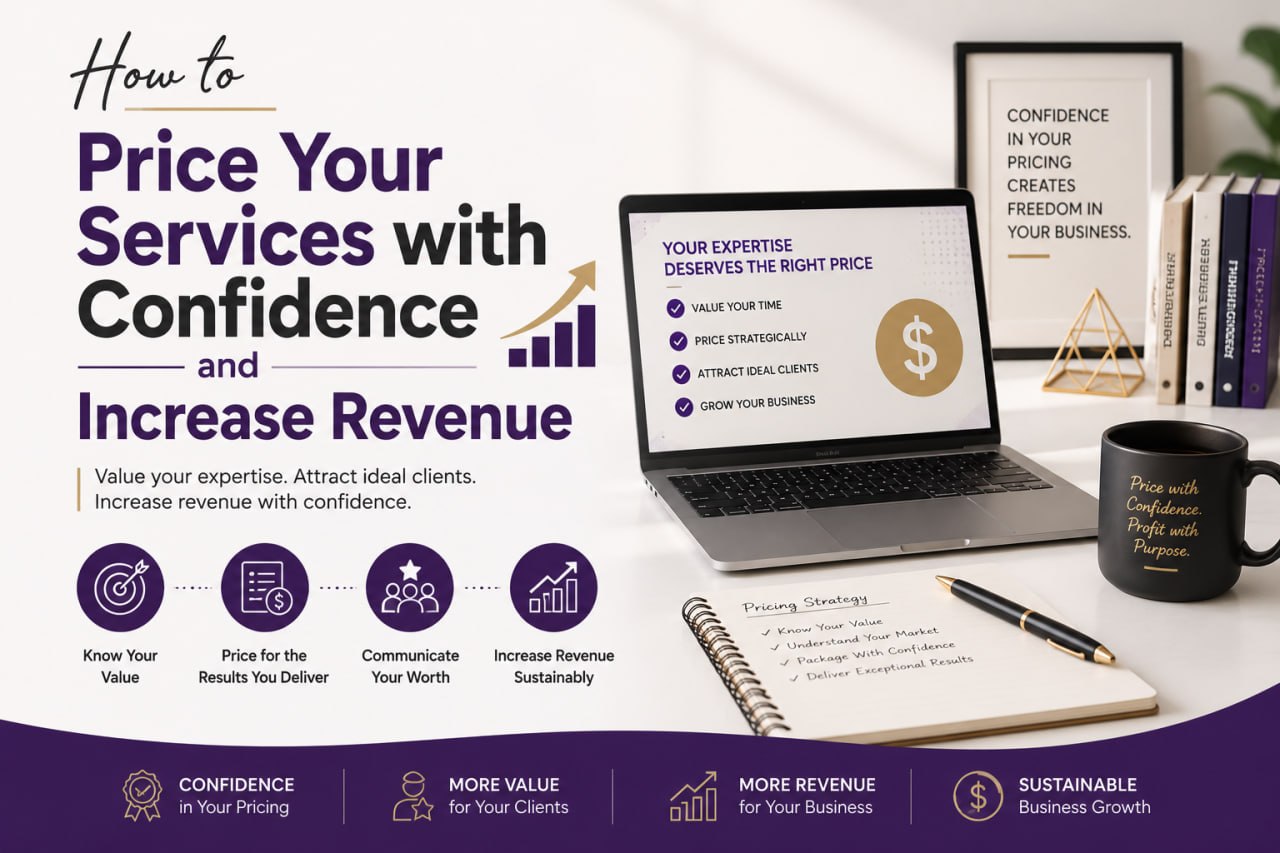
    How to Price Your Services with Confidence and Increase Revenue

    If pricing your services makes you anxious, second-guess yourself, or discount before a client even asks you’re not alone. Most entrepreneurs struggle with this, and it rarely has anything to do with math. A strong pricing strategy for service businesses is about psychology, positioning, and value as much as it is about numbers.

    I’ve coached hundreds of women entrepreneurs through this exact challenge. The pattern is almost always the same: talented professionals underprice out of fear, then burn out trying to serve too many clients for too little money. The fix isn’t just “charge more.” It’s building a profitable pricing model rooted in clear value and real confidence.

    This guide walks you through exactly how to price consulting services and other offers so you can charge what you’re worth without hesitation.

    1. What Is a Pricing Strategy for Service Businesses?

    A pricing strategy for service businesses is the deliberate approach you use to set, communicate, and adjust your prices based on the value you deliver, your market position, and your business goals. It’s not a single number — it’s a system.

    Core Elements of a Pricing Strategy

    •    Value alignment: pricing tied to outcomes, not just hours

    •    Market positioning: how your price signals your expertise level

    •    Pricing structure: hourly, project-based, retainer, or value-based

    •    Confidence delivery: how clearly and firmly you communicate price

    2. Why Confidence Matters as Much as Numbers

    Clients read hesitation. If you apologize for your rate, over-explain, or rush to offer a discount, clients sense uncertainty — even if your price is fair. Confidence in your delivery often influences a buying decision as much as the number itself.

    Behavioral pricing research, including work referenced by Harvard Business Review on pricing psychology, consistently shows that perceived value and delivery confidence shape willingness to pay more than the raw price point alone.

    3. Common Pricing Models Compared

    Model Best For Pros Cons
    Hourly Short-term or undefined scope work Simple to calculate Caps income to time; penalizes efficiency
    Project-based Defined deliverables Predictable for clients Requires accurate scoping
    Retainer Ongoing support relationships Predictable recurring revenue Requires clear scope boundaries
    Value-based High-impact consulting/coaching Highest earning potential Requires strong positioning and proof

    For most consultants and coaches, a profitable pricing model blends value-based pricing with clear packages, rather than relying solely on hourly billing.

    4. The 6-Step Framework to Price Your Services Confidently

    Step 1: Calculate Your Financial Baseline

    Know your minimum viable rate: expenses, taxes, and desired income divided by realistic billable capacity. This is your floor, not your goal.

    Step 2: Identify the Value You Deliver

    List the tangible and intangible outcomes clients get: time saved, revenue generated, risk avoided, confidence gained. Price should reflect this value, not just your time.

    Step 3: Research Market Positioning

    Look at comparable providers at your experience level, but don’t anchor solely to averages. Position based on your unique expertise and results, not the cheapest option in your niche.

    Step 4: Choose Your Pricing Structure

    Decide between hourly, project-based, retainer, or value-based pricing, based on the nature of your service and client expectations.

    Step 5: Set Your Price With a Buffer

    Price slightly above your comfort zone. Most entrepreneurs undershoot; a small stretch keeps you profitable and sustainable.

    Step 6: Practice Delivering Your Price With Confidence

    State your price clearly, pause, and avoid over-justifying. Practice out loud until it feels natural, not rehearsed.

    5. How to Price Consulting Services Specifically

    Consulting pricing tends to work best with value-based or project-based models because clients are paying for outcomes and expertise, not just hours.

    1.   Define the specific business outcome your consulting delivers

    2.   Estimate the financial impact of that outcome for the client

    3.   Price as a percentage of that impact, or as a premium project fee

    4.   Offer tiered packages (e.g., strategy-only, strategy + implementation, full done-for-you)

    5.   Include clear scope boundaries to prevent scope creep

    6. Signs You’re Underpricing Your Services

    •    Clients rarely question or negotiate your price

    •    You feel resentful or exhausted after projects

    •    You’re consistently busy but not profitable

    •    You discount quickly when asked

    •    Your rates haven’t changed in over a year despite more experience

    7. Common Pricing Mistakes to Avoid

    •    Pricing based only on competitor rates instead of your own value

    •    Using hourly billing for high-impact, outcome-driven work

    •    Discounting immediately when a client hesitates

    •    Failing to revisit pricing as your experience and results grow

    •    Not communicating price with clarity and confidence

    •    Offering too many customizable options instead of clear packages

    8. Myth vs. Fact: Pricing Edition

    Myth Fact
    Charging more will scare away clients. Higher prices often attract more serious, committed clients.
    You must match competitor pricing. Pricing should reflect your unique value and results, not just the market average.
    Hourly billing is the safest pricing model. Hourly billing often caps income and penalizes efficiency and experience.
    Confidence in pricing comes naturally with experience. Confidence is a skill built through practice and clear value framing, regardless of experience level.

    9. Expert Tips for a Profitable Pricing Model

    •    Revisit your pricing every 6–12 months as your expertise and results grow

    •    Use case studies and testimonials to reinforce value before the price conversation

    •    Avoid justifying your price with a long list of deliverables — lead with outcomes

    •    Build in a buffer for scope creep and unexpected client needs

    Inside my coaching programs, I help women entrepreneurs pair strategic pricing frameworks with the confidence and mindset shifts needed to actually hold their rates in real client conversations.

    Related Reading on This Site

    See the amethyst business solutions coaching page, the business strategy services page, and the client results page for real examples of pricing transformations.

    Frequently Asked Questions

    What is the best pricing strategy for service businesses?

    Value-based pricing is generally the most profitable, as it ties price to the outcome delivered rather than time spent.

    How do I know if I’m underpricing my services?

    Signs include clients never negotiating, feeling resentful after projects, and rates that haven’t changed despite growing experience.

    Should I charge hourly or by project?

    Project-based or value-based pricing is usually more profitable for defined, outcome-driven work, while hourly suits undefined or ongoing tasks.

    How do I price consulting services with no set market rate?

    Base pricing on the financial or strategic impact of your work, then validate against comparable expert-level providers in your niche.

    How often should I raise my prices?

    Most entrepreneurs review and adjust pricing every 6–12 months as their experience, results, and demand increase.

    What if a client says my price is too high?

    Reframe the conversation around value and outcomes rather than immediately discounting, and be prepared to hold your price confidently.

    Does higher pricing attract better clients?

    Often, yes. Higher prices tend to attract clients who are more committed, decisive, and easier to work with.

    How do I build confidence when stating my price?

    Practice saying your price out loud, pause after stating it, and avoid over-explaining or apologizing.

    What’s a profitable pricing model for beginners?

    Start with clear, tiered packages based on outcomes, with a built-in buffer above your minimum viable rate.

    Can I switch from hourly to value-based pricing later?

    Yes. Many entrepreneurs transition as they gain experience, testimonials, and clearer proof of the outcomes they deliver.

    Key Takeaways

    •    A pricing strategy for service businesses should be based on value delivered, not just time spent.

    •    Confidence in how you communicate your price matters as much as the number itself.

    •    Value-based and project-based pricing typically outperform hourly billing for consultants and coaches.

    •    Underpricing is often driven by fear, not market reality.

    •    Review and adjust pricing regularly as your expertise and results grow.

    •    A profitable pricing model pairs clear positioning with practiced, confident delivery.

    Final Thoughts

    Pricing your services with confidence isn’t about finding a magic number — it’s about aligning your price with the real value you deliver and communicating it without hesitation. When you combine a clear pricing strategy for service businesses with genuine confidence, you stop competing on price and start attracting clients who are ready to invest in real results.

    Ready to Price Your Services with Confidence?

    If you’re tired of undercharging, second-guessing your rates, or feeling anxious during pricing conversations, I can help you build a profitable pricing model backed by real confidence. Inside my coaching programs, we work together on positioning, pricing strategy, and the mindset shifts needed to hold your rates with ease.

    Visit https://amethystbusinesssolutions.com to book a discovery call and start pricing your services like the expert you are.

  • The Complete Guide to Personal Branding for Women Entrepreneurs

    The Complete Guide to Personal Branding for Women Entrepreneurs

    If you’re a woman entrepreneur trying to grow your business, you’ve probably heard the phrase “personal brand” more times than you can count. But here’s the truth most people won’t tell you: personal branding for women entrepreneurs isn’t about being loud on social media or having a perfect logo. It’s about becoming known, trusted, and chosen for the specific value only you can offer.

    I’ve spent years coaching women entrepreneurs through this exact process, and I’ve watched the same pattern repeat itself. Talented women with real expertise stay invisible, undercharge, and lose clients to competitors who are, frankly, less qualified but more visible. The difference almost always comes down to one thing: a clear, intentional personal brand strategy.

    This guide breaks down exactly what personal branding means for entrepreneurs, why it matters more than ever in 2026, and how to build one step by step — even if you’re starting from zero.

    1. What Is Personal Branding for Women Entrepreneurs?

    Personal branding for women entrepreneurs is the intentional process of shaping how the world perceives you as a business owner, expert, and leader. It combines your expertise, values, personality, and story into a consistent message that builds trust and attracts the right clients.

    Unlike a logo or a tagline, your personal brand lives in every interaction: how you speak on a sales call, what you post online, how you show up in a networking room, and how clients describe you to their friends. It’s not something you create once and forget — it’s something you build with every decision.

    Core Elements of a Strong Personal Brand

    •    Positioning: the specific problem you solve and for whom

    •    Voice: the tone and language that feels authentically you

    •    Visibility: where and how consistently you show up

    •    Proof: testimonials, results, and credibility markers

    •    Story: the experiences that make your perspective unique

    2. Why Personal Branding Matters for Business Growth

    A strong personal brand strategy directly impacts revenue. When potential clients already trust you before the first conversation, sales conversations become easier, pricing objections drop, and referrals increase.

    Research from LinkedIn and Edelman’s Trust Barometer studies consistently shows that people trust individuals more than institutions, which is exactly why entrepreneur branding built around a real person — not just a company name — tends to outperform generic business marketing.

    Business Benefits of Strong Entrepreneur Branding

    •    Higher perceived value, which supports premium pricing

    •    Increased inbound leads through word-of-mouth and referrals

    •    Faster trust-building with new prospects

    •    Stronger client retention and loyalty

    •    More opportunities: speaking, media, partnerships, collaborations

    3. Personal Branding vs. Business Branding: What’s the Difference?

    Many women entrepreneurs confuse personal branding with business branding. They overlap, but they are not the same thing.

    Aspect Personal Branding Business Branding
    Focus You as the expert and face The company as an entity
    Trust source Relationship and reputation Product and systems
    Flexibility Evolves with your career Tied to the business model
    Best for Coaches, consultants, service providers Product companies, larger teams

    For most service-based women entrepreneurs — coaches, consultants, creatives, and solopreneurs — personal branding for women entrepreneurs is the stronger growth lever because clients are ultimately buying you.

    4. The 5-Step Personal Brand Strategy Framework

    Here is the exact framework I use with clients to build a personal brand strategy that converts followers into paying clients.

    Step 1: Clarify Your Positioning

    Define the specific transformation you provide, for whom, and why you’re different. Avoid vague statements like “I help entrepreneurs grow.” Instead, get specific about the outcome and audience.

    Step 2: Audit Your Current Brand Presence

    Review your website, social profiles, and public content. Ask: does this reflect where I want my business to go, or where it has already been?

    Step 3: Craft Your Brand Message

    Develop a clear message architecture: your core statement, your story, your proof points, and your call to action. This becomes the foundation for all future content.

    Step 4: Build Visibility Consistently

    Choose one to two platforms and show up consistently. Consistency beats frequency — a weekly presence sustained over months outperforms a sporadic daily burst.

    Step 5: Reinforce Through Client Experience

    Your brand is confirmed or broken in the client experience. Every touchpoint, from your onboarding process to your invoicing, should reflect the same values and professionalism you promote publicly.

    5. How to Define Your Unique Brand Positioning

    Positioning is the foundation of entrepreneur branding. Without it, even the best content strategy will feel scattered. Use these guiding questions to clarify your position in the market:

    1.   What specific result do I consistently deliver for clients?

    2.   Who is my ideal client, and what do they struggle with most?

    3.   What personal experience or perspective makes my approach different?

    4.   What do past clients say about working with me?

    5.   What am I willing to be known for, even if it’s not for everyone?

    6. Building Authority and Visibility as an Entrepreneur

    Visibility without authority creates attention without trust. Authority without visibility creates trust without reach. You need both.

    How to Build Authority

    •    Share original insights, not just generic tips

    •    Publish case studies and client results

    •    Speak at events, podcasts, or webinars in your niche

    •    Get featured in relevant press or guest content

    How to Build Visibility

    •    Post consistently on one primary platform

    •    Repurpose long-form content into shorter formats

    •    Engage genuinely with your existing community

    •    Collaborate with complementary entrepreneurs

    7. Common Personal Branding Mistakes to Avoid

    •    Trying to appeal to everyone instead of a defined audience

    •    Copying another entrepreneur’s voice instead of developing your own

    •    Inconsistent messaging across platforms and touchpoints

    •    Waiting until you feel “ready” or “expert enough” to start

    •    Focusing only on aesthetics while neglecting positioning and message

    •    Underpricing services because of low visibility confidence

    8. Myth vs. Fact: Personal Branding Edition

    Myth Fact
    Personal branding is only for influencers. Every entrepreneur has a personal brand, whether intentional or not.
    You need a large following to be credible. Trust and conversion depend on relevance and positioning, not follower count.
    Personal branding means oversharing your life. Effective branding shares strategically, centered on expertise and value.
    It’s a one-time project. Personal branding is an ongoing strategy that evolves with your business.

    9. Expert Tips for Sustainable Entrepreneur Branding

    After years of coaching women entrepreneurs through brand strategy and positioning, here are the insights that separate brands that last from ones that fade:

    •    Build your brand around your zone of genius, not trending topics

    •    Document your client transformations, not just your opinions

    •    Revisit your positioning every 6–12 months as your business grows

    •    Invest in confidence and mindset work alongside strategy — visibility fear is the top blocker for women entrepreneurs

    This is exactly the kind of work I guide clients through inside my coaching programs — combining strategic positioning with the confidence to show up and own it.

    Related Reading on This Site

    Explore more on the amethyst business solutions coaching page, the personal branding services page, and the client success stories page to see this framework applied in real businesses.

    Frequently Asked Questions

    What is personal branding for women entrepreneurs?

    It’s the strategic process of defining and communicating your unique expertise, values, and story so ideal clients trust and choose you over competitors.

    How long does it take to build a personal brand?

    Most entrepreneurs see initial traction within 3–6 months of consistent effort, with stronger authority building over 12–18 months.

    Do I need social media to build a personal brand?

    Social media helps with visibility, but authority can also be built through speaking, referrals, podcasts, and written content like blogs and newsletters.

    What’s the difference between personal branding and marketing?

    Marketing promotes offers; personal branding builds the trust and recognition that makes marketing more effective.

    How do I find my brand positioning?

    Identify the specific outcome you deliver, your ideal audience, and what makes your approach different, then write it as a clear one-sentence statement.

    Can personal branding help me raise my prices?

    Yes. A clear, trusted personal brand increases perceived value, which supports premium pricing and reduces price objections.

    What platform is best for entrepreneur branding?

    The best platform is the one your ideal clients already use consistently and where you can show up sustainably, whether that’s LinkedIn, Instagram, or a newsletter.

    Is personal branding only for coaches and consultants?

    No. Any entrepreneur whose business depends on trust and relationships benefits from a strong personal brand, including creatives, consultants, and service providers.

    How do I stay authentic while building a brand?

    Base your brand on real experience, values, and results rather than trends, and let your voice reflect how you naturally communicate.

    What’s the biggest mistake women entrepreneurs make with branding?

    Waiting to feel “ready” before becoming visible, which delays trust-building and revenue growth.

    Key Takeaways

    •    Personal branding for women entrepreneurs is a strategic system, not a personality trait or aesthetic.

    •    A clear personal brand strategy increases trust, referrals, and pricing power.

    •    Positioning is the foundation — get specific about your outcome, audience, and difference.

    •    Consistency in visibility matters more than frequency or perfection.

    •    Your brand is reinforced or broken by the actual client experience.

    •    Confidence and mindset work are just as important as strategy for sustainable entrepreneur branding.

    Final Thoughts

    Building a personal brand strategy is one of the highest-leverage investments a woman entrepreneur can make. It shapes how clients perceive your value, how confidently you price your services, and how sustainably your business grows. The entrepreneurs who commit to clear positioning and consistent visibility don’t just build a brand — they build a business that reflects their full expertise and worth.

    Ready to Build a Personal Brand That Attracts Premium Clients?

    If you’re ready to stop blending in and start building a personal brand strategy that positions you as the go-to expert in your industry, I’d love to help. Through my coaching programs, I work with women entrepreneurs to clarify their positioning, build authentic authority, and price their services with confidence.

    Visit https://amethystbusinesssolutions.com to book a discovery call and take the first step toward a brand that truly reflects your value.