Day: 16 July 2026

  • From Self-Doubt to CEO Mindset: Confidence Tips for Women Entrepreneurs

    From Self-Doubt to CEO Mindset: Confidence Tips for Women Entrepreneurs

    You can have the perfect offer, a solid strategy, and real expertise — and still hold yourself back. If self-doubt keeps showing up right when you need to make a bold decision, raise your prices, or put yourself out there, you’re not broken. You’re missing a CEO mindset for women entrepreneurs that supports the business you’re building.

    I’ve coached many talented, capable women who had every qualification to succeed but were quietly sabotaged by self-doubt. The shift that changed everything wasn’t more credentials. It was building genuine entrepreneurial confidence and a mindset that matched their ambition.

    This guide walks you through what a CEO mindset actually looks like, practical confidence tips, and how to build a women business mindset that supports sustainable growth instead of constant self-doubt.

    1. What Is a CEO Mindset for Women Entrepreneurs?

    A CEO mindset for women entrepreneurs is a way of thinking and making decisions that reflects self-trust, ownership, and resilience, rather than fear or self-doubt. It’s less about title and more about how you show up in your business daily.

    Core Traits of a CEO Mindset

    •    Self-trust in decision-making, even without full certainty

    •    Ownership of outcomes, both successes and setbacks

    •    Resilience when facing rejection or setbacks

    •    Willingness to be visible and take up space professionally

    2. Why Self-Doubt Shows Up More for Women in Business

    Research on workplace confidence, including studies referenced by organizations like the American Psychological Association, has shown that women are more likely to underestimate their competence, often referred to as impostor syndrome, even when objectively qualified.

    This isn’t a personal flaw — it’s a pattern shaped by social conditioning, lack of representation in leadership, and years of being taught to minimize rather than assert. Recognizing this pattern is the first step toward shifting it.

    3. Self-Doubt vs. CEO Mindset: A Side-by-Side Comparison

    Situation Self-Doubt Response CEO Mindset Response
    Pricing a service Undercharge to avoid rejection Price based on value, hold the line confidently
    Receiving feedback Internalize as personal failure Evaluate objectively, adjust if useful
    Making a decision Delay, seek endless validation Decide with available information, adjust as needed
    Visibility Avoid being seen or heard Show up consistently despite discomfort

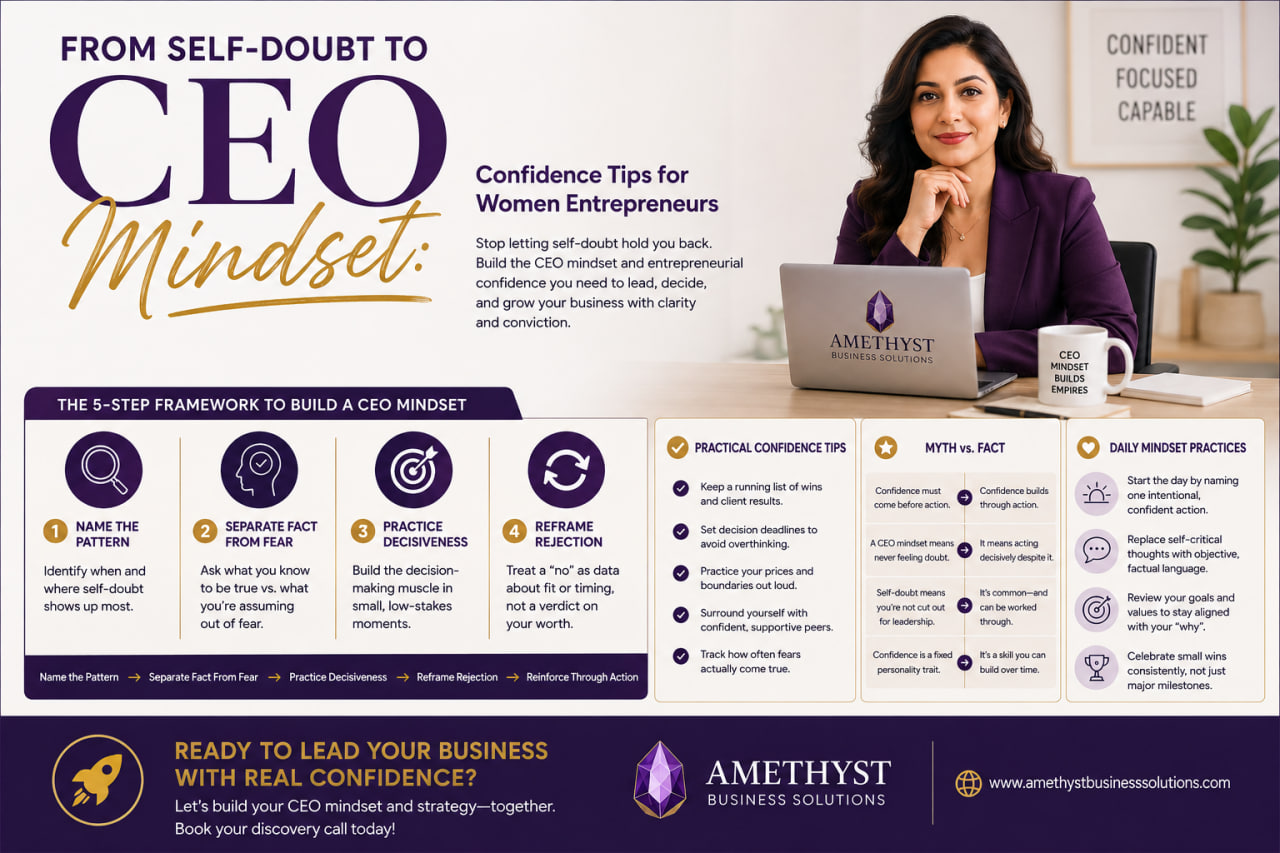
    4. The 5-Step Framework to Build a CEO Mindset

    Step 1: Name the Self-Doubt Pattern

    Identify when and where self-doubt shows up most: pricing, visibility, decision-making. Awareness interrupts the automatic reaction.

    Step 2: Separate Facts From Fear-Based Stories

    Ask: what do I actually know to be true here, versus what am I assuming out of fear? This creates space for clearer decisions.

    Step 3: Practice Decisive Action in Small Moments

    Build the decision-making muscle with low-stakes choices before applying it to bigger business decisions.

    Step 4: Reframe Rejection as Information

    Treat a “no” as data about fit or timing, not a verdict on your worth or capability.

    Step 5: Reinforce Identity Through Action

    Confidence often follows action, not the other way around. Each aligned action reinforces your identity as a capable leader.

    Framework Summary: Name the Pattern → Separate Fact From Fear → Practice Decisiveness → Reframe Rejection → Reinforce Through Action.

    5. Practical Entrepreneurial Confidence Tips

    1.   Keep a running list of past wins and client results to reference when doubt creeps in

    2.   Set a decision deadline for yourself to avoid endless overthinking

    3.   Practice stating your prices and boundaries out loud before real conversations

    4.   Surround yourself with peers or mentors who model strong entrepreneurial confidence

    5.   Track how often your fears actually come true versus how often they don’t

    6. Building a Strong Women Business Mindset Daily

    Daily Mindset Practices

    •    Start the day by naming one intentional, confident action you’ll take

    •    Replace self-critical inner dialogue with objective, factual language

    •    Review your goals and values regularly to stay grounded in your “why”

    •    Celebrate small wins consistently, not just major milestones

    7. Common Confidence Mistakes to Avoid

    •    Waiting to feel fully confident before taking action

    •    Comparing your early stage to someone else’s highlight reel

    •    Apologizing excessively in professional communication

    •    Seeking constant external validation instead of building self-trust

    •    Avoiding visibility out of fear of judgment or failure

    8. Myth vs. Fact: CEO Mindset Edition

    Myth Fact
    Confidence must come before action. Confidence often builds through taking action, not before it.
    A CEO mindset means never feeling doubt. It means acting decisively and effectively despite occasional doubt.
    Self-doubt means you’re not cut out for leadership. Self-doubt is common even among highly successful leaders and can be actively worked through.
    Confidence is a fixed personality trait. Entrepreneurial confidence is a skill that can be built and strengthened over time.

    9. Expert Tips for Sustaining Confidence Long Term

    •    Revisit your wins list regularly, especially during high-pressure periods

    •    Build a support system of mentors or coaches who reinforce your growth

    •    Set boundaries that protect your energy and decision-making clarity

    •    Treat mindset work as ongoing, not a one-time fix

    Inside my coaching programs, I help women entrepreneurs build a genuine CEO mindset paired with practical strategy, so confidence isn’t just a feeling it’s reflected in real business decisions and results.

    Related Reading on This Site

    See the amethyst business solutions coaching page, the confidence and mindset coaching page, and the client success stories page for real examples of this mindset shift in action.

    Frequently Asked Questions

    What is a CEO mindset for women entrepreneurs?

    It’s a way of thinking rooted in self-trust, ownership, and resilience that allows you to lead your business confidently, even amid uncertainty.

    Why do women entrepreneurs experience more self-doubt?

    Social conditioning and underrepresentation in leadership often contribute to women underestimating their competence, a pattern known as impostor syndrome.

    Can entrepreneurial confidence really be built, or is it innate?

    Confidence is a skill that can be built through consistent action, reflection, and reframing, regardless of natural personality.

    How do I stop self-doubt from affecting my pricing decisions?

    Practice separating facts from fear-based assumptions, and anchor your pricing in the value you deliver rather than your comfort level.

    What’s the fastest way to build a CEO mindset?

    Taking small, decisive actions consistently often builds confidence faster than waiting to feel fully ready.

    How is a women business mindset different from general business mindset advice?

    It specifically addresses patterns like impostor syndrome and conditioned self-minimization that disproportionately affect women in business.

    Does having a CEO mindset mean I’ll never feel afraid?

    No. It means acting effectively and decisively despite fear, not eliminating fear entirely.

    How can I stay confident during business setbacks?

    Reframe setbacks as information rather than personal failure, and revisit past wins to stay grounded in your capability.

    What role does community play in building entrepreneurial confidence?

    Surrounding yourself with supportive peers or mentors reinforces confident behavior and provides perspective during difficult moments.

    How long does it take to build a strong CEO mindset?

    Meaningful shifts often begin within weeks of consistent practice, with deeper, lasting change developing over several months.

    Key Takeaways

    •    A CEO mindset for women entrepreneurs is built through self-trust, ownership, and resilience not the absence of doubt.

    •    Self-doubt is a common, conditioned pattern, not a reflection of actual capability.

    •    Entrepreneurial confidence is a skill that can be built through consistent, intentional action.

    •    Confidence often follows action, rather than needing to come first.

    •    Reframing rejection as information helps sustain a strong women business mindset.

    •    Ongoing mindset practices, not one-time fixes, support long-term confidence.

    Final Thoughts

    Moving from self-doubt to a genuine CEO mindset for women entrepreneurs isn’t about eliminating fear entirely. It’s about building the self-trust and decisive action that let you lead your business with confidence, even when uncertainty is present. When you pair practical entrepreneurial confidence tips with consistent action, you build a women business mindset strong enough to support real, lasting growth.

    Ready to Lead Your Business With Real Confidence?

    If self-doubt has been holding you back from pricing confidently, showing up visibly, or making bold business decisions, I can help. Inside my coaching programs, we work together on building a genuine CEO mindset paired with strategic action, so confidence becomes part of how you lead not something you’re waiting to feel.

    Visit https://amethystbusinesssolutions.com to book a discovery call and start building the confident mindset your business deserves.
  • Building a Sustainable Business: Systems, Strategy, and Growth

    Building a Sustainable Business: Systems, Strategy, and Growth

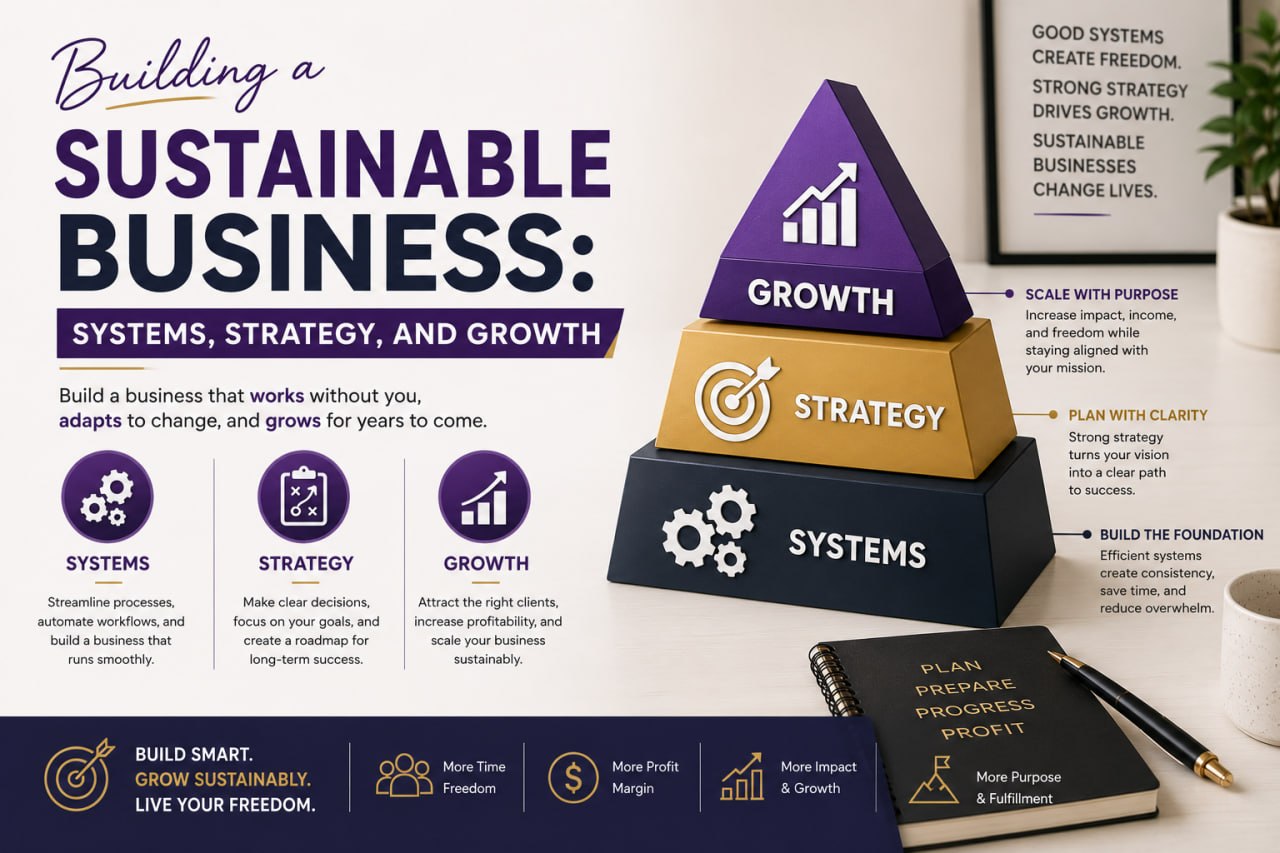
    Growth feels exciting until it starts to break you. If you’ve ever hit a busy season and felt like your business was running you instead of the other way around, you’re not alone. Sustainable business growth isn’t about doing more — it’s about building the systems and strategy that let your business grow without burning you out.

    I’ve worked with many women entrepreneurs who hit six figures and still felt like they were drowning. The common thread was always the same: they had demand, but no scalable business systems to support it. Growth without structure creates chaos, not success.

    This guide walks you through a clear business growth strategy, the systems that make growth sustainable, and how to scale without sacrificing your energy, quality, or sanity.

    1. What Is Sustainable Business Growth?

    Sustainable business growth is the strategic expansion of revenue, capacity, and impact using repeatable systems, rather than constant manual effort. It prioritizes long-term stability over short bursts of unsustainable hustle.

    Core Elements of Sustainable Growth

    •    Predictable systems for delivery, marketing, and operations

    •    A pricing model that supports profit, not just revenue volume

    •    Clear boundaries around capacity and workload

    •    Data-driven decisions instead of reactive scrambling

    2. Why Growth Without Systems Leads to Burnout

    When demand increases faster than your systems can support, everything falls on you personally: client delivery, admin, marketing, and problem-solving. This is one of the most common reasons ambitious entrepreneurs burn out right as their business starts to succeed.

    Research on entrepreneurial burnout consistently points to lack of structure and unsustainable workload, not lack of ambition, as the leading cause of founder exhaustion.

    3. Hustle Growth vs. Sustainable Growth: A Comparison

    Aspect Hustle Growth Sustainable Growth
    Approach Constant manual effort Repeatable systems and delegation
    Pace Fast but unstable Steady and scalable
    Risk High burnout risk Lower burnout risk
    Long-term outcome Often plateaus or collapses Supports lasting business growth strategy

    Hustle growth can create short-term wins, but scalable business systems are what allow a business to keep growing without requiring more and more of your personal time.

    4. The 6-Step Framework for Sustainable Business Growth

    Step 1: Audit Your Current Capacity

    Identify where your time is going and which tasks truly require your personal involvement versus what could be systematized or delegated.

    Step 2: Document Your Core Processes

    Write down your repeatable workflows: client onboarding, delivery, marketing, and follow-up. Documentation is the foundation of scalable business systems.

    Step 3: Identify Your Growth Bottlenecks

    Determine what’s actually limiting growth: is it leads, conversion, delivery capacity, or pricing? Solve the true bottleneck first.

    Step 4: Build or Improve Supporting Systems

    Set up tools, templates, or team support for the processes you documented, so growth doesn’t depend entirely on your personal bandwidth.

    Step 5: Revisit Your Pricing and Offer Structure

    Ensure your pricing supports profit at scale, not just at your current capacity. Sustainable growth requires margin, not just volume.

    Step 6: Set Growth Metrics and Review Regularly

    Track key numbers monthly: revenue, capacity, client satisfaction, and profit margin, and adjust your business growth strategy accordingly.

    Framework Summary: Audit Capacity → Document Processes → Identify Bottlenecks → Build Systems → Revisit Pricing → Track Metrics.

    5. How to Build Scalable Business Systems

    1.   Create standard operating procedures (SOPs) for repeatable tasks

    2.   Use templates for proposals, emails, and client onboarding

    3.   Automate scheduling, invoicing, and follow-up where possible

    4.   Delegate or outsource tasks outside your zone of genius

    5.   Build a simple client management system to track leads and projects

    6. Core Elements of a Strong Business Growth Strategy

    Strategic Pillars

    •    Clear positioning that attracts the right clients consistently

    •    A pricing model that scales profitably, not just proportionally

    •    Marketing systems that don’t rely entirely on your daily presence

    •    Operational systems that support consistent quality at higher volume

    7. Common Mistakes That Undermine Sustainable Growth

    •    Scaling marketing before delivery systems can support the demand

    •    Keeping pricing flat as workload and complexity increase

    •    Trying to do everything personally instead of building systems

    •    No clear metrics to guide growth decisions

    •    Ignoring burnout warning signs until capacity fully breaks down

    8. Myth vs. Fact: Business Growth Edition

    Myth Fact
    Growth always requires working more hours. Sustainable business growth relies on systems and delegation, not just more personal effort.
    Scalable systems are only for large companies. Even solo entrepreneurs benefit from documented, repeatable systems as they grow.
    More leads always equal more growth. Growth also depends on delivery capacity, pricing, and systems, not leads alone.
    Burnout is just part of being an entrepreneur. Burnout is often a sign of missing systems and boundaries, not an unavoidable cost of growth.

    9. Expert Tips for Long-Term Scalability

    •    Revisit your systems every time you hit a new revenue milestone

    •    Build in review points before adding new offers or services

    •    Protect delivery quality over rapid, unsystematic expansion

    •    Invest in support (team, tools, or coaching) before you’re overwhelmed, not after

    Inside my coaching programs, I help women entrepreneurs build a business growth strategy paired with the systems and confidence needed to scale sustainably, without sacrificing their wellbeing.

    Related Reading on This Site

    See the amethyst business solutions coaching page, the business strategy services page, and the client success stories page for real examples of sustainable growth in action.

    Frequently Asked Questions

    What is sustainable business growth?

    It’s the strategic expansion of a business through repeatable systems and sound decisions, rather than constant manual effort, so growth doesn’t lead to burnout.

    How is business growth strategy different from marketing strategy?

    Business growth strategy includes marketing, but also pricing, systems, operations, and capacity planning across the entire business.

    What are scalable business systems?

    They are documented, repeatable processes—like SOPs, templates, and automation—that allow a business to grow without relying entirely on the founder’s personal time.

    Why does growth sometimes lead to burnout?

    Burnout often occurs when demand increases faster than a business’s systems and capacity can support, forcing the founder to absorb the gap personally.

    What’s the first step to building scalable systems?

    Start by documenting your core recurring processes, such as client onboarding and delivery, so they no longer rely solely on memory or manual effort.

    Should I focus on more leads or better systems first?

    If delivery or capacity is already strained, building systems first is usually more effective than adding more leads.

    How often should I review my business growth strategy?

    Review your strategy and key metrics monthly, with a deeper strategic review each quarter or at major revenue milestones.

    Can a solo entrepreneur build scalable systems?

    Yes. Even solo entrepreneurs benefit significantly from documented processes, templates, and automation as they grow.

    Does sustainable growth mean growing slower?

    Not necessarily. It means growing in a way that’s supported by systems, which often makes growth faster and more stable long term.

    How do I know if my business needs better systems?

    Signs include feeling overwhelmed by routine tasks, inconsistent client experience, and growth stalling despite strong demand.

    Key Takeaways

    •    Sustainable business growth relies on systems and strategy, not constant hustle.

    •    Growth without scalable business systems is one of the leading causes of entrepreneurial burnout.

    •    A strong business growth strategy includes pricing, systems, and operations—not just marketing.

    •    Documenting core processes is the first step toward scalability.

    •    Solving the true growth bottleneck matters more than simply generating more leads.

    •    Reviewing systems and metrics regularly keeps growth sustainable as your business evolves.

    Final Thoughts

    Sustainable business growth isn’t about working harder or saying yes to everything. It’s about building the systems and strategy that let your business expand without requiring more and more of you personally. When you combine a clear business growth strategy with scalable business systems, growth becomes something you can sustain—not something that eventually burns you out.

    Ready to Build a Business That Grows Without Burning You Out?

    If you’re ready to move from constant hustle to sustainable, systems-supported growth, I can help. Inside my coaching programs, we work together on business growth strategy, scalable systems, and the confidence to lead a business that grows on your terms.

    Visit https://amethystbusinesssolutions.com to book a discovery call and start building sustainable business growth today.