Day: 21 July 2026

  • How to Create an Irresistible Offer That Clients Want to Buy

    How to Create an Irresistible Offer That Clients Want to Buy

    You can be talented, hardworking, and genuinely great at what you do — and still struggle to sell. Often, the problem isn’t you. It’s the offer. Learning how to create a profitable offer is one of the highest-leverage skills you can build as a service provider.

    I’ve helped many entrepreneurs realize their marketing wasn’t the problem — their offer was unclear, underpriced, or not positioned around what clients actually wanted. Once we fixed the offer, everything else got easier.

    This guide walks you through exactly how to build service business offers that feel like an easy yes, using a proven offer positioning strategy.

    1. What Makes an Offer Actually Profitable?

    A profitable offer clearly communicates the specific problem it solves, the outcome it delivers, and why it’s worth the investment. It’s not just a list of deliverables — it’s a promise of transformation.

    Core Elements of a Profitable Offer

    •    A specific problem the offer solves

    •    A clear, tangible outcome the client receives

    •    Pricing that reflects the value delivered

    •    A simple, understandable structure

    2. Why Great Work Doesn’t Always Sell Itself

    Many talented entrepreneurs assume quality alone will attract clients. But if potential clients don’t clearly understand what they’re getting or why it matters, even excellent work goes unnoticed.

    Marketing research consistently shows that clarity, not complexity, drives buying decisions — people need to immediately understand the value before they’ll invest.

    3. Feature-Based vs. Outcome-Based Offers: A Comparison

    Aspect Feature-Based Offer Outcome-Based Offer
    Focus What’s included (calls, deliverables) What the client achieves
    Client understanding Requires more explanation Immediately clear value
    Pricing power Often lower, compared on features Higher, tied to results
    Conversion Slower decision-making Faster, more confident buying decisions

    Shifting from a feature-based to an outcome-based offer is one of the most effective ways to increase both conversion and pricing power.

    4. The 6-Step Framework to Build a Profitable Offer

    Step 1: Identify a Specific, Painful Problem

    Choose a problem your ideal client actively wants solved, not just something you enjoy doing.

    Step 2: Define the Tangible Outcome

    Get specific about what changes for the client by the end of working with you.

    Step 3: Map the Delivery Process

    Outline exactly how you’ll get the client from their current problem to the desired outcome.

    Step 4: Name Your Offer Clearly

    Choose a name that reflects the outcome or transformation, not just a generic service description.

    Step 5: Price Based on Value

    Set your price according to the outcome’s worth to the client, not just the time it takes you to deliver.

    Step 6: Test and Refine With Real Clients

    Launch your offer, gather feedback, and refine the structure, messaging, or pricing based on real results.

    Framework Summary: Identify Problem → Define Outcome → Map Delivery → Name Offer → Price for Value → Test and Refine.

    5. How to Apply Offer Positioning Strategy

    1.   Speak directly to the specific client situation your offer addresses

    2.   Lead with the transformation, not the process or tools involved

    3.   Differentiate your offer clearly from similar options in the market

    4.   Use client language, not internal jargon, to describe the outcome

    5.   Highlight what makes your particular approach uniquely effective

    6. Structuring and Pricing Your Offer

    Structuring Considerations

    •    Decide between one-time, package, or retainer-based delivery

    •    Include clear scope boundaries to prevent scope creep

    •    Consider tiered options for different levels of investment

    •    Keep the structure simple enough to explain in one or two sentences

    7. Common Offer Mistakes to Avoid

    •    Describing deliverables instead of outcomes

    •    Making the offer too broad or trying to solve too many problems at once

    •    Underpricing to compensate for unclear positioning

    •    Overcomplicating the structure with too many components

    •    Failing to test and refine the offer based on client feedback

    8. Myth vs. Fact: Offer Creation Edition

    Myth Fact
    More features make an offer more valuable. Clarity and outcome focus typically increase perceived value more than added features.
    Your offer should appeal to as many people as possible. A specific offer for a defined problem converts better than a broad, general one.
    Pricing should be based on time spent. Value-based pricing tied to outcomes usually supports higher profitability.
    A great offer never needs to change. Successful offers are refined over time based on client feedback and results.

    9. Expert Tips for Refining Your Offer Over Time

    •    Ask past clients what almost stopped them from buying

    •    Track which parts of your offer clients value most in feedback

    •    Revisit your offer’s name and positioning every 6–12 months

    •    Simplify before you add — most offers benefit from less complexity, not more

    Inside my coaching programs, I help entrepreneurs apply a proven offer positioning strategy to build service business offers that clients are genuinely excited to say yes to.

    Related Reading on This Site

    See the Amethyst Business Solutions coaching page, the business strategy services page, and the client success stories page for real examples of offer transformations.

    Frequently Asked Questions

    What makes an offer profitable versus just available?

    A profitable offer clearly solves a specific problem, delivers a defined outcome, and is priced according to that value, not just time spent.

    How do I know if my offer needs to change?

    If potential clients frequently hesitate, ask a lot of clarifying questions, or compare you mainly on price, your offer likely needs clearer positioning.

    Should I focus on outcomes or deliverables in my offer description?

    Outcomes. Clients care most about the result they’ll get, not the individual tasks or deliverables involved.

    What is offer positioning strategy?

    It’s the approach of clearly communicating your offer’s unique value and fit for a specific client situation, differentiating it from alternatives.

    How many offers should a service business have?

    Most service businesses perform best with one to three clear offers rather than many overlapping or unclear options.

    Should I price my offer based on my time or the client’s results?

    Pricing based on the value and results delivered typically supports greater profitability than pricing based solely on time.

    How do I test a new offer before fully launching it?

    Offer it to a small group of clients first, gather feedback, and refine the structure and messaging before a full launch.

    What’s the biggest mistake in offer creation?

    Describing what’s included instead of the outcome delivered is one of the most common and costly offer mistakes.

    Can I have tiered pricing within one offer?

    Yes. Tiered options can work well, as long as each tier’s value and outcome remain clear and distinct.

    How often should I revisit my service business offers?

    Review your offers every six to twelve months, or whenever client feedback suggests a shift is needed.

    Key Takeaways

    •    A profitable offer clearly communicates the outcome, not just the deliverables.

    •    Outcome-based offers typically convert better and support higher pricing than feature-based offers.

    •    Offer positioning strategy focuses on clarity, differentiation, and client language.

    •    Simple, well-structured offers are easier for clients to say yes to.

    •    Testing and refining your offer based on real feedback improves it over time.

    •    Common mistakes include vague positioning, overcomplication, and underpricing.

    Final Thoughts

    Learning how to create a profitable offer is one of the most valuable skills you can develop as a service provider. When your offer clearly solves a specific problem, delivers a defined outcome, and is priced according to its true value, selling stops feeling like convincing and starts feeling like a natural yes. A strong offer positioning strategy makes your service business offers the obvious choice for the right clients.

    Ready to Build an Offer Clients Are Excited to Buy?

    If your current offer isn’t converting the way your expertise deserves, I can help you rebuild it from the ground up. Inside my coaching programs, we work together on offer positioning strategy, pricing, and messaging so your service business offers become an easy, confident yes for the right clients.

    Visit amethystbusinesssolutions.com to book a discovery call and start creating a truly profitable offer.
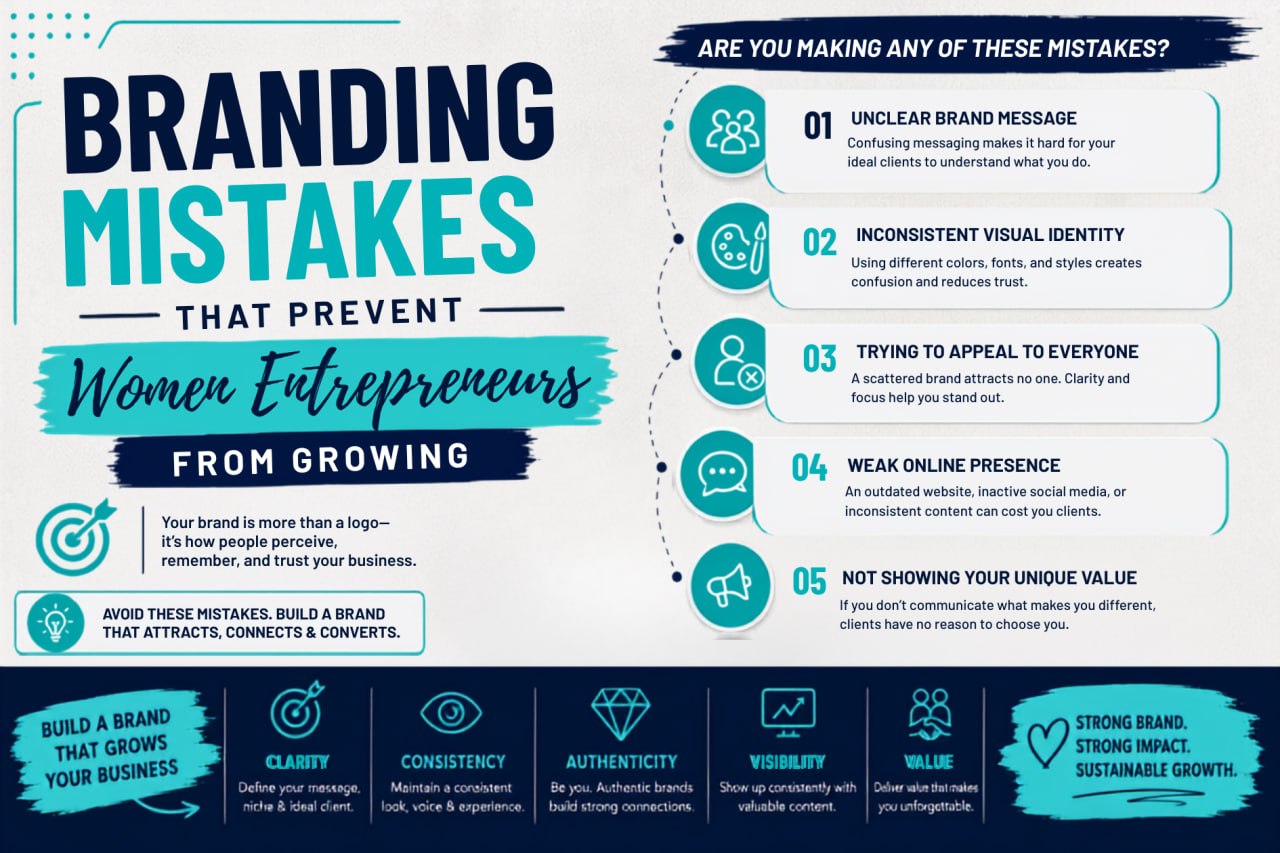
  • Branding Mistakes That Prevent Women Entrepreneurs from Growing

    Branding Mistakes That Prevent Women Entrepreneurs from Growing

    You’re putting in the work. You’re posting, networking, and showing up — so why does growth still feel slow? Often, the answer isn’t effort. It’s one or two branding mistakes for entrepreneurs quietly working against you behind the scenes.

    I’ve reviewed countless brands built by talented, capable women, and the same handful of issues show up again and again. The good news is that once you spot them, they’re fixable — usually without a full rebrand.

    This guide breaks down the most common branding mistakes, how they block growth, and what a stronger personal branding strategy and entrepreneur marketing approach actually looks like.

    1. What Counts as a Branding Mistake?

    A branding mistake is any inconsistency or gap between how you want to be perceived and how your business actually presents itself to potential clients. These mistakes often go unnoticed by the business owner but are immediately felt by prospective clients.

    Categories of Branding Mistakes

    •    Positioning mistakes: unclear or overly broad messaging

    •    Consistency mistakes: mixed signals across platforms

    •    Visual mistakes: generic or mismatched design choices

    •    Proof mistakes: missing testimonials or credibility markers

    2. Why Branding Mistakes Quietly Limit Growth

    Branding mistakes rarely cause an obvious, single failure. Instead, they create small doubts that add up: a potential client scrolls past, hesitates, or chooses a competitor without fully understanding why.

    Trust research, including work referenced by the Edelman Trust Barometer, consistently shows that consistency and clarity are among the strongest predictors of whether someone trusts a brand enough to buy.

    3. Weak Branding vs. Strategic Branding: A Comparison

    Aspect Weak Branding Strategic Branding
    Messaging Vague, tries to appeal to everyone Specific, speaks to one ideal client
    Consistency Varies across platforms Aligned voice and message everywhere
    Proof Few or no testimonials shown Results and social proof front and center
    Outcome Slower trust-building, stalled growth Faster trust and stronger entrepreneur marketing

    4. The Top 7 Branding Mistakes for Entrepreneurs

    Mistake 1: Trying to Appeal to Everyone

    Broad messaging dilutes your impact. Clear positioning for a specific audience builds trust faster than trying to be relevant to everyone.

    Mistake 2: Inconsistent Messaging Across Platforms

    When your website, social media, and sales conversations say different things, potential clients feel confused rather than confident.

    Mistake 3: Leading With Services Instead of Outcomes

    Listing services without explaining the transformation clients receive makes your brand forgettable.

    Mistake 4: No Visible Proof or Testimonials

    Without social proof, potential clients have to take your word for it, which slows trust-building considerably.

    Mistake 5: Copying Another Entrepreneur’s Brand Voice

    Borrowed voice feels inauthentic and makes it harder to build a genuine connection with your audience.

    Mistake 6: Inconsistent Visibility

    Sporadic posting or outreach prevents the repeated exposure needed to build recognition and trust.

    Mistake 7: Outdated Positioning as You’ve Grown

    Many entrepreneurs outgrow their original branding but never update their messaging to reflect their current expertise.

    5. How to Audit Your Own Brand for These Mistakes

    1.   Review your website and social bios: do they say the same thing?

    2.   Ask a few ideal clients what they think you help people with

    3.   Check whether your last ten posts had a clear, consistent theme

    4.   Count how many testimonials or proof points are visible to a new visitor

    5.   Compare your current expertise to how you’re currently positioned

    6. Building a Personal Branding Strategy That Fixes Them

    Core Fixes for a Stronger Brand

    •    Write a single, clear positioning statement and use it everywhere

    •    Audit and align your messaging across all platforms

    •    Add testimonials and results prominently to your website and content

    •    Commit to consistent visibility on one primary platform

    7. Myth vs. Fact: Entrepreneur Branding Edition

    Myth Fact
    Branding is mostly about visuals like logos and colors. Positioning and messaging clarity matter more than visual design alone.
    Appealing to a broad audience gets more clients. Specific, niche-focused messaging tends to convert better than broad appeal.
    Once you build your brand, it’s done. Branding should evolve as your expertise and business grow.
    Small inconsistencies don’t really matter. Small inconsistencies accumulate and quietly erode trust over time.

    8. Expert Tips for Avoiding Future Branding Mistakes

    •    Revisit your positioning statement every 6–12 months as your business evolves

    •    Ask trusted colleagues or clients for honest feedback on brand clarity

    •    Keep a running list of testimonials and update your platforms regularly

    •    Avoid chasing every new trend — consistency builds more trust than novelty

    Inside my coaching programs, I help women entrepreneurs audit and rebuild their personal branding strategy, so their entrepreneur marketing actually reflects the expertise and results they deliver.

    Related Reading on This Site

    See the Amethyst Business Solutions coaching page, the personal branding services page, and the client success stories page for real brand transformations.

    Frequently Asked Questions

    What is the most common branding mistake entrepreneurs make?

    Trying to appeal to everyone instead of clearly positioning for a specific ideal client is one of the most common and costly mistakes.

    How do I know if my branding is inconsistent?

    Compare your website, social bios, and how you describe your work in conversation—if they tell different stories, your branding is inconsistent.

    Does branding really affect whether someone becomes a client?

    Yes. Clarity and consistency directly influence trust, which strongly affects a potential client’s decision to reach out or buy.

    How often should I update my personal branding strategy?

    Review and refine your branding every six to twelve months, or whenever your expertise and offers significantly evolve.

    Is it a mistake to change my brand voice over time?

    Not necessarily, but frequent, inconsistent shifts in voice can confuse your audience. Evolve intentionally, not randomly.

    Do I need a professional designer to fix branding mistakes?

    Not always. Many branding mistakes are about messaging and positioning clarity, which don’t require a full visual redesign.

    What’s the fastest branding mistake to fix?

    Adding visible testimonials and proof points is often one of the quickest, highest-impact fixes.

    How does entrepreneur marketing relate to branding?

    Strong marketing relies on clear branding; without consistent positioning, marketing efforts tend to feel scattered and less effective.

    Can outdated branding hurt an established business?

    Yes. Positioning that no longer reflects your current expertise can undersell your value and confuse potential clients.

    Should I hire a coach to fix branding mistakes?

    Coaching can help you spot blind spots in your branding that are difficult to see on your own, accelerating the fix.

    Key Takeaways

    •    Branding mistakes for entrepreneurs are often subtle but significantly slow down growth.

    •    Unclear positioning and inconsistent messaging are among the most common issues.

    •    Visible proof and testimonials build trust faster than claims alone.

    •    A strong personal branding strategy requires ongoing review, not a one-time fix.

    •    Consistency across platforms matters more than perfect visual design.

    •    Auditing your brand regularly helps catch mistakes before they cost you clients.

    Final Thoughts

    Most branding mistakes for entrepreneurs aren’t dramatic — they’re small inconsistencies and unclear messaging that quietly cost you trust and clients over time. When you fix your positioning, align your messaging, and show visible proof of your results, your personal branding strategy starts working for you instead of against you.

    Ready to Fix the Branding Mistakes Holding You Back?

    If you suspect your branding isn’t fully reflecting your expertise, I can help you find and fix what’s holding you back. Inside my coaching programs, we audit your positioning, messaging, and entrepreneur marketing so your brand finally matches the value you deliver.

    Visit amethystbusinesssolutions.com to book a discovery call and start building a brand that grows with you.