Day: 23 July 2026

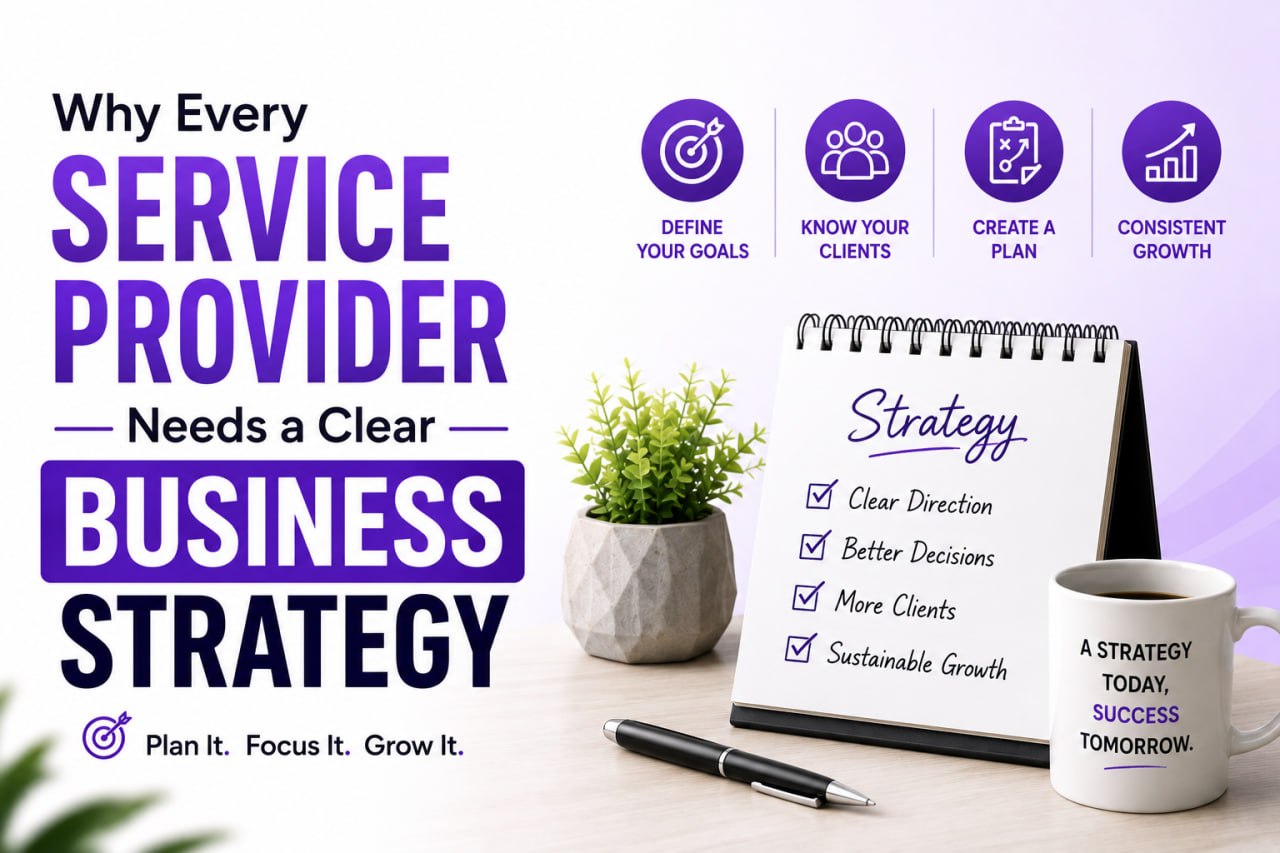
  • Why Every Service Provider Needs a Clear Business Strategy

    Why Every Service Provider Needs a Clear Business Strategy

    Running a service-based business often feels like a constant juggling act. Between client work, invoicing, marketing, and day-to-day operations, it’s easy to spend every hour reacting to whatever is most urgent instead of working toward what actually matters. This is exactly why a clear business strategy for service providers isn’t optional it’s the foundation that separates businesses that grow predictably from those that stay stuck in survival mode.

    Whether you’re a consultant, coach, bookkeeper, designer, or agency owner, the quality of your services alone won’t guarantee success. You need a roadmap that connects your daily actions to your long-term goals. In this guide, we’ll break down why business strategy matters so much for service providers, what happens when it’s missing, and how to build one that actually works.

    What Is a Business Strategy, and Why Does It Matter for Service Providers?

    A business strategy is a defined plan that outlines how your company will achieve its goals who you serve, what makes you different, how you’ll price and deliver your services, and how you’ll grow sustainably over time. It’s the difference between “I offer bookkeeping services” and “I help small business owners in specific industries get audit-ready financials so they can secure funding and scale with confidence.”

    For service providers specifically, strategy matters more than most people realize because:

    ●       You’re selling expertise, not a product. Without a clear positioning strategy, it’s hard for potential clients to understand why they should choose you over another provider offering similar services.

    ●       Your time is your inventory. Unlike product businesses, you can’t simply produce more stock. Strategic business planning helps you decide which clients, services, and opportunities are worth your limited hours.

    ●       Growth requires intention. Service businesses rarely scale by accident. A defined entrepreneur success strategy ensures every new client, hire, or service offering moves you closer to your goals rather than further from them.

    Signs Your Business Is Missing a Clear Strategy

    Many service providers operate for years without a documented strategy and the symptoms tend to show up in predictable ways. You might recognize a few of these in your own business:

    1.      Inconsistent revenue. Some months are strong, others are lean, and there’s no clear pattern or plan to smooth things out.

    2.      Difficulty saying no. Without clarity on your ideal client or niche, you take on any project that comes your way, even ones that drain your energy or don’t pay well.

    3.      Burnout from doing everything yourself. Strategy includes decisions about delegation, systems, and outsourcing without it, you become the bottleneck in your own business.

    4.      Unclear messaging. If your website, proposals, or sales conversations struggle to explain what makes you different, that’s usually a sign of a missing strategic foundation, not a marketing problem.

    5.      No clear path to your next revenue milestone. You might have a general sense that you want to “grow,” but no concrete plan for how to get there.

    If any of these sound familiar, you’re not alone and the good news is that these are solvable problems once you commit to real business planning.

    The Core Elements of a Strong Business Strategy for Service Providers

    A workable strategy doesn’t need to be a 40-page document. It needs to be clear, honest, and specific enough to guide real decisions. Here are the essential components.

    1. A Defined Target Client

    Trying to serve everyone is one of the most common strategic mistakes service providers make. The most successful entrepreneurs narrow their focus to a specific type of client whose problems they deeply understand. This allows you to:

    ●       Tailor your messaging so it resonates immediately

    ●       Charge premium rates because you’re positioned as a specialist, not a generalist

    ●       Build referral relationships more easily, since your ideal clients know exactly who to send your way

    2. Clear Positioning and Differentiation

    Once you know who you serve, the next question is: why should they choose you? This is where many service providers struggle, because they compete on price instead of value. A strong strategy identifies your unique combination of expertise, process, and results, and builds your messaging around that instead of racing to the bottom on cost.

    3. A Sustainable Pricing Model

    Pricing is strategic, not just financial. Service providers who price reactively matching competitors or guessing — often undervalue their work. A clear strategy considers your costs, the value you deliver, your desired income, and your capacity, then builds a pricing structure that supports long-term profitability rather than just covering bills.

    4. Systems for Delivery and Operations

    Strategy isn’t only about growth and marketing — it’s also about how you actually run the business. Service providers who scale successfully typically have documented processes for onboarding clients, delivering work, and handling financial management. Without these systems, growth simply means more chaos.

    5. Financial Clarity and Planning

    You cannot make sound strategic decisions without understanding your numbers. This includes knowing your profit margins, cash flow patterns, and the true cost of delivering each service. This is one of the most overlooked pieces of business planning, and it’s where many service providers benefit from professional financial coaching or outsourced support, so strategic decisions are based on real data instead of guesswork.

    6. A Growth and Marketing Plan

    Finally, a strategy needs a plan for how you’ll attract and convert new clients consistently, rather than relying on referrals alone or scrambling when your pipeline runs dry.

    How a Clear Strategy Fuels Entrepreneur Success

    An effective entrepreneur success strategy isn’t just about hitting revenue targets it changes how you experience running your business day to day.

    It reduces decision fatigue. When you have a clear strategy, you’re not re-deciding your priorities every morning. You already know which opportunities align with your goals and which ones to decline.

    It improves cash flow predictability. Strategic business planning includes forecasting and financial goal-setting, which means fewer surprises and more confidence in your ability to cover expenses, pay yourself consistently, and reinvest in growth.

    It attracts better-fit clients. When your positioning and messaging are clear, you naturally filter out mismatched leads and attract the clients who value your expertise and are willing to pay for it.

    It creates room for delegation and growth. Once your strategy defines your systems and processes, you can start bringing on support whether that’s subcontractors, employees, or outsourced financial and administrative help without everything falling apart.

    It supports better financial decisions. Entrepreneurs with a clear strategy are better equipped to decide when to invest in new tools, hire help, raise prices, or expand into new services, because those decisions are tied to a bigger picture rather than made in isolation.

    Common Business Planning Mistakes Service Providers Make

    Even motivated entrepreneurs can fall into a few common traps when building their strategy:

    ●       Confusing activity with strategy. Being busy is not the same as being strategic. It’s possible to work long hours without making progress toward meaningful goals.

    ●       Skipping the financial side of planning. Many service providers focus their strategy entirely on marketing and client acquisition while ignoring pricing, cash flow, and profitability planning which are just as critical.

    ●       Setting the strategy once and never revisiting it. A good strategy is a living document. Markets shift, your skills grow, and your goals evolve, so your strategy should be reviewed regularly.

    ●       Not tracking the right numbers. Without accurate bookkeeping and financial reporting, it’s nearly impossible to know whether your strategy is actually working.

    ●       Trying to do it all alone. Many of the most successful service providers work with coaches, consultants, or financial partners to build and refine their strategy, rather than trying to figure everything out in isolation.

    How to Start Building Your Business Strategy Today

    If you don’t currently have a documented strategy, here’s a simple starting framework:

    6.      Clarify your ideal client. Write down who you serve best and why be specific about their challenges, goals, and what they value.

    7.      Define your differentiator. Identify what makes your approach, expertise, or results different from other providers in your space.

    8.      Review your financials. Understand your current profit margins, pricing, and cash flow before setting new goals.

    9.      Set 90-day priorities. Instead of an overwhelming annual plan, choose two or three priorities you can focus on in the next quarter.

    10.   Document your core processes. Write down how you onboard clients and deliver your services so the process isn’t only in your head.

    11.   Revisit and adjust quarterly. Treat your strategy as a working document that evolves as your business grows.

    Why Financial Clarity Is the Backbone of Strategic Planning

    It’s worth emphasizing this point: strategy without financial clarity is guesswork. You can have the best positioning and marketing plan in the world, but if you don’t understand your numbers, you won’t know whether your strategy is actually leading to profitability.

    This is where working with a financial and business coaching partner can make a meaningful difference. Instead of trying to interpret spreadsheets and forecasts on your own, service providers benefit from having someone who can translate the numbers into strategic direction helping you decide when to raise prices, when it’s safe to hire, and where your business is leaking money.

    Final Thoughts

    A clear business strategy for service providers isn’t a luxury reserved for large companies it’s a necessity for any entrepreneur who wants sustainable, predictable growth instead of constant reaction and stress. By defining your ideal client, clarifying your positioning, building sound financial systems, and revisiting your plan regularly, you create a foundation that supports long-term success rather than short-term survival.

    At Amethyst Business Solutions, we help service-based entrepreneurs build the financial clarity and strategic foundation their businesses need to grow with confidence. From bookkeeping and financial coaching to strategic business planning support, our goal is to help you turn your expertise into a thriving, sustainable business.

    Frequently Asked Questions

    Why do service providers need a business strategy more than other businesses?

    Because service providers sell time and expertise rather than physical products, strategic decisions around pricing, positioning, and client selection have an outsized impact on profitability and sustainability.

    How often should I revisit my business strategy?

    Most entrepreneurs benefit from a quarterly review, with a deeper annual planning session to reassess long-term goals and financial performance.

    What’s the first step in building a business strategy?

    Start by clarifying your ideal client and reviewing your current financial picture. Strategy built without financial clarity is difficult to execute effectively.

    Do I need a formal business plan document?

    Not necessarily. What matters most is having clear, written answers to key strategic questions who you serve, how you’re different, how you price, and how you plan to grow even if it’s not a formal, lengthy document.

  • Women Entrepreneurs: The Complete Guide to Building a Profitable Online Business

    Women Entrepreneurs: The Complete Guide to Building a Profitable Online Business

    More women are launching online businesses than ever before, drawn by the flexibility, low startup costs, and unlimited potential of building something entirely their own. But turning an idea into a genuinely profitable online business takes more than passion and a great offer. It requires a clear strategy, strong financial foundations, and the right systems to support sustainable growth.

    This guide walks through everything women entrepreneurs need to know to build an online business that isn’t just active, but actually profitable from choosing the right business model to managing your finances like a CEO.

    Why Women Entrepreneurs Are Reshaping the Online Business Landscape

    Women-owned businesses have been growing at a faster rate than businesses overall for years, and the online space has become one of the most accessible paths to entrepreneurship. Coaching, consulting, e-commerce, digital products, and service-based businesses allow women to build income streams around their expertise and lifestyle needs, often while balancing family responsibilities or transitioning from corporate careers.

    But accessibility doesn’t guarantee profitability. Many women entrepreneur business owners launch with excitement, only to struggle with inconsistent income, unclear pricing, or the overwhelm of trying to do everything themselves. Building a profitable business requires intentional planning from day one not just a website and a social media page.

    Step 1: Choose a Business Model Built for Profit, Not Just Passion

    Passion matters, but profitability depends on choosing a business model that has real market demand and a sustainable path to revenue. Common profitable online business models for women entrepreneurs include:

    ●       Service-based businesses — coaching, consulting, done-for-you services, freelance expertise

    ●       Digital products — courses, templates, memberships, and digital downloads

    ●       E-commerce — physical products sold through your own store or third-party marketplaces

    ●       Hybrid models — combining services with digital products to create multiple income streams

    The key question isn’t just “what am I passionate about?” but “what problem am I solving, and are people willing to pay to solve it?” Validating demand before investing heavily in a business model saves both time and money.

    Step 2: Get Clear on Your Ideal Client

    One of the biggest profit killers for online businesses is trying to appeal to everyone. Instead, successful women entrepreneurs get specific about who they serve their challenges, goals, budget, and buying behavior. This clarity does several things at once:

    ●       Makes your marketing more effective, since your messaging speaks directly to a specific person’s pain points

    ●       Allows you to price based on the value you deliver to that specific client, rather than competing on price alone

    ●       Helps you create offers and content that actually convert, instead of generic content that gets ignored

    A narrower focus almost always leads to more profit than a broad, undefined audience.

    Step 3: Build a Pricing Strategy That Actually Supports Profitability

    Pricing is one of the areas where many online business owners especially those newer to entrepreneurship — undervalue themselves. Setting prices based on what feels comfortable, rather than what the business needs to be sustainable, is one of the fastest ways to end up working long hours for very little profit.

    A sound pricing strategy considers:

    ●       Your costs — including tools, subscriptions, contractors, and your own time

    ●       Your desired income — working backward from your financial goals to determine how many clients or sales you need

    ●       The value delivered — what results, transformation, or outcome your offer provides

    ●       Market positioning — pricing that reflects your expertise rather than competing purely on being the cheapest option

    This is where many entrepreneurs benefit from online business coaching or financial guidance, since it can be difficult to price objectively when you’re emotionally close to your own business.

    Step 4: Set Up Financial Systems From the Start

    It’s easy to focus entirely on sales and marketing while treating bookkeeping and financial management as an afterthought — but this is one of the most common reasons online businesses stall out or fail to become truly profitable. Revenue is not the same as profit, and without clear financial systems, it’s nearly impossible to know how your business is actually performing.

    Foundational financial systems for a profitable online business include:

    1.      Separate business and personal finances, including a dedicated business bank account

    2.      Consistent bookkeeping, so income and expenses are tracked accurately and in real time

    3.      A simple profit and loss review process, so you know monthly whether the business is actually profitable

    4.      Tax planning, so you’re setting aside the right amount and avoiding surprises

    5.      Cash flow forecasting, especially important for businesses with seasonal or inconsistent sales cycles

    Many women entrepreneurs delay this step, assuming it’s only necessary once the business is larger — but building these systems early prevents costly mistakes and gives you the financial clarity needed to make smart growth decisions.

    Step 5: Create a Marketing Strategy That Converts

    Visibility alone doesn’t create profitability conversion does. A strong marketing strategy for an online business typically includes:

    ●       A clear content strategy built around your ideal client’s questions and pain points, rather than posting randomly

    ●       An owned audience, such as an email list, so you’re not entirely dependent on social media algorithms

    ●       A defined sales process, whether that’s a sales page, discovery call, or automated funnel, that guides potential clients toward a purchase decision

    ●       Consistent follow-up, since most sales happen after multiple touchpoints, not the first interaction

    Women entrepreneurs who treat marketing as a strategic system, rather than a series of disconnected social media posts, tend to see far more consistent revenue.

    Step 6: Build Systems So the Business Doesn’t Depend Entirely on You

    Many online businesses hit a profit ceiling because the owner is doing everything content creation, client delivery, admin, bookkeeping, and customer service. Scaling profitably requires building systems and, eventually, delegating tasks that don’t require your specific expertise.

    This might include:

    ●       Outsourcing bookkeeping and financial management to a professional

    ●       Using templates and standard operating procedures for repetitive tasks

    ●       Hiring a virtual assistant or contractor for administrative work

    ●       Automating parts of your marketing and sales process

    Delegation isn’t just about freeing up time it directly impacts profitability by allowing you to focus your energy on the highest-value activities in your business.

    Step 7: Track the Right Metrics

    Profitability isn’t just about how much revenue you bring in it’s about understanding the full financial picture. Women entrepreneurs building a profitable online business should regularly track:

    ●       Gross revenue — total sales before expenses

    ●       Net profit — what’s actually left after all expenses

    ●       Profit margin — the percentage of revenue that becomes profit

    ●       Customer acquisition cost — how much it costs to gain a new client or customer

    ●       Client lifetime value — how much revenue a client generates over the full relationship

    Without tracking these numbers, it’s easy to feel busy and “successful” while the business is actually barely breaking even, or losing money once expenses are factored in.

    The Role of Online Business Coaching in Long-Term Success

    Building a profitable online business rarely happens in isolation. Many successful women entrepreneurs credit part of their growth to working with a coach, mentor, or financial partner who helps them see blind spots, make objective pricing decisions, and stay accountable to their goals.

    Good online business coaching typically helps with:

    ●       Clarifying strategy and business model decisions

    ●       Building confidence around pricing and sales conversations

    ●       Creating financial systems and reviewing performance objectively

    ●       Navigating growth decisions like hiring, expanding offers, or raising prices

    Rather than trying to learn everything through trial and error, working with the right support can significantly shorten the path to profitability.

    Common Mistakes That Keep Online Businesses From Becoming Profitable

    ●       Underpricing offers out of fear of rejection or lack of confidence

    ●       Ignoring bookkeeping until tax season creates a stressful scramble

    ●       Chasing every new marketing trend instead of building a consistent strategy

    ●       Trying to serve everyone instead of narrowing in on an ideal client

    ●       Reinvesting without a plan, spending on courses, tools, or ads without a clear return-on-investment strategy

    ●       Not separating business and personal finances, which makes it nearly impossible to understand true profitability

    Avoiding these common pitfalls puts women entrepreneurs significantly ahead of the curve when it comes to building sustainable, profitable businesses.

    Building a Business That’s Profitable, Not Just Busy

    Building a profitable online business as a woman entrepreneur takes more than a great idea it requires a defined business model, a clear ideal client, sound pricing, strong financial systems, and a marketing strategy built to convert. The entrepreneurs who succeed long-term are the ones who treat their business like a business from the start, tracking their numbers and making strategic decisions instead of just staying busy.

    At Amethyst Business Solutions, we support women entrepreneurs with the financial coaching, bookkeeping, and strategic guidance needed to turn an online business idea into a genuinely profitable venture. Whether you’re just starting out or ready to scale, having the right financial foundation makes all the difference.

    Frequently Asked Questions

    What makes an online business actually profitable, not just busy?

    Profitability comes from having a validated business model, sound pricing, low unnecessary overhead, and consistent tracking of revenue versus expenses not simply from generating sales or staying active online.

    How much should I charge as a new online business owner?

    Pricing should be based on your costs, desired income, and the value your offer provides not simply what feels comfortable or what competitors charge. Many entrepreneurs benefit from professional guidance when setting initial pricing.

    Do I need bookkeeping if I’m just starting my online business?

    Yes. Setting up bookkeeping and separating business finances from personal finances early prevents costly mistakes and gives you the financial clarity needed to make good business decisions as you grow.

    Is online business coaching worth it for new entrepreneurs?

    For many women entrepreneurs, coaching accelerates growth by providing objective feedback on pricing, strategy, and financial decisions helping avoid common, costly mistakes made when building a business alone.