Day: 24 July 2026

  • 15 Signs You’re Ready to Become an Entrepreneur

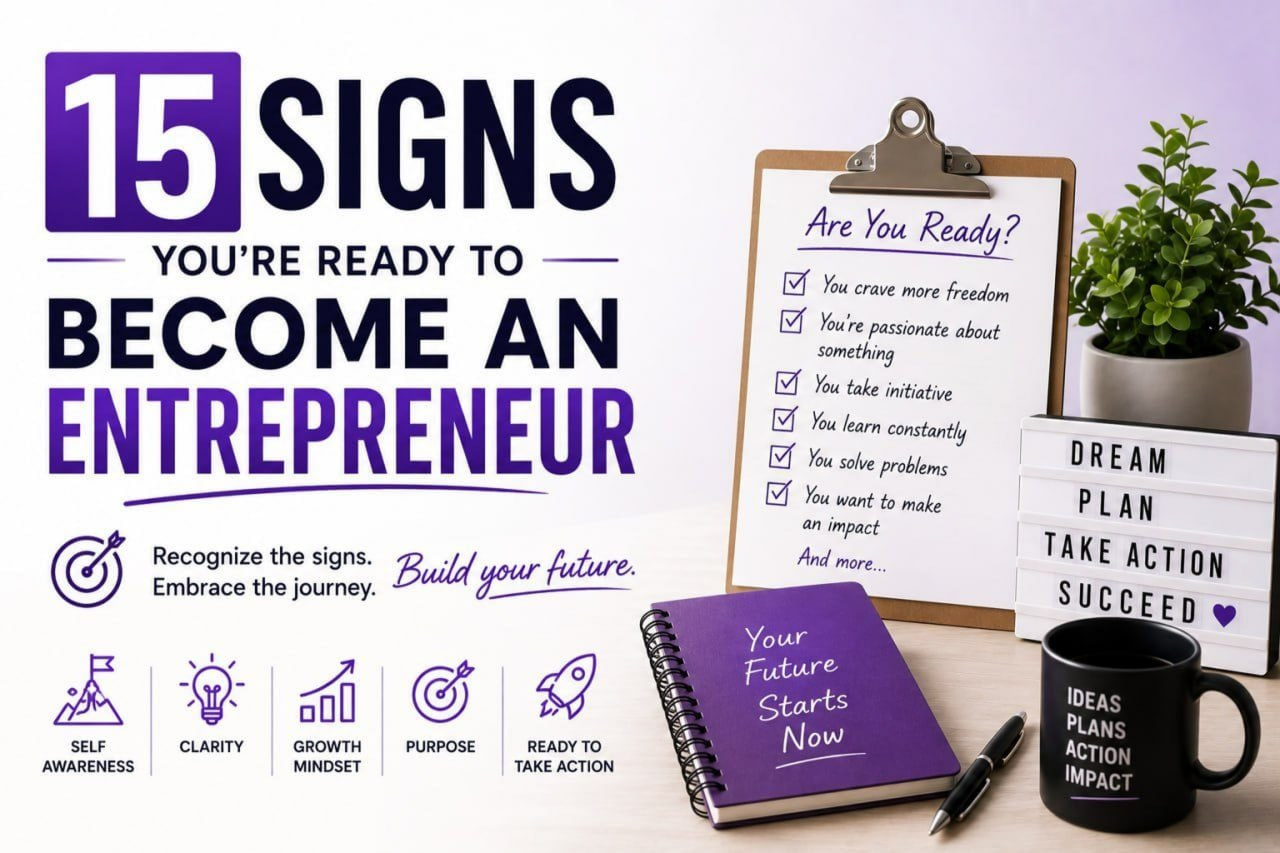
    15 Signs You’re Ready to Become an Entrepreneur

    Somewhere between “I have an idea” and “I actually started my business,” most people get stuck asking the same question: am I really ready to do this? It’s a fair question. Deciding to become an entrepreneur isn’t just a career move it’s a shift in identity, income structure, and daily life.

    Here’s the truth: nobody feels 100% ready. Readiness isn’t a feeling you wait for it’s a pattern you can recognize in yourself, built from small, consistent signals rather than one dramatic lightning-bolt moment. If you’re weighing whether to start your own business, these 15 signs will help you separate genuine readiness from fear dressed up as “not the right time.”

    This matters because the cost of waiting is real. Every year spent waiting for certainty is a year of expertise, income potential, and momentum you don’t get back. On the flip side, jumping in without any of these signs present can lead to a business built on impulse rather than insight. The goal here isn’t to talk you into anything it’s to help you see your own readiness clearly, so you can move forward deliberately instead of guessing.

    1. You Can’t Stop Thinking About It

    If your business idea keeps showing up in the shower, during meetings, and right before bed, that’s not a passing daydream that’s a signal. Persistent, specific ideas (not vague “someday” fantasies) are one of the clearest early markers of an entrepreneurship journey beginning to take shape.

    2. You’ve Outgrown Your Current Role

    You’ve mastered your job. You could do it in your sleep, and the growth, challenge, or compensation you once had simply isn’t there anymore. When a role stops stretching you, it’s often a sign your ambition has outgrown the container you’re in.

    3. You Already Have In-Demand Expertise

    You don’t need to reinvent yourself to become an entrepreneur you likely already have the skills. If colleagues, friends, or clients regularly come to you for advice in your area of expertise, that’s a business asset, not just a reputation.

    4. You’re Willing to Trade Certainty for Ownership

    A steady paycheck is comfortable, but comfort and fulfillment aren’t the same thing. If you’re mentally ready to trade guaranteed income for the potential of building something that’s entirely yours, that’s a real mindset shift and a necessary one.

    5. You’ve Started Researching, Not Just Dreaming

    Browsing “how to start a business” is one thing. Actually researching business models, pricing structures, competitors, and legal setup is another. If you’ve moved from fantasy into fact-finding, you’re further along than you think.

    6. You Have (or Are Building) a Financial Cushion

    Readiness isn’t just emotional it’s financial. If you’re actively saving, budgeting, or restructuring your finances to prepare for a transition, you’re approaching entrepreneurship strategically instead of impulsively.

    7. You’re Comfortable With Discomfort

    Entrepreneurship guarantees uncertainty: unpredictable income, unclear timelines, and constant decision-making. You don’t have to love discomfort, but if you can tolerate it without shutting down, you have a critical trait most successful founders share.

    8. You Ask “How” Instead of “If”

    Notice your own language. “If I started a business” is exploratory. “How would I structure my pricing” or “how do I find my first clients” is operational. When your internal dialogue shifts from possibility to logistics, that’s momentum.

    9. You’ve Identified a Real Problem to Solve

    Every sustainable business exists to solve a specific problem for a specific person. If you can clearly articulate who you’d serve and what problem you’d solve for them, you already have the foundation of a business model not just an idea. This is different from having a general passion or skill; it means you can finish the sentence, “I help [specific person] achieve [specific outcome],” without rambling. That level of clarity usually only comes from paying close attention to real conversations, real frustrations, and real gaps in the market not from brainstorming alone in your head.

    10. You’re Willing to Start Small

    You don’t need a perfect five-year plan to start your own business. If you’re willing to start with an imperfect offer, a small first client, or a simple version of your idea, you understand that momentum matters more than perfection.

    11. You Seek Out Other Entrepreneurs

    Pay attention to who you’re drawn to lately are you gravitating toward founder stories, business podcasts, or entrepreneur communities? Seeking out people already living the path you want is a strong, often subconscious, sign of readiness.

    12. You’re Protective of Your Time

    If you’ve started guarding your evenings and weekends to work on a side project, learn a new skill, or plan your business, you’re already behaving like an entrepreneur treating your future business as a priority, not an afterthought.

    13. You Handle Rejection Without Quitting

    Entrepreneurship involves a steady stream of “no” from potential clients, partners, investors, or even your own self-doubt. It’s rarely a straight line from idea to income; most founders face rejection long before they see traction. If setbacks make you recalibrate rather than retreat if a “no” makes you ask “what can I adjust?” instead of “should I give up?” you have the resilience this path demands.

    14. You Want Ownership of Your Decisions

    Beyond money, many people become entrepreneurs because they want control – over their schedule, their strategy, and the direction of their work. If the idea of answering to no one (while being accountable to everyone, including yourself) excites more than it terrifies you, that’s telling.

    15. You’re Tired of Waiting for “Ready”

    This is the biggest sign of all. If you’ve read this whole list nodding along, but you’re still waiting to feel 100% certain before you start – recognize that clarity and confidence come from taking action, not from more preparation. Perfectionism is one of the most common obstacles standing between capable people and their first step.

    What to Do If You Recognize Yourself in This List

    Seeing yourself in several of these signs doesn’t mean you need to quit your job tomorrow. It means it’s time to move from reflection into structure. A successful entrepreneurship journey usually follows a clear sequence:

    1. Clarify your destination – get specific about the business you want to build and the lifestyle you’re building it for.
    2. Draw your personalized plan – define your niche, your ideal client, and your business model.
    3. Plan your route – branding, pricing, and marketing strategy.
    4. Start building – establish your business foundations, online presence, and early systems.
    5. Reach your milestones – acquire clients, manage cash flow, and grow with intention.

    Trying to build all five stages alone, from scratch, is exactly why so many aspiring founders stall out at “someday.” It’s not usually a lack of ability that stalls people it’s the sheer number of decisions happening at once, with no clear order and no one to sanity-check them. Having a roadmap — and someone who’s walked other founders through this exact process turns readiness into results, because you’re no longer guessing which step comes next or second-guessing every decision alone.

    How Do You Know You’re Truly Ready to Become an Entrepreneur?

    There’s no single “aha” moment that makes someone ready to start their own business. Readiness is cumulative a mix of mindset, financial preparation, market clarity, and resilience that builds over time. If you recognize even five or six of the signs above, you’re not early in your entrepreneurship journey. You’re likely closer to the starting line than you realize.

    Ready to Take the Next Step?

    You don’t have to have every answer before you begin you just need the next right step and a plan to guide you there. Amethyst Business Solutions helps women turn “I think I’m ready” into a clear, confident business roadmap, from your first idea to your first paying clients.

    Book your free 30-minute consultation and find out exactly where you are on your entrepreneurship journey and what your next step should be.


    Frequently Asked Questions

    How do I know if I’m ready to become an entrepreneur? 

    Readiness shows up as a combination of signs — persistent business ideas, in-demand skills, financial preparation, tolerance for uncertainty, and a shift from “if” to “how” in your thinking. Recognizing several of these traits in yourself is a strong indicator.

    Do I need savings before I start my own business? 

    While it’s possible to start small without significant savings, having a financial cushion reduces pressure and lets you make strategic decisions instead of reactive ones during your entrepreneurship journey.

    Can I become an entrepreneur while still working full-time? 

    Yes — many successful founders validate and build the early stages of their business on the side before transitioning out of full-time employment. This approach reduces financial risk while proving demand.

    What’s the first step to start your own business? 

    The first step is clarity: defining your niche, your ideal client, and the specific problem you solve. From there, a structured roadmap helps you build your business model, brand, and go-to-market strategy.
  • How to Leave Your Corporate Job and Start a Business with Confidence

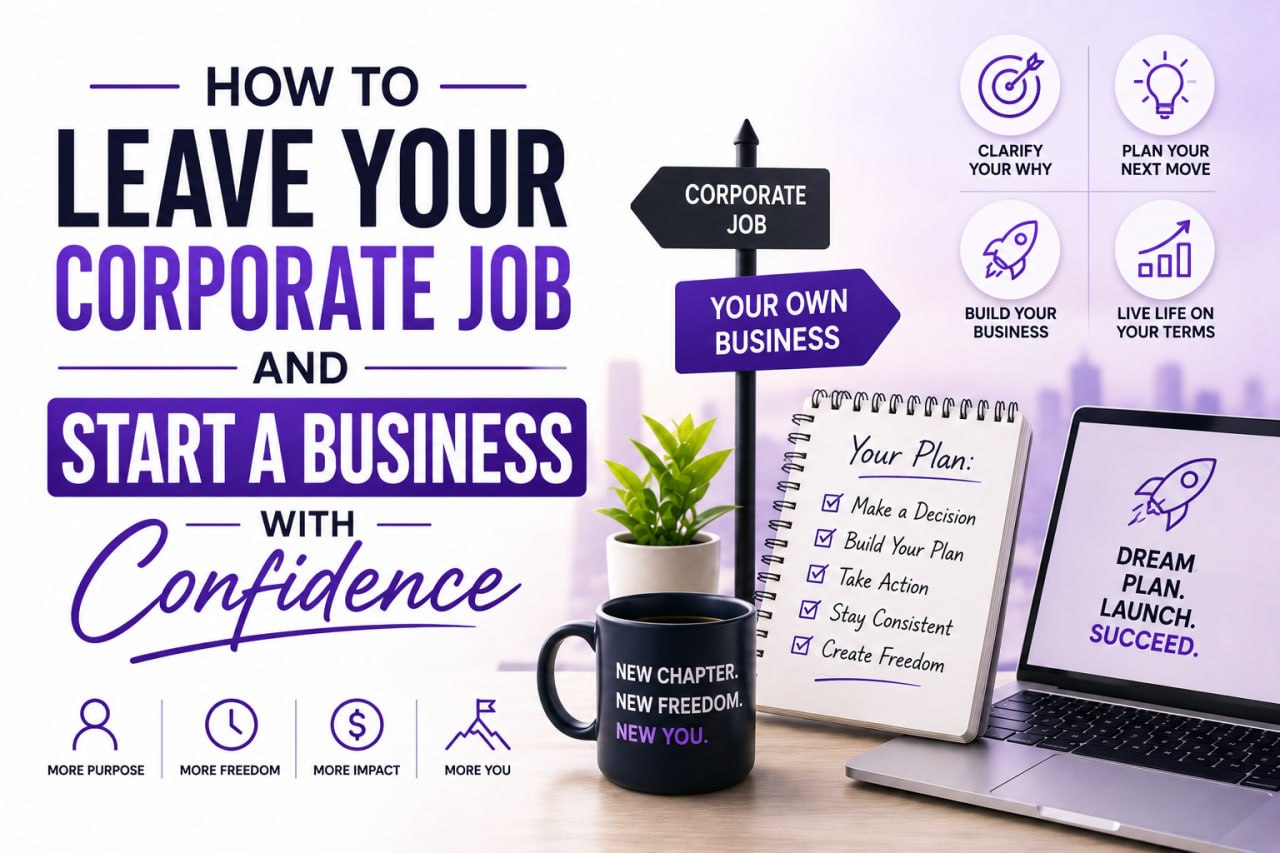
    How to Leave Your Corporate Job and Start a Business with Confidence

    There’s a specific kind of exhaustion that comes from sitting in a job that no longer fits checking the clock, refreshing your inbox, and wondering if there’s a different version of your career waiting for you. If you’ve been quietly Googling how to leave your corporate job, you already know the feeling. You’re not lazy, and you’re not “just having a bad week.” You’re ready for a change, and you want to make it without blowing up your life to do it.

    The good news: the shift from employee to entrepreneur doesn’t have to be reckless. With the right plan, a realistic timeline, and a little support, your career transition can be one of the most confident decisions you’ll ever make.

    This guide walks you through exactly how to leave your corporate job and start a business the smart way step by step, without the guesswork.

    Why So Many People Are Ready to Leave Their Corporate Job

    You’re far from alone. More professionals, especially women in mid-to-senior roles are stepping away from “safe” jobs that quietly stopped serving them. The common threads usually sound like this:

    • You’ve hit a ceiling. There’s no more room to grow, and the next promotion doesn’t excite you anymore.
    • Your time isn’t yours. Someone else decides your calendar, your priorities, and your worth.
    • You have expertise nobody’s paying you fairly for. You could be charging clients directly for the exact skills your employer relies on.
    • You crave ownership. Not just of your time, but of your decisions, your income ceiling, and your future.

    None of these reasons are impulsive. They’re signals. The key is translating that readiness into a plan you can actually execute.

    Step 1: Get Honest About Your “Why”

    Before you touch a business plan or a resignation letter, get clear on why you want to leave your corporate job in the first place. Is it freedom? Financial growth? Doing work that actually reflects your values? Escaping a toxic environment?

    Your “why” becomes your anchor. On the hard days of entrepreneurship and there will be hard days this is what keeps you moving instead of running back to the safety of a paycheck out of fear rather than choice.

    Step 2: Choose a Profitable Niche, Not Just a Passion

    One of the biggest mistakes in any employee-to-entrepreneur transition is building a business around a hobby instead of a market. Passion matters, but profitability keeps the lights on.

    Ask yourself:

    • What problem do I solve better than most people I know?
    • Who is actively paying for this solution right now?
    • Can I describe my ideal client in one sentence?

    A profitable niche sits at the intersection of your expertise, a real market need, and people who are already willing to pay for the outcome you provide. This is exactly the kind of clarity a personalized business roadmap is designed to uncover narrowing down “I could do a lot of things” into “this is the business I’m building.”

    Step 3: Build Your Financial Runway Before You Resign

    Confidence doesn’t come from blind optimism it comes from preparation. Before you leave your corporate job, build a financial runway that lets you focus on your business instead of panicking about rent.

    A few practical benchmarks:

    • Save 3–6 months of essential expenses as a buffer.
    • Track your current spending so you know your real “survival number.”
    • Consider a transition period where you build your business on the side before going full-time.
    • Separate personal and business finances early, even if the business is still small.

    This isn’t about waiting for “someday when I feel 100% ready” perfectionism is one of the biggest obstacles to progress. It’s about giving yourself enough breathing room that fear isn’t making your decisions for you.

    Step 4: Test and Validate Before You Leap

    You don’t need a fully-formed business to start testing it. In fact, you shouldn’t wait that long. Validate your idea while you’re still employed:

    • Offer your service to a handful of paying beta clients on evenings or weekends.
    • Create a simple offer page or landing page and see if people actually inquire.
    • Talk to 10–15 people in your target market about the problem you want to solve.
    • Track real interest inquiries, sign-ups, or sales, not just compliments.

    Validation replaces guesswork with evidence. It’s far easier to leave your corporate job with confidence when you already have proof that people want what you’re building.

    Step 5: Build Your Business Foundations

    Once you’ve validated the idea, it’s time to build the structure that will support it: your business model, pricing, branding, and simple operating systems. This is the stage where many aspiring entrepreneurs get stuck – not because they lack ability, but because they’re trying to figure out branding, sales, legal setup, and marketing all at once, alone.

    At this stage, focus on:

    • Business model – how you’ll deliver your product or service and how you’ll get paid.
    • Pricing strategy – priced for profit, not just to “get your foot in the door.”
    • Branding and online presence – a simple, professional way for potential clients to find and trust you.
    • Sales process – a repeatable way to turn conversations into paying clients.

    This is exactly where a structured roadmap like the one used in Amethyst Business Solutions’ step-by-step program saves months of trial and error, because someone who’s guided founders through this exact transition maps the route with you instead of leaving you to figure it out solo.

    Step 6: Plan Your Exit Strategically

    When it’s finally time to leave your corporate job, do it with the same professionalism that got you the job in the first place.

    • Give appropriate notice – protect your reputation and your references.
    • Understand your benefits transition – health insurance, retirement accounts, and any equity or bonuses tied to your departure date.
    • Review your contract – check for non-compete or non-solicitation clauses that could affect your new business.
    • Keep it professional – you never know when a former employer becomes a future client or referral source.

    A clean exit protects the relationships and reputation you’ve spent years building.

    Step 7: Manage the Emotional Side of the Career Transition

    Nobody talks enough about this part. Leaving corporate life isn’t just a financial and logistical shift it’s an identity shift. For years, your job title may have been part of how you introduced yourself. Replacing that structure with the open-endedness of entrepreneurship can feel disorienting, even when it’s exactly what you wanted.

    Some ways to manage the transition emotionally:

    • Expect a period of uncertainty. It doesn’t mean you made the wrong choice.
    • Find community. Other entrepreneurs ideally ones who’ve already made this shift normalize what you’re feeling.
    • Redefine success on your own terms. It no longer has to look like a corner office or a title on a business card.
    • Get support. A mentor or coach who’s guided others through this exact path can shorten your learning curve and steady your confidence when self-doubt creeps in.

    How Long Does It Take to Go From Employee to Entrepreneur?

    There’s no universal timeline, but a focused, guided transition often takes around three months to establish real business foundations: a clear niche, a validated offer, a business plan, and the beginnings of an online presence with ongoing growth after that. Rushing rarely helps, and neither does waiting indefinitely for the “perfect” moment. Clarity and confidence come from taking action, not from more research.

    You Don’t Have to Figure This Out Alone

    Leaving your corporate job is one of the biggest professional decisions you’ll make but it doesn’t have to be a leap into the unknown. With a clear destination, a personalized plan, and the right support along the way, your career transition can be deliberate, strategic, and genuinely exciting instead of terrifying.

    Amethyst Business Solutions was built specifically to help women make this exact shift from employee to confident, thriving entrepreneur with a step-by-step roadmap instead of guesswork.

    Book your free 30-minute consultation and start building your next chapter with confidence.

    Frequently Asked Questions

    How much money should I save before I leave my corporate job? 

    Most financial advisors recommend 3–6 months of essential living expenses as a starting buffer, though the right number depends on your business model, income needs, and how quickly your new business is likely to generate revenue.

    Should I start my business before quitting my job? 

    In most cases, yes. Building and validating your business idea on the side evenings, weekends, or reduced hours lets you test demand and generate early income before you rely on it fully.

    What’s the biggest mistake people make when leaving corporate to start a business? 

    Skipping validation. Many new entrepreneurs invest heavily in branding and logistics before confirming that real people will actually pay for their product or service.

    How do I know if I’m ready to leave my corporate job? 

    Readiness usually shows up as a mix of clear motivation, a validated business idea, a financial plan, and emotional preparedness for uncertainty not just frustration with your current job.