You can have the perfect business idea, a validated market, and a solid plan and still feel completely paralyzed by fear. If that sounds familiar, you’re not broken, and you’re not alone. Learning how to overcome entrepreneurial fear is one of the most important, least talked-about skills in building a business. The strategy matters, but so does the mindset behind it.
Fear doesn’t mean you’re on the wrong path. In fact, it usually means you’re on exactly the right one stepping toward something meaningful enough to actually matter. This guide walks through where that fear comes from, and practical ways to build real confidence for entrepreneurs so it stops running the show.
If you’ve ever caught yourself rewriting the same email ten times, delaying a launch “just a little longer,” or quietly assuming everyone else feels more certain than you do, this is for you. None of that means you’re unprepared. It usually just means no one ever taught you how to work with fear instead of waiting for it to disappear.
Why Fear and Self-Doubt Are So Common Among New Entrepreneurs
Starting a business asks you to give up certainty a steady paycheck, a defined role, an existing structure in exchange for something you’re building yourself. That trade is inherently uncomfortable, and a few specific fears tend to show up again and again:
• Fear of financial failure. What if the business doesn’t work and I’ve wasted my savings, or worse?
• Fear of judgment. What will people think if I fail publicly, after telling everyone I was doing this?
• Fear of not being “enough.” Enough experience, enough skill, enough credibility to charge what I’m worth.
• Fear of losing identity. Who am I without the job title, the team, the structure I’ve built my identity around?
• Imposter syndrome. The nagging sense that you’ll be “found out” as underqualified, even when your track record says otherwise.
None of these fears are irrational they’re logical responses to real uncertainty. The goal isn’t to eliminate fear entirely. It’s to stop letting it make your decisions for you.
Understanding the Difference Between Fear and Intuition
One of the most useful skills you can build is learning to tell the difference between fear and genuine intuition, because they can feel remarkably similar in the moment.
• Fear tends to be vague, repetitive, and focused on worst-case scenarios: “What if this all falls apart?”
• Intuition tends to be specific and actionable: “This particular client isn’t the right fit” or “I need more information before I commit to this.”
When a worry shows up, ask yourself: is this pointing me toward a specific, useful action — or is it just spinning worst-case scenarios on repeat? That distinction alone can quiet a surprising amount of noise.
Practical Strategies to Overcome Entrepreneurial Fear
1. Name the specific fear, not the vague anxiety
“I’m scared” is hard to work with. “I’m scared that if I raise my prices, no one will hire me” is something you can actually examine and address. Get specific about what you’re afraid of it shrinks the fear from an overwhelming cloud into a solvable problem.
2. Separate facts from stories
Fear often tells a story: “I’ll fail and everyone will know.” The facts are usually far more manageable: “I have relevant experience, I’ve validated demand, and I have a financial plan in place.” Write both down side by side. The gap between them is usually where the fear is doing its damage. This exercise sounds simple, but seeing it in writing rather than looping in your head — often makes the distortion obvious in a way that just “thinking it through” rarely does.
3. Build evidence through small wins
Confidence isn’t something you wait to feel before you act it’s something you build by acting. Each small win a client conversation, a completed task, a first sale becomes evidence that counters the fear. Momentum builds confidence far more reliably than reassurance alone.
4. Reframe failure as information
Every setback in business a client who says no, a launch that underperforms is data, not a verdict on your worth. Founders who treat failure as feedback move forward faster than those who treat it as proof they shouldn’t have started.
5. Set a “good enough to start” standard
Perfectionism disguises itself as high standards, but it’s often just fear wearing a more acceptable mask. Give yourself a real, specific standard for launching not perfect, but ready and hold yourself to that instead of an undefined, ever-moving bar.
6. Limit comparison, especially on social media
Comparing your first month to someone else’s fifth year is a distorted, unfair comparison and it’s one of the fastest ways to talk yourself out of starting. If a particular account consistently triggers self-doubt, it’s worth muting, even temporarily.
7. Build a support system
Isolation amplifies fear; community interrupts it. Surrounding yourself with other entrepreneurs especially those a few steps ahead normalizes the hard parts and reminds you that doubt is part of the process, not a sign you’re doing it wrong.
Building a Resilient Women Entrepreneur Mindset
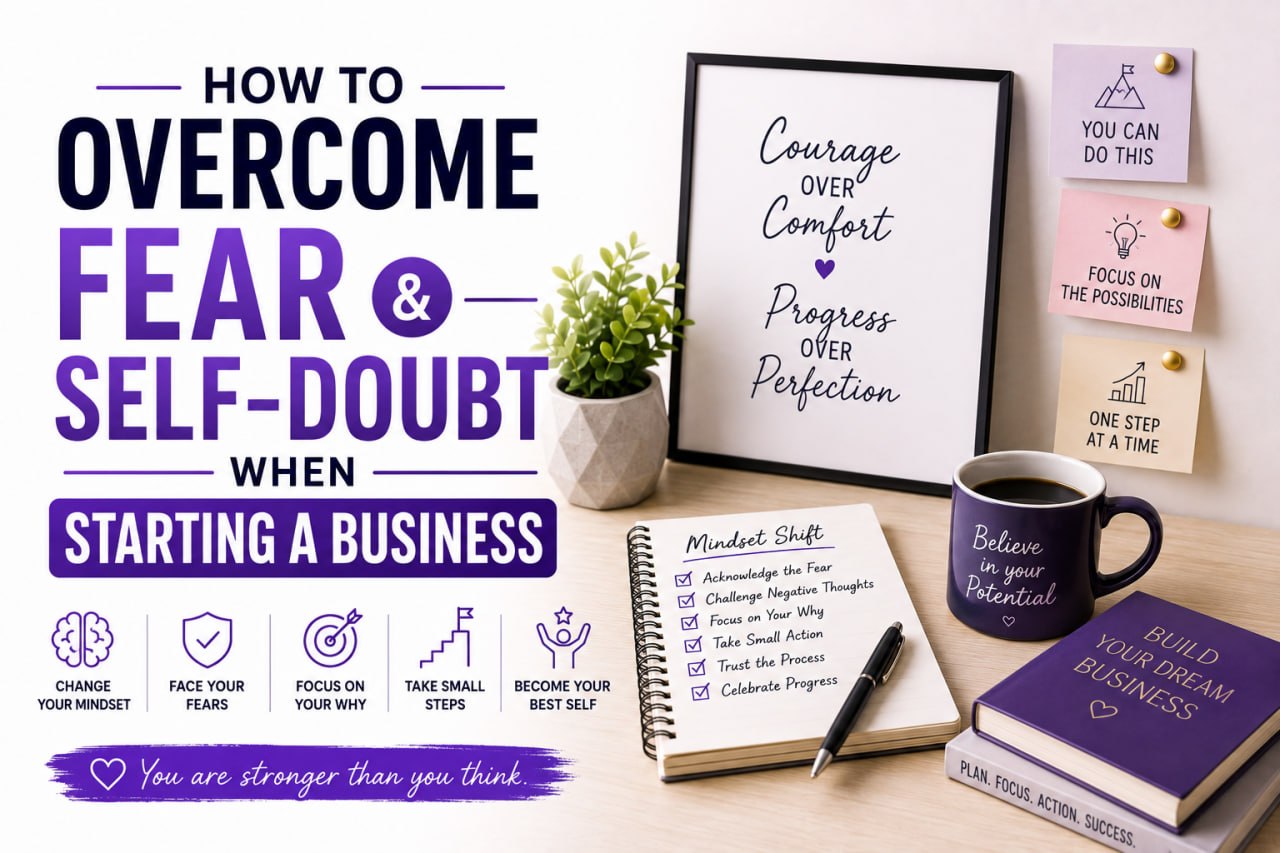
Confidence for entrepreneurs isn’t about eliminating self-doubt entirely even experienced founders feel it. It’s about building a mindset that keeps moving despite it. A few mindset shifts that make a measurable difference:
• From “Am I ready?” to “What’s my next step?” Readiness is proven through action, not certainty felt in advance.
• From “I have to do this perfectly” to “I have to do this well enough to learn and improve.” Progress compounds; perfection stalls.
• From “What if I fail?” to “What will I learn either way?” Reframing risk as information reduces its emotional weight.
• From isolation to community. Doubt grows quietly in isolation and shrinks in the presence of people who understand exactly what you’re navigating.
• From waiting for confidence to building it through action. Confidence is a byproduct of experience, not a prerequisite for starting.
This mindset doesn’t appear overnight, and it’s not something you’re expected to build alone. It’s built through consistent, supported action which is exactly why so many founders benefit from a guide, mentor, or structured roadmap rather than trying to white-knuckle their way through doubt solo.
When Fear Signals Something Worth Listening To
Not all fear should be pushed through. Sometimes hesitation is pointing to something real a plan that needs more validation, a financial cushion that isn’t quite in place yet, or a decision made too quickly under pressure. The goal isn’t to ignore every uncomfortable feeling; it’s to get specific enough to tell the difference between fear that’s protecting you and fear that’s just familiar.
If you’re unsure which one you’re feeling, it often helps to talk it through with someone outside your own head a mentor, coach, or peer who can offer perspective you can’t access alone.
How Do You Know If Fear Is Holding You Back From Starting a Business?
A useful check: if your hesitation is vague, repetitive, and hasn’t changed despite new information or preparation, it’s likely fear rather than a legitimate red flag. If, on the other hand, your hesitation points to a specific, addressable gap like insufficient validation or an unclear offer it’s worth resolving that gap before moving forward, rather than pushing through blindly.
You Don’t Have to Push Through Fear Alone
Overcoming entrepreneurial fear isn’t about becoming fearless it’s about building enough clarity, evidence, and support that fear stops being the loudest voice in the room. With the right roadmap and the right people around you, self-doubt becomes a normal part of the journey instead of a roadblock that stops you before you start.
Amethyst Business Solutions helps women build both the strategy and the confidence to move forward with a personalized plan and support at every step, not just a generic pep talk.
[Book your free 30-minute consultation](https://amethystbusinesssolutions.com/contact/) and start building your business with clarity instead of fear in the driver’s seat.
Frequently Asked Questions
Is it normal to feel afraid when starting a business?
Yes, fear and self-doubt are extremely common among new entrepreneurs, even those who go on to build highly successful businesses. The presence of fear doesn’t indicate the wrong path; it often reflects the significance of the decision.
How do I stop imposter syndrome as a new entrepreneur?
Building evidence through small, consistent wins, separating facts from fear-based stories, and connecting with a support community are among the most effective ways to quiet imposter syndrome over time.
What’s the difference between fear and a legitimate red flag?
Fear tends to be vague and repetitive regardless of new information. A legitimate concern is usually specific and points to an identifiable gap like insufficient validation or an unclear financial plan that can be directly addressed.
How long does it take to build confidence as an entrepreneur?
Confidence typically builds gradually through action and small wins rather than arriving all at once. Most founders notice a meaningful shift within the first few months of consistent, supported progress.