
Day: 13 August 2026

  • How to Turn Your Knowledge Into a High-Value Service Offer

    How to Turn Your Knowledge Into a High-Value Service Offer

    Introduction

    Knowledge on its own doesn’t have a price tag, offers do. Two people with identical expertise can generate very different revenue depending entirely on how that knowledge is packaged, positioned, and priced. Learning how to build a high value service offer is the specific skill of converting what you know into something a client can clearly evaluate, trust, and pay a premium for.

    At Amethyst Business Solutions, we help experts package your expertise into offers that command real value rather than getting compared to the cheapest available option. Here’s the exact approach we use.

    Why Knowledge Alone Rarely Commands a Premium Price

    Undifferentiated expertise gets compared on price, because there’s nothing else to compare it on. A high-value offer avoids this trap by making the specific outcome, method, and experience clear enough that price comparison against generic alternatives no longer feels relevant to the buyer.

    1. Anchor the Offer to a High-Stakes Outcome

    The foundation of any effective service offer strategy is choosing an outcome significant enough that the client’s stakes justify a premium price. Compare:

    •     Lower perceived value: “Marketing advice for small businesses.”

    •     Higher perceived value: “A 90-day plan to fill your sales pipeline before a critical fundraising round.”

    The second example ties directly to a specific, high-stakes moment, which naturally supports a higher price than generic advice.

    2. Package Your Expertise Around a Named Method

    Generic advice-giving is hard to price highly because it’s hard to differentiate. When you package your expertise into a named framework or process, even an internally-developed one, it signals a repeatable system behind the results, not just improvised guidance. This alone is one of the most effective ways to shift perceived value upward.

    3. Build in Depth, Not Just Duration

    A common mistake is equating value with more hours or a longer engagement. High-value offers are often defined less by how long they last and more by how thoroughly they solve a specific, well-defined problem, depth of outcome matters more than volume of time.

    4. Reduce the Client’s Perceived Risk

    Premium pricing requires premium confidence from the buyer. Reduce perceived risk through:

    •     Specific, named proof: case studies and results with real numbers, not vague testimonials.

    •     A clearly defined scope, so the client knows precisely what they’re purchasing.

    •     A built-in checkpoint or milestone so results are visible before the engagement fully concludes.

    5. Price the Transformation, Not the Time

    A core principle of service offer strategy is pricing based on the value of the outcome to the client, not the number of hours the work takes you. Ask what the problem is actually costing the client (in lost revenue, wasted time, or risk) and what solving it is genuinely worth, then price accordingly.

    6. Make the Offer Easy to Say Yes To, Without Discounting It

    High-value doesn’t mean high-friction. Clear communication, a straightforward sales process, and confident presentation of the offer all make it easier for a qualified buyer to say yes, without needing to lower the price to compensate for confusion or hesitation.

    A Simple Framework for Packaging a High-Value Offer

    1.   Identify a specific, high-stakes outcome your expertise can deliver.

    2.   Name your method or approach, even if it’s never been formally labeled before.

    3.   Define a clear, bounded scope, not an open-ended engagement.

    4.   Gather specific proof (results, case studies, numbers) that reduces perceived risk.

    5.   Price based on the value of the outcome, then present it with confidence.

    Common Mistakes That Undercut Offer Value

    •     Describing the offer in terms of activities (“weekly calls”) instead of outcomes.

    •     Failing to name a distinct method, leaving the offer indistinguishable from generic advice.

    •     Over-explaining or apologizing for the price instead of anchoring it to the outcome’s value.

    •     Making the scope too broad or vague, which increases perceived risk for the buyer.

    Frequently Asked Questions

    Q: What makes a service offer ‘high value’ rather than just expensive?

    A: A high-value offer ties directly to a significant, well-defined outcome and reduces the buyer’s perceived risk through proof and clear scope, expensive alone, without that justification, just invites price comparison.

    Q: How do I package my expertise if I don’t have a formal certification?

    A: Results and a clearly articulated method matter more to most buyers than formal credentials. Naming your process and showing specific outcomes is often more persuasive than a certification alone.

    Q: What’s the difference between a service offer strategy and just setting a price?

    A: Pricing is one output of a broader strategy that also includes outcome positioning, scope definition, and risk reduction. A strong strategy makes the price feel justified rather than arbitrary.

    Q: Can a brand-new business command a high-value service offer price?

    A: Yes, provided the offer is anchored to a specific, credible outcome and backed by relevant proof, even if that proof comes from prior professional experience rather than the new business itself.

    Final Thoughts

    A high value service offer isn’t created by charging more for the same generic advice, it’s built by anchoring your expertise to a specific outcome, naming your method, and reducing the risk a buyer feels in saying yes. Get the service offer strategy right, and the price becomes a natural reflection of real value, not a number you have to defend.

    At Amethyst Business Solutions, we help experts package their knowledge into offers that reflect what it’s actually worth. If you’re ready to build yours, our team can help you design it.
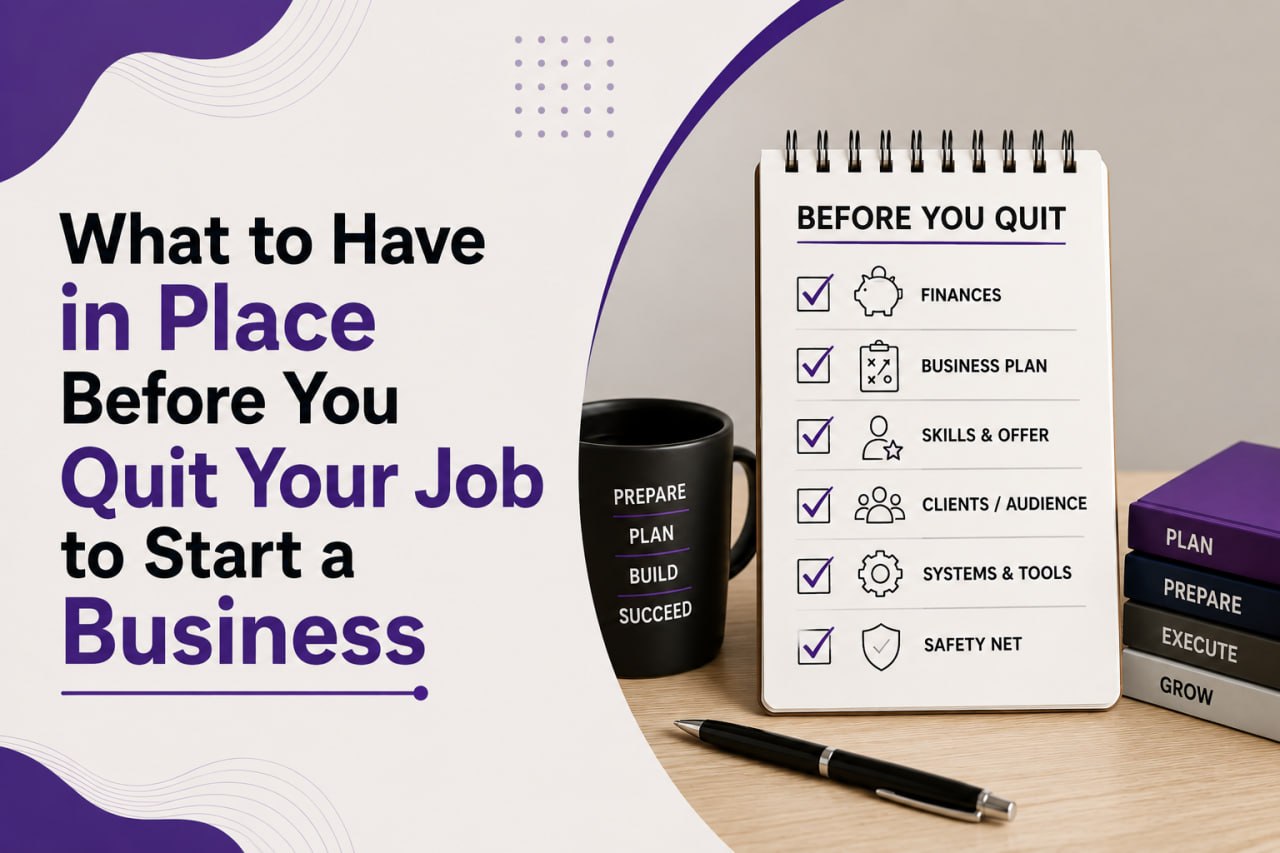
  • Ready to Quit Your Job? What to Have in Place Before Becoming an Entrepreneur

    Ready to Quit Your Job? What to Have in Place Before Becoming an Entrepreneur

    Introduction

    Deciding to quit your job to start a business is rarely just one decision, it’s a series of smaller ones about timing, finances, and readiness that determine whether the leap lands safely or turns into a scramble. The founders who make this transition well aren’t necessarily braver than everyone else; they’ve simply done the preparation that makes the leap calculated instead of reckless.

    At Amethyst Business Solutions, we’ve guided professionals through this exact career to entrepreneurship shift. Here’s what a realistic employee transition plan actually includes before handing in notice.

    Why Timing the Jump Matters More Than the Decision Itself

    Almost everyone eventually decides they want to leave; far fewer plan the transition itself with the same care. The difference between a stressful, reactive exit and a controlled one usually comes down to what’s already in place before the resignation, not the resignation itself.

    1. A Validated Revenue Signal, Not Just an Idea

    Before leaving a paycheck behind, there should be some real evidence the business idea works: early paying clients, a tested offer, or consistent demand, not just enthusiasm and a business plan. Even modest proof of concept dramatically reduces the risk of the transition.

    2. A Financial Runway You’ve Actually Calculated

    Vague confidence in “having some savings” isn’t a plan. A real employee transition plan includes specific numbers:

    •     Monthly essential expenses, calculated honestly, not optimistically.

    •     A savings buffer, commonly 3–6 months of expenses, set aside specifically for this transition.

    •     A realistic minimum revenue threshold the business needs to hit before the runway runs out.

    3. A Plan for Benefits You’re Currently Getting Through Employment

    Health insurance, retirement contributions, and other benefits often go unaccounted for until the transition is already underway. Research replacement costs and options before leaving, since these expenses can meaningfully change the actual financial picture.

    4. A Specific, Not Vague, First 90-Day Plan

    “Figure it out once I’m free to focus on it” is a common but risky plan. A concrete first-90-days outline, target clients, specific outreach activities, weekly milestones, gives the transition direction from day one rather than a disorienting period of open-ended freedom.

    5. Early Proof You Can Sell, Not Just Deliver

    Many professionals are confident in their ability to do the work but untested in their ability to sell it independently, without a company brand or existing pipeline behind them. Testing sales ability before leaving, through side projects, freelance work, or informal client conversations, is one of the most protective steps in the entire transition.

    6. A Support System Independent of Your Current Job

    Leaving a role often means losing built-in professional community: colleagues, structure, and a sense of shared purpose. Part of a thoughtful career to entrepreneurship transition is proactively building a replacement, a mastermind, a coach, a peer group, before that structure disappears, not scrambling to find it after.

    7. A Legal and Administrative Foundation

    Before officially launching, most founders need at minimum a business entity, basic contracts or service agreements, and clarity on tax obligations as a self-employed individual. These are unglamorous but foundational; retrofitting them after the fact is more complicated than setting them up first.

    8. An Honest Conversation With Whoever Shares Your Financial Life

    If you have a partner, family, or shared financial obligations, this transition affects them too. A candid conversation about risk tolerance and expectations before quitting prevents a source of stress that has nothing to do with the business itself but can derail it anyway.

    A Simple Pre-Quit Checklist

    1.   Validated demand: real interest or early paying clients, not just an idea.

    2.   Calculated financial runway and a specific minimum revenue trigger.

    3.   A plan for replacing employer-provided benefits.

    4.   A concrete first-90-days plan, not just a general direction.

    5.   Tested sales ability, independent of your current employer’s brand.

    6.   A support system already in place outside of work.

    7.   Basic legal and administrative setup underway or complete.

    8.   An honest conversation with anyone financially affected by the decision.

    Frequently Asked Questions

    Q: How much savings should I have before I quit my job to start a business?

    A: A common, conservative benchmark is 3–6 months of essential living expenses set aside specifically for the transition, though the right number depends on how validated your revenue already is.

    Q: Do I need paying clients before I quit, or can I build the business after?

    A: Having at least some validated demand or early clients before quitting significantly reduces risk. Many successful transitions include testing the business alongside employment before making it full-time.

    Q: What’s the biggest mistake people make in a career to entrepreneurship transition?

    A: Underestimating both the financial runway needed and the time it takes to replicate a stable income independently, often compounded by not testing sales ability before leaving.

    Q: Should I create an employee transition plan even if I already know I want to quit?

    A: Yes. Even a firm decision benefits from a structured plan, since the specifics of timing, financial buffer, and first steps significantly affect how smoothly the transition goes.

    Final Thoughts

    The decision to quit your job to start a business is rarely the risky part, the risky part is doing it without the groundwork in place. A thoughtful employee transition plan turns a leap of faith into a calculated, well-supported move, one that gives the new business its best possible chance from day one.

    At Amethyst Business Solutions, we help professionals plan this transition with clarity instead of guesswork. If you’re weighing this decision, our team can help you build a realistic plan before you make the leap.