Introduction
Starting or growing a business can feel overwhelming when you do not know what to do first.
You may have a business idea, a product, professional skills, or a strong desire to become an entrepreneur—but turning that vision into a successful business requires more than motivation.
You need direction.
That is where a business roadmap can help.
A business roadmap gives you a structured view of where your business is today, where you want it to go, and what steps you need to take to get there. It helps transform a collection of ideas into a practical plan.
At Amethyst Business Solutions, we help entrepreneurs create clarity around their goals, priorities, positioning, and growth strategies so they can move forward with greater confidence.
If you are wondering where to start, this guide will walk you through the essential steps for creating your own business roadmap.
What Is a Business Roadmap?
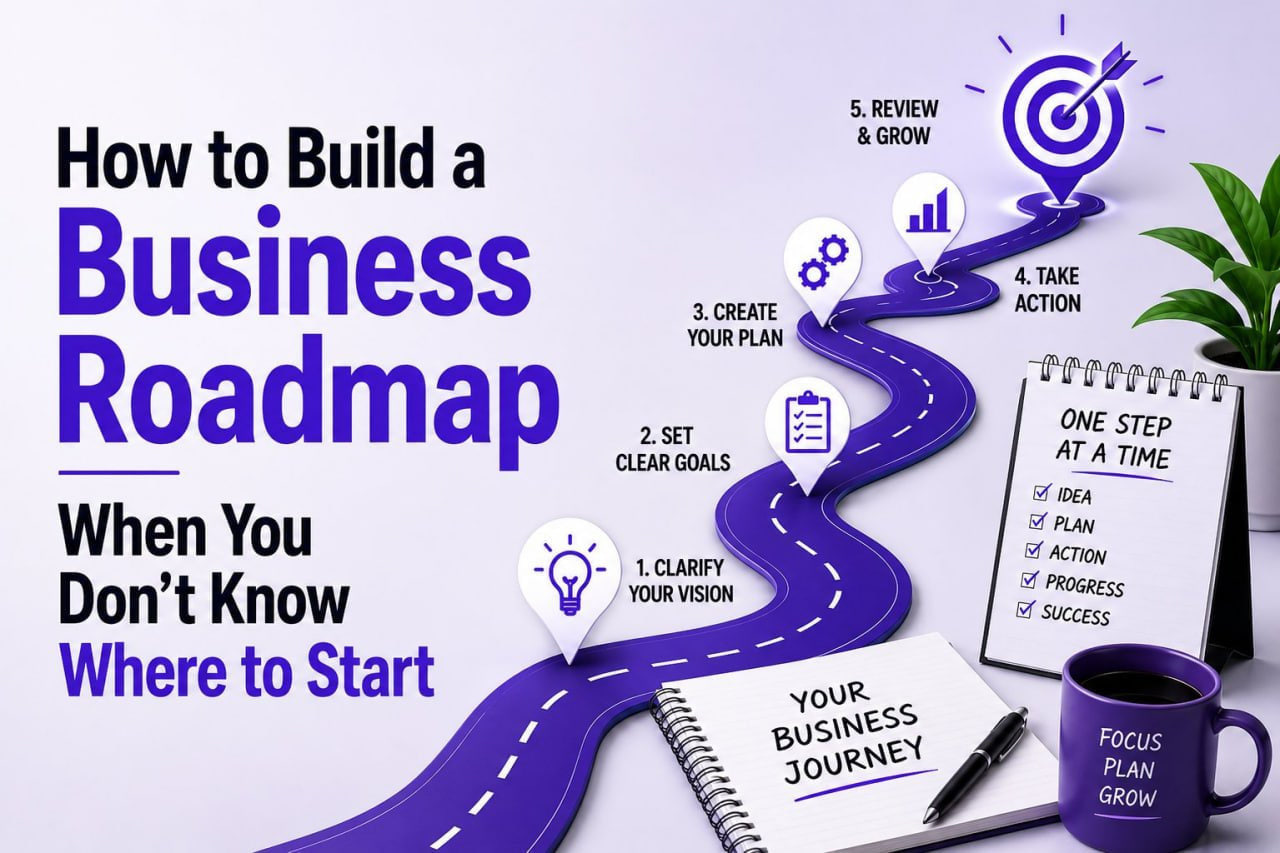
A business roadmap is a strategic plan that outlines your business direction, major goals, priorities, and key actions over a specific period.
Think of it as a high-level guide for your business.
A roadmap can help answer questions such as:
- What am I trying to achieve?
- Who are my customers?
- What problem am I solving?
- What should I sell?
- How will I generate revenue?
- How will customers find me?
- What resources do I need?
- What should I prioritize first?
- How will I measure progress?
Unlike a rigid business plan, a roadmap can remain flexible.
Your business may change as you learn more about your customers, market, competitors, and financial performance. Therefore, your roadmap should be reviewed and updated regularly.
Why Do You Need a Business Roadmap?
Without a clear roadmap, entrepreneurs often fall into the “busy but not productive” trap.
You might spend hours designing a logo, posting on social media, researching competitors, or creating a website without knowing whether those activities are helping you achieve your primary business goals.
A roadmap helps you prioritize.
It can help you:
- Focus on your most important goals
- Organize business activities
- Reduce unnecessary distractions
- Identify potential challenges
- Allocate resources more effectively
- Create measurable milestones
- Make better business decisions
- Track your progress
Most importantly, it gives you a clear answer to one important question:
What should I do next?
Step 1: Start With Your Business Vision
Before creating detailed tasks, define the bigger picture.
Ask yourself:
What do I want this business to become?
Your vision could involve building a profitable small business, creating a scalable company, replacing your employment income, serving a specific customer group, or eventually building a team.
Your vision does not need to be perfect.
It simply needs to provide direction.
For example:
“I want to build a profitable consulting business that helps small businesses improve their marketing and eventually create a team that can serve clients across multiple markets.”
This vision can influence the decisions you make throughout your roadmap.
Step 2: Define Your Business Goals
Once you have a vision, turn it into specific goals.
Avoid vague goals such as:
“I want my business to grow.”
Instead, make your objectives measurable.
For example:
- Generate 20 qualified leads per month.
- Reach $10,000 in monthly revenue.
- Launch a new service within 90 days.
- Acquire the first 10 paying customers.
- Build an email list of 1,000 subscribers.
- Expand into a new market within 12 months.
Your goals should be realistic but meaningful.
You can organize them into:
Short-Term Goals
Usually focused on the next 30–90 days.
Mid-Term Goals
Usually focused on the next 3–12 months.
Long-Term Goals
Usually focused on one year or beyond.
This structure prevents you from focusing only on immediate tasks while ignoring the bigger picture.
Step 3: Identify Your Ideal Customer
A business cannot effectively serve everyone.
One of the most important parts of your startup roadmap is identifying who you want to serve.
Ask:
- Who has the problem I solve?
- What type of customer is most likely to buy?
- What are their biggest challenges?
- What motivates their purchasing decisions?
- Where do they search for solutions?
- What alternatives are they currently using?
Create a simple customer profile that includes demographics, business characteristics where relevant, challenges, goals, buying behavior, and expectations.
The more clearly you understand your customer, the easier it becomes to develop your offer and marketing strategy.
Step 4: Clarify the Problem You Solve
Customers generally do not buy products or services simply because they exist.
They buy solutions to problems.
Your roadmap should clearly define:
What problem does my business solve?
For example, instead of saying:
“We provide marketing services.”
A clearer positioning statement could be:
“We help small businesses build predictable lead-generation systems through strategic marketing.”
This distinction matters because customers need to understand the value you provide.
Step 5: Define Your Products or Services
Now determine exactly what you are selling.
List your core products or services and identify:
- What is included?
- Who is it for?
- What problem does it solve?
- How is it different?
- How much will you charge?
- How will customers purchase it?
- Can it be delivered profitably?
Avoid creating too many offers at the beginning.
A focused offer can make your marketing, sales, operations, and customer experience easier to manage.
Step 6: Develop Your Business Model
Your business roadmap should explain how your company will make money.
Consider:
Revenue
Where will your income come from?
Pricing
How much will customers pay?
Costs
What expenses are required to deliver your product or service?
Profitability
Will your pricing and costs allow the business to generate a sustainable profit?
Customer Acquisition
How will you attract potential customers?
Customer Retention
How will you encourage customers to continue buying from you?
You do not need a complicated financial model initially. However, you should understand the basic economics of your business before investing significant resources.
Step 7: Create a Marketing and Sales Strategy
A business roadmap should connect your business goals with your customer acquisition strategy.
Start by identifying where your target customers spend their time.
Potential channels may include:
- Google Search
- Social media
- Email marketing
- Content marketing
- SEO
- Paid advertising
- Networking
- Partnerships
- Referrals
- Events
You do not necessarily need to use every channel.
Choose the channels that make sense for your audience, budget, industry, and business stage.
Then define how a person moves from:
Awareness → Interest → Consideration → Purchase → Retention
This gives you a basic customer journey that your marketing and sales activities can support.
Step 8: Establish Your Brand Positioning
Your brand should communicate why customers should choose you.
Your roadmap should include basic positioning elements such as:
- Brand purpose
- Target audience
- Core offer
- Unique value proposition
- Brand personality
- Key messages
- Competitive differentiation
Strong positioning helps you avoid becoming another generic business in a crowded market.
Customers should be able to understand what you do, who you help, and why your solution is valuable.
Step 9: Break the Roadmap Into Milestones
A large business goal can feel overwhelming.
Breaking it into milestones makes it easier to execute.
For example:
Month 1
- Finalize business idea.
- Research target customers.
- Define service offering.
- Establish pricing.
- Develop basic brand positioning.
Month 2
- Build website.
- Create marketing assets.
- Set up social profiles.
- Create lead-generation process.
- Begin outreach and content marketing.
Month 3
- Launch campaigns.
- Generate initial leads.
- Track results.
- Collect customer feedback.
- Improve the offer.
The exact timeline will vary by business, but the principle remains the same:
Big goals become manageable when divided into smaller milestones.
Step 10: Decide What to Do First
This is where many entrepreneurs struggle.
Everything may appear important.
But everything cannot be the first priority.
Use three questions to prioritize:
1. Does this directly support my current goal?
If not, it may be possible to delay it.
2. Will this help generate revenue or validate my idea?
Prioritize activities that create meaningful learning, customer conversations, leads, or revenue.
3. Is this necessary right now?
Some tasks are useful but not urgent.
For example, spending weeks perfecting your logo may not be the best first priority if you have not yet validated your offer.
Step 11: Set KPIs to Measure Progress
Your roadmap should include measurable indicators.
Depending on your business, useful KPIs may include:
- Revenue
- Profit margin
- Leads
- Conversion rate
- Customer acquisition cost
- Average order value
- Website traffic
- Email subscribers
- Customer retention
- Repeat purchases
Do not track dozens of metrics simply because they are available.
Choose the numbers that directly connect to your business objectives.
Step 12: Review and Update Your Roadmap
A business roadmap is not a document you create once and forget.
Your assumptions may change.
Customers may provide unexpected feedback. Competitors may change their positioning. Marketing channels may perform differently than expected.
Review your roadmap regularly—monthly or quarterly depending on your business stage.
Ask:
- What worked?
- What did not work?
- What did we learn?
- Which goals have been achieved?
- What has changed?
- What should we prioritize next?
This keeps your strategy relevant.
Common Mistakes When Creating a Business Roadmap
Trying to Do Everything at Once
Trying to launch a website, create social media content, run ads, develop multiple products, build an email list, and enter new markets simultaneously can quickly create overwhelm.
Start with your highest-impact priorities.
Creating Goals Without a Strategy
A goal such as “increase revenue” is not enough.
You need to determine how you will achieve it.
Ignoring Your Customers
Your roadmap should be based on customer needs—not only your personal assumptions.
Focusing Only on Branding
Branding matters, but a beautiful logo does not automatically create a profitable business.
Failing to Track Results
Without measurement, you cannot determine whether your strategy is working.
Refusing to Change the Plan
A roadmap provides direction, not a prison.
If your data tells you that something is not working, adjust your strategy.
When Should You Get Business Planning Support?
You do not need to build your entire roadmap alone.
Professional business planning support can be especially useful when:
- You have multiple business ideas.
- You are unsure which opportunity to pursue.
- You cannot clearly define your target customer.
- You need help developing your offer.
- You struggle with pricing.
- You do not know which marketing channels to prioritize.
- You want to create measurable business goals.
- You are preparing for business growth.
- You feel overwhelmed by competing priorities.
An experienced business advisor or coach can provide an outside perspective and help turn scattered ideas into a structured direction.
How Amethyst Business Solutions Can Help
At Amethyst Business Solutions, we understand that many entrepreneurs do not need more information—they need clarity.
Our approach focuses on helping business owners understand where they are today, define where they want to go, and identify the practical steps required to move forward.
From business planning and positioning to strategy and growth planning, we can help you create a roadmap that reflects your specific business goals.
Rather than following a one-size-fits-all formula, the focus is on developing a practical strategy that you can actually implement.
Final Thoughts
Creating a business roadmap does not mean predicting everything that will happen in your business.
It means creating a clear direction.
When you know your destination, understand your customer, define your offer, establish measurable goals, and prioritize the right actions, running a business becomes much more manageable.
You may not know exactly what the next three years will look like—and that is okay.
Start with the next important step.
Then the next one.
Your roadmap can evolve as your business grows.
If you are unsure where to start or need professional business planning support, Amethyst Business Solutions can help you turn your business vision into a practical roadmap.
Ready to create a clearer path for your business? Contact Amethyst Business Solutions and take the first step toward building a focused, strategic, and sustainable business.
Frequently Asked Questions
What is a business roadmap?
A business roadmap is a strategic guide that outlines a company’s goals, priorities, milestones, and key actions over a specific period.
How do I create a business roadmap?
Start by defining your vision, goals, target customer, problem, products or services, business model, marketing strategy, milestones, and KPIs. Then prioritize the actions that are most important for your current stage.
What is the difference between a business plan and a business roadmap?
A business plan is typically a more detailed document covering areas such as market analysis, operations, finances, and strategy. A business roadmap provides a higher-level view of goals, priorities, milestones, and direction.
Do startups need a business roadmap?
Yes. A startup roadmap can help founders prioritize important activities, validate their ideas, understand their customers, and avoid wasting resources on low-priority tasks.
Can a business roadmap change?
Absolutely. A roadmap should evolve as your business, customers, market conditions, and goals change. Regular reviews help keep it useful and realistic.
Can Amethyst Business Solutions help create a business roadmap?
Yes. Amethyst Business Solutions can provide strategic guidance and business planning support to help entrepreneurs clarify their goals, priorities, positioning, and next steps.