
Day: 19 August 2026

  • How to Know Whether Your Business Idea Is Ready for the Market

    How to Know Whether Your Business Idea Is Ready for the Market

    Quick answer: A business idea is ready for the market when you can point to real evidence not assumptions that a specific group of people has the problem, wants it solved, and will pay to solve it. A solid business idea assessment checks for a defined customer, a validated problem, willingness to pay, and a realistic path to reach that customer. If any of these are missing, the idea needs more validation before launch, not more building.

    Most business ideas don’t fail because the idea itself was bad. They fail because they launched before anyone confirmed the market actually wanted them. Knowing how to properly evaluate market readiness before investing serious time or money is one of the most valuable skills a new entrepreneur can develop.

    This guide walks through a practical business idea assessment framework you can apply to any concept, in any industry.

    Why Most Business Ideas Feel Ready Before They Actually Are

    Founders are naturally close to their own ideas. That closeness creates a common trap: mistaking personal conviction for market evidence. You might feel certain your idea solves a real problem, but feeling certain and having proof are two very different things.

    Business idea validation exists specifically to close that gap replacing internal confidence with external evidence before you commit real resources.

    The Four-Part Business Idea Assessment Framework

    A useful way to assess any business idea is to test it against four specific criteria. If any one of these is weak or unanswered, the idea isn’t market-ready yet.

    1. Is There a Clearly Defined Customer?

    “Everyone could use this” is a warning sign, not a strength. Market-ready ideas can name a specific type of customer: their industry, role, company size, or life stage. If you can’t describe your ideal customer in one or two sentences, the idea needs more focus before it can be properly tested.

    2. Is the Problem Real and Urgent?

    Not every inconvenience is worth solving commercially. Ask whether the problem is something people:

    • Actively complain about, unprompted
    • Have already tried (and paid) to solve in some way
    • Would prioritize fixing over other competing problems

    A problem that’s mildly annoying rarely gets budget. A problem that’s costly, painful, or urgent usually does.

    3. Will People Actually Pay to Solve It?

    This is where business idea validation becomes concrete. Interest is not the same as willingness to pay. Signs of real market readiness include:

    • Prospects asking how much it costs, unprompted
    • People willing to pre-order, put down a deposit, or commit to a pilot
    • Evidence that similar solutions already generate revenue in the market

    If people say “I love this idea” but hesitate the moment payment comes up, the idea likely needs refinement.

    4. Can You Actually Reach These Customers?

    A great solution to a real, painful problem can still fail if there’s no realistic way to reach the people who have it. Before launching, confirm:

    • Where your ideal customers already spend time or attention
    • Whether you have (or can build) access to that audience
    • Whether the cost of reaching them makes sense against what they’ll pay

    How to Actually Test Market Readiness

    Assessment shouldn’t happen only in your head. Here’s how to gather real evidence:

    1. Talk to 10–15 potential customers directly. Ask about their problems and current solutions, not your idea.
    2. Watch for unprompted pain points. If multiple people mention the same frustration without being asked, that’s a strong signal.
    3. Test willingness to pay. Offer a small paid pilot, a deposit, or a pre-sale before building the full solution.
    4. Look for existing competitors. Contrary to instinct, competition is often a good sign it means the problem is proven to have budget behind it.

    Signs Your Business Idea Is NOT Yet Market-Ready

    • You can’t clearly name who the customer is
    • Conversations are polite but vague no strong reactions either way
    • People are interested in concept but unwilling to pay or commit
    • You can’t identify a realistic way to reach your target customer
    • The idea depends heavily on behavior change that’s historically hard to achieve

    None of these mean the idea is dead. They mean it needs another round of refinement and testing before real investment.

    Where Professional Guidance Helps

    A structured business idea assessment can be difficult to do objectively on your own, since it’s natural to want validation for an idea you’re personally invested in. This is where outside perspective adds real value. Amethyst Business Solutions works with entrepreneurs to pressure-test business ideas against real market evidence, helping founders avoid the costly mistake of building before validating.

    Frequently Asked Questions

    What’s the difference between a business idea assessment and a business plan? A business idea assessment happens earlier and is narrower in scope it specifically tests whether the idea has real market demand. A business plan comes after, once the idea has been validated, and lays out how the business will operate, grow, and reach financial goals.

    How long does business idea validation usually take? For most ideas, a focused validation process of direct customer conversations and small market tests can be done in a few weeks. The timeline depends on how quickly you can reach real prospects in your target market, not how long you spend building.

    Can a business idea be market-ready without a finished product? Yes. Market readiness is about proven demand, not a finished product. Many ideas are validated through pilots, pre-sales, or paid trials of a minimum version, well before a fully built product or service exists.

    Final Thought

    A business idea assessment isn’t about second-guessing yourself endlessly it’s about replacing assumptions with evidence before you commit serious time and money. By testing for a defined customer, a real problem, genuine willingness to pay, and a realistic path to reach that customer, you can confidently determine market readiness before you launch.

    If you want an objective, structured evaluation of your business idea before you invest further, Amethyst Business Solutions helps entrepreneurs validate ideas against real market evidence, not assumptions.
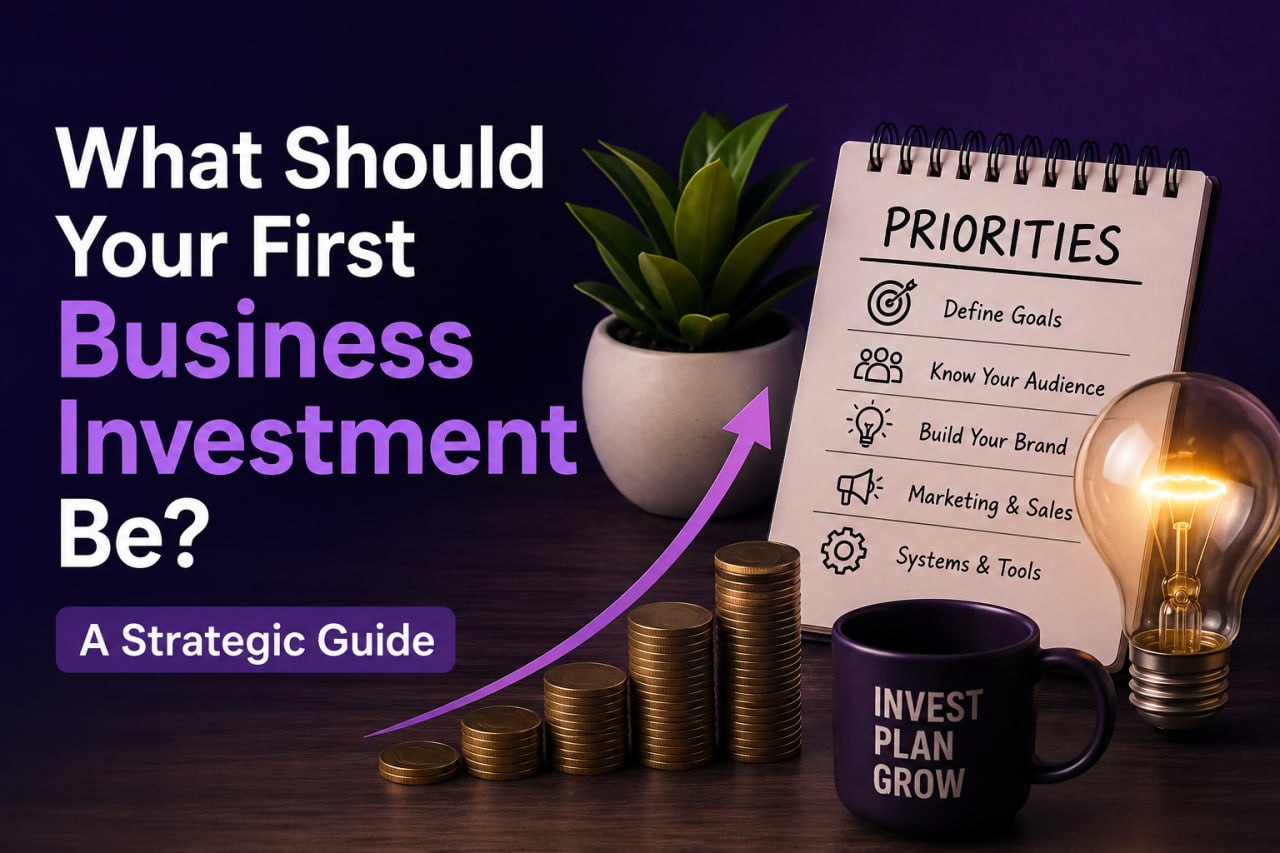
  • What Should Your First Business Investment Be? A Strategic Guide for New Entrepreneurs

    What Should Your First Business Investment Be? A Strategic Guide for New Entrepreneurs

    Quick answer: Your first business investment should go toward whatever directly gets you a paying client faster usually validation, a minimum viable offer, or basic legal/financial infrastructure not branding, a fancy website, or office space. The right investment strategy prioritizes revenue-generating activities first, and “nice to have” polish only after real client demand is proven.

    New entrepreneurs often ask the wrong first question. Instead of “what should I spend money on?” the better question is “what does this business need to prove before it deserves more investment?” Getting this sequence right is one of the biggest differentiators between businesses that gain traction quickly and those that burn cash before ever landing a client.

    This guide lays out a clear business investment strategy for deciding where your first dollars should go.

    Why the First Investment Matters So Much

    Early-stage capital, whether it’s $500 or $50,000, is the most valuable money your business will ever have — because it’s the money that has to prove the model works. Spend it in the wrong place, and you end up with a polished-looking business that still has no clients. Spend it well, and even a small budget can generate the evidence you need to justify further investment.

    This is the core idea behind smart startup business priorities: sequence spending around what reduces risk and generates revenue, not what looks impressive.

    Step 1: Separate “Must-Have” From “Feels Important”

    Most first-time entrepreneurs are tempted to invest first in the things that feel most like “having a real business”:

    • A custom logo and brand identity
    • A fully built website
    • Business cards, signage, office space
    • Paid ads before there’s even a defined offer

    These aren’t wrong investments they’re just premature ones. None of them are required to get your first paying client. What actually moves a business forward at the start is far more basic.

    Step 2: Prioritize Validation Before Anything Else

    Before spending on infrastructure, spend time and if necessary, a small amount of money confirming that people will actually pay for what you’re offering. This might mean:

    • Running a small paid pilot or beta offer
    • Talking directly to 10–15 potential customers
    • Testing a landing page with a simple offer, even before the product is fully built

    Validation is the highest-leverage first business investment because it prevents you from investing further in an idea the market doesn’t actually want.

    Step 3: Invest in the Business Foundation Next

    Once there’s real signal that people will pay, the next tier of startup business priorities should be foundational, not cosmetic:

    1. Legal structure — forming the right entity for liability protection and tax treatment
    2. Business banking — separating personal and business finances early
    3. Contracts and agreements — protecting you and setting clear expectations with early clients
    4. Basic bookkeeping — so you understand cash flow from day one, not a year in

    This is where many entrepreneurs benefit from outside expertise rather than trial and error. Amethyst Business Solutions works with early-stage business owners to get this foundational layer right the first time, so early capital goes toward a structure that scales instead of one that needs to be redone later.

    Step 4: Only Then Invest in Growth and Brand

    Once you have a validated offer, a working foundation, and at least a few paying clients, it’s time to consider:

    • A professional brand identity and website
    • Paid marketing and lead generation
    • Tools and software that scale delivery
    • Hiring support to handle growing demand

    Investing here too early is common and it’s also one of the most reversible mistakes, since it primarily costs money rather than time or client trust. Investing here too late, on the other hand, can cap growth once demand is already proven. The key is sequencing: validate, then build the foundation, then scale the brand and marketing.

    A Simple Framework for Any First Business Investment Decision

    Before spending, ask three questions:

    • Does this get me closer to a paying client? If not, it can likely wait.
    • Does this protect the business or the client relationship? (Legal, financial, contracts) If yes, it’s foundational and worth prioritizing early.
    • Does this only make the business look more established? If yes, it belongs later in the sequence, once revenue justifies it.

    Common Mistakes New Entrepreneurs Make With Early Capital

    • Overspending on branding before the offer is validated
    • Buying software or tools for a scale the business hasn’t reached yet
    • Skipping legal and financial basics, creating risk that surfaces later
    • Treating every dollar as equally urgent, instead of sequencing by what reduces the most risk

    Frequently Asked Questions

    What is usually the best first business investment for a new entrepreneur? For most new businesses, the best first investment is validation confirming through direct customer conversations or a small pilot offer that people will actually pay for the product or service, before spending on branding, tools, or infrastructure.

    Should legal and financial setup happen before or after the first sale? Basic legal and financial setup, such as choosing a business entity and separating finances, is generally worth prioritizing early because it protects both the owner and the client, even at a small scale. It doesn’t need to be elaborate at first, just in place.

    How much money is actually needed for a first business investment? The amount varies widely by industry, but many service-based businesses can validate an idea and land a first client with a very small budget, sometimes under a few hundred dollars, since the earliest priority is proving demand rather than building infrastructure.

    Final Thought

    The right first business investment isn’t the one that makes your business look the most established it’s the one that proves your business actually works. By prioritizing validation, then foundational structure, then growth and branding, you build a business investment strategy that protects your capital and accelerates real traction.

    If you want guidance sequencing your early investments and setting up the right business foundation, Amethyst Business Solutions works with new entrepreneurs to prioritize spending where it matters most, at every stage of growth.