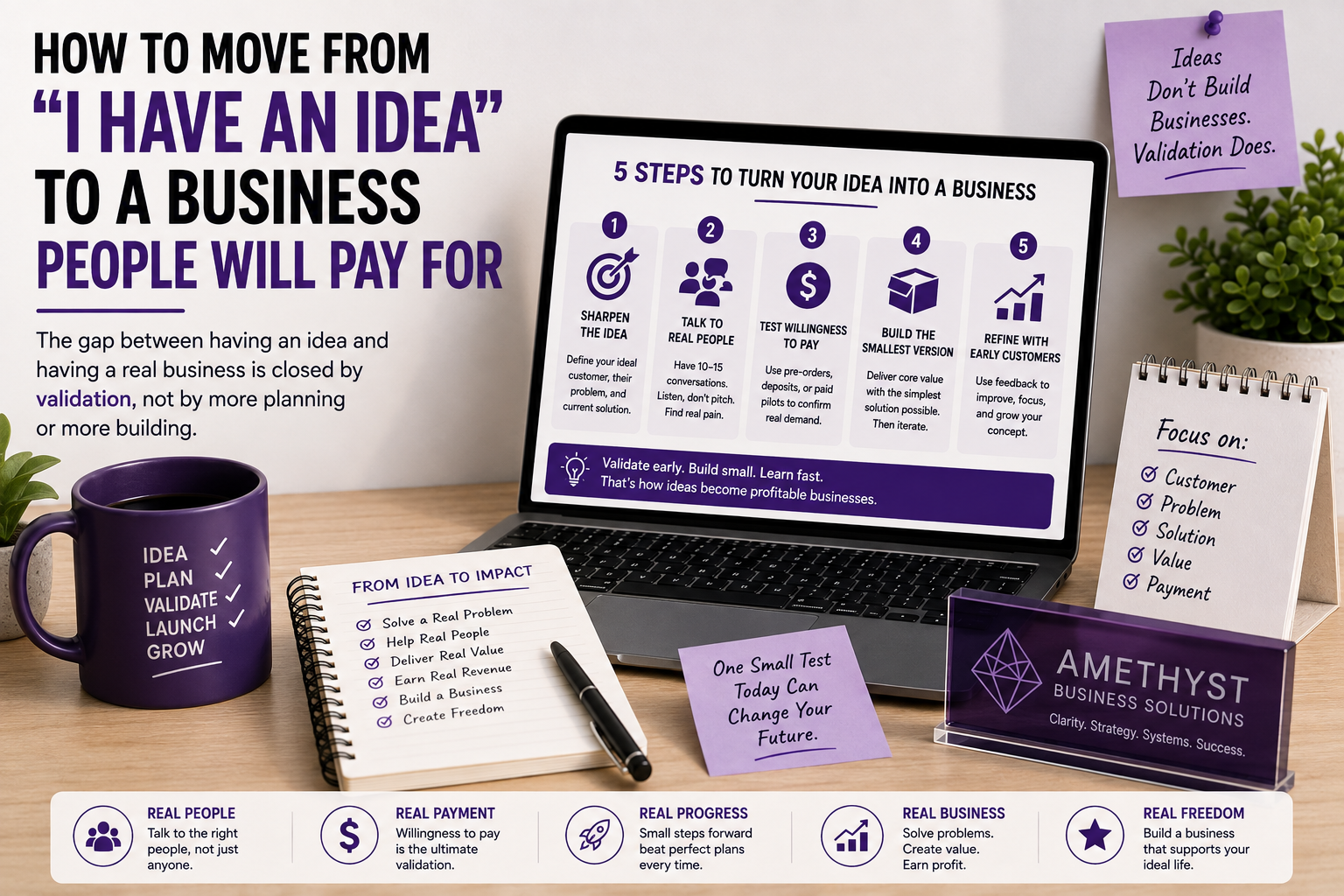
To turn a business idea into reality, move through three stages: sharpen the idea into a specific offer for a specific customer, validate it with real conversations and small paid tests, and only then build out the full product or service. The gap between “having an idea” and having a real business is almost always closed by validation, not by more planning or more building.
Almost everyone has had a business idea. Very few people turn that idea into an actual business. The difference usually isn’t talent, luck, or even the quality of the idea itself — it’s whether the idea gets tested against real customers before serious time and money go into building it.
This guide lays out the practical steps to validate a business idea and move it toward becoming a profitable business concept, rather than staying a permanent “someday” project.
Why Most Ideas Never Become Businesses
Ideas stay ideas for a predictable set of reasons:
- The idea stays vague (“something in wellness,” “an app for X”) instead of becoming a specific offer
- There’s no real customer feedback, just internal conviction that it’s a good idea
- Building starts before validating, so months go into something nobody asked for
- There’s no clear first step, so momentum never actually starts
Closing each of these gaps is what actually moves you from “I have an idea” to a working business.
Step 1: Sharpen the Idea Into a Specific Offer
A vague idea can’t be tested. Before anything else, narrow it down to specifics:
- Who exactly is this for? (Not “everyone,” a specific type of person or business)
- What exact problem does it solve for them?
- How would they currently solve this problem without you?
The sharper this is, the easier it becomes to test. “A meal planning app” is vague. “A meal planning tool for busy parents managing multiple kids’ allergies” is testable.
Step 2: Talk to Real People Before Building Anything
This is the single most important step to validate a business idea, and the one most often skipped. Talk to 10–15 people who match your target customer. The goal isn’t to pitch your idea — it’s to understand their current reality:
- What do they currently do to solve this problem?
- What frustrates them about their current solution?
- What would it be worth to them to solve it better?
Listen for unprompted pain points and specific frustrations. If people struggle to describe a real problem in this area, the idea may need to shift toward something with more genuine urgency behind it.
Step 3: Test Willingness to Pay, Not Just Interest
Polite enthusiasm is common and mostly meaningless. Real validation comes from testing whether people will actually commit money, even in a small way:
- Offer a pre-order or deposit for early access
- Run a small paid pilot version of the service
- Ask directly what they’d expect to pay, and gauge the reaction
A profitable business concept isn’t defined by how much people like the idea — it’s defined by whether they’ll pay for it before it’s even fully built.
Step 4: Build the Smallest Version That Delivers Real Value
Once there’s evidence of demand, resist the urge to build the full, polished version right away. Instead, build the smallest version that still delivers genuine value to a real customer:
- A limited service offer instead of a full productized system
- A manual process instead of custom software, at first
- A single, well-executed use case instead of every planned feature
This smaller version lets you turn business idea into reality faster, with less capital at risk, while still gathering real feedback from paying customers.
Step 5: Use Early Customers to Refine the Concept
Your first customers are not just revenue — they’re the most valuable feedback source you’ll ever have. Pay close attention to:
- What they use most, and what they ignore
- Where they get confused or frustrated
- What they’d tell a friend about the value, in their own words
This feedback loop is what turns an initial concept into a genuinely profitable business concept, refined by real use rather than assumptions made in isolation.
Common Mistakes When Turning an Idea Into a Business
- Staying in planning mode indefinitely, mistaking research for progress
- Building the full version first, before any real customer feedback
- Confusing interest with commitment, and skipping the willingness-to-pay test
- Ignoring early customer feedback because it doesn’t match the original vision
Where Outside Perspective Helps
Founders are often too close to their own idea to evaluate it objectively — that’s simply human nature when you’re personally invested. An outside perspective can spot gaps in the plan, challenge weak assumptions, and help structure a validation process that produces real evidence. Amethyst Business Solutions works with early-stage founders to pressure-test ideas and build a clear path from concept to a genuinely profitable business.
Frequently Asked Questions
How do I validate a business idea without spending a lot of money? Most validation can be done cheaply through direct customer conversations, small paid pilots, or pre-orders, rather than building a full product. The goal at this stage is gathering evidence of demand, not creating a polished final version.
How long does it typically take to turn a business idea into reality? Timelines vary, but many ideas can move from concept to a validated, small-scale version within a few months of focused effort, particularly for service-based businesses. Product-based businesses with manufacturing or development requirements often take longer.
What makes a business concept “profitable” versus just interesting? A profitable business concept has confirmed willingness to pay from real customers, not just expressed interest. Interesting ideas generate enthusiasm; profitable ones generate actual transactions, even at a small scale.
Final Thought
The distance between “I have an idea” and “I have a business” is almost always closed by validation, not by more planning. By sharpening your idea into a specific offer, testing it with real conversations and real payment, and building only the smallest version needed to deliver value, you can turn a business idea into reality with far less risk than most people assume.
If you’re ready to pressure-test your idea and build a clear validation plan, Amethyst Business Solutions helps founders move from concept to a confirmed, profitable business concept.