Category: Blogs

  • Is Amethyst Business Solutions Right for You? Take the Self-Assessment

    Is Amethyst Business Solutions Right for You? Take the Self-Assessment

    Not every business coaching program is right for every person. Before you invest your time and money, it’s worth asking: is this actually the right fit for where you are right now?

    Below is a simple self-assessment to help you find out. Answer honestly — there’s no wrong answer, only the answer that’s true for you right now.

    Question 1: Where Are You Starting From?

    • A. I’m currently employed and thinking about starting a business on the side or eventually leaving my job.
    • B. I’ve already started a business, but it feels unstructured or stuck.
    • C. I’m not sure I even want to start a business yet — I’m just exploring.

    If you answered A or B, you’re in exactly the position we specialize in at Amethyst Business Solutions — helping women move from employment (or an unstructured start) into a confident, structured business.

    Question 2: What’s Stopping You Right Now?

    • A. I don’t have a clear plan — I don’t know where to start.
    • B. I have ideas but no confidence that I can actually pull them off.
    • C. I’ve tried DIY resources (courses, YouTube, books) but nothing has stuck.

    Any of these answers points to the same underlying gap: structure and support. That’s precisely what our personalized business roadmap is built to solve — a real plan, not more generic content to sort through alone.

    Question 3: How Do You Prefer to Learn and Grow?

    • A. I do better with a guide and accountability, not just self-paced content.
    • B. I want a plan built around my specific skills and goals, not a one-size-fits-all course.
    • C. I’m ready to take action, even if I don’t feel 100% ready yet.

    If this sounds like you, our approach — personalized coaching over generic courses — is likely to be a strong match.

    Question 4: What Does Success Look Like for You?

    • A. Leaving my current job to run my own business full-time.
    • B. Building a profitable business as an advisor, consultant, or service provider.
    • C. Simply having the confidence to finally get started.

    Whatever your version of success looks like, our program is designed to meet you where you are and build toward it — step by step, over roughly 12 weeks.

    So, Is Amethyst Business Solutions Right for You?

    If most of your answers were A or B, this program was built with you in mind. You’re either at the starting line of your entrepreneurial journey or trying to bring structure to an idea that’s already in motion — and that’s exactly the gap we help close.

    If you answered mostly C, that’s okay too. It simply means you may benefit from a conversation first, before committing to the full roadmap — which is exactly what a free consultation is for.

    Ready to Find Out for Certain?

    A self-assessment can only tell you so much. The clearest way to know if business coaching for women through Amethyst Business Solutions is right for you is to talk it through directly.

    Still not sure if you’re ready? Book your free 30-minute consultation — no pressure, no obligation. Just clarity on whether this is your next right step.

  • Real Results: How Women Go From Employee to Entrepreneur in 90 Days

    Real Results: How Women Go From Employee to Entrepreneur in 90 Days

    Ninety days doesn’t sound like much time. But for the women who go through the Amethyst Business Solutions roadmap, it’s often the difference between “I want to start a business someday” and “I run a business.”

    Here’s what that 90-day transformation typically looks like, milestone by milestone.

    Week 1-2: From Uncertainty to a Clear Destination

    Most women come to Amethyst Business Solutions with an idea, but no clear plan. They know they’re unhappy in their current job. They know they have expertise worth sharing. What they don’t have yet is clarity on what their business actually looks like.

    In the first two weeks, that changes. Through the “Deciding on the Destination” phase, clients walk away with a defined goal, a clear vision of the life they’re building, and — often for the first time — real belief that this is achievable.

    Week 3-5: Building a Business That Fits

    This is where the guesswork ends. Instead of trying to copy a competitor’s model or follow generic templates, clients build their personalized MAP: their specific product or service, their niche, and their business model.

    This phase is often where clients describe feeling a shift — from “I hope this works” to “I understand exactly why this will work.”

    Week 6-8: Branding, Pricing, and Getting Visible

    With a MAP in place, clients move into building their brand, setting their pricing, and creating a sales and marketing strategy. This is typically the phase where a business starts to feel real to the outside world — a professional online presence, clear messaging, and a plan to reach the right audience.

    Week 9-11: Launching the Foundations

    By this stage, clients are building their actual business infrastructure: their online presence, their systems, and the trust and community that will support their first clients.

    Week 12: The First Clients

    By the end of the 90 days, the goal is simple but significant: paying clients, a working business model, and — just as importantly — the confidence to keep going.

    Why the Roadmap Works

    The women who go through this process aren’t necessarily more talented or more resourced than anyone else trying to start a business. What they have is a structured, step-by-step plan and someone guiding them through every decision point — instead of trying to figure it all out alone.

    What This Could Look Like for You

    If you’re currently employed and dreaming about entrepreneurship, it’s worth asking: what would your business look like 90 days from now if you had a clear roadmap and dedicated support?

    At Amethyst Business Solutions, this is exactly what we help you build — a real plan, grounded in your skills and goals, with the accountability to see it through.

    Curious what your own 90-day journey could look like? Book your free 30-minute consultation with Amethyst Business Solutions and find out.

  • Business Coach vs. DIY: Why Trying to Figure It Out Alone Costs You More

    Business Coach vs. DIY: Why Trying to Figure It Out Alone Costs You More

    You’ve probably told yourself, “I can figure this out on my own.” You’ve got Google, YouTube tutorials, a stack of free templates, and maybe a business book or two on your nightstand. It feels responsible. Resourceful, even.

    But here’s the question worth sitting with: how much time, money, and confidence have you already spent trying to DIY your way into entrepreneurship — without a clear result to show for it?

    At Amethyst Business Solutions, we work with women every day who come to us after months (sometimes years) of going it alone. They’re smart, capable, and driven. What they were missing wasn’t effort — it was a clear roadmap and someone in their corner who had already walked the path.

    The Real Cost of “Figuring It Out Yourself”

    DIY entrepreneurship isn’t free. It just hides its costs differently.

    • Time. Every hour spent guessing which strategy to try next is an hour not spent serving clients or generating income.
    • Money. Trial and error is expensive — the wrong pricing model, the wrong niche, the wrong marketing channel all cost real dollars to correct.
    • Confidence. Every failed attempt without guidance chips away at your belief that you can actually do this.

    Most first-time entrepreneurs don’t fail because they lack ideas. They fail because they lack a structured plan and the confidence to execute it consistently.

    What a Business Coach Actually Gives You

    So, is a business coach worth it? Here’s what changes when you stop going it alone:

    1. A Personalized Roadmap, Not Generic Advice Free content online is written for everyone, which means it’s tailored to no one. A business coach looks at your skills, your goals, and your market — and builds a plan specifically for you.

    2. Faster Decisions, Fewer Costly Mistakes When you’re unsure whether to raise your prices, pick a niche, or launch a new offer, a coach helps you decide with clarity instead of guessing and hoping.

    3. Accountability That Keeps You Moving It’s easy to let “someday” become “never” when no one is checking in. A coach keeps you accountable to the goals you set for yourself.

    4. Emotional Support Through the Hard Moments Entrepreneurship is as much a mindset journey as it is a business one. Perfectionism, fear, and self-doubt stop more businesses than bad ideas ever will. A good coach helps you push through those moments instead of getting stuck in them.

    Business Coach vs. DIY: A Side-by-Side Look

      DIY Approach Working With a Business Coach
    Direction Trial and error Personalized roadmap
    Speed Slower, inconsistent progress Structured, faster momentum
    Cost of mistakes High, learned the hard way Lower, guided decisions
    Accountability Self-motivated only Built-in support system
    Confidence Fluctuates with setbacks Reinforced through guidance

    Why Women Choose Amethyst Business Solutions

    At Amethyst Business Solutions, we specialize in helping women transition from employment into confident, capable entrepreneurship. Our approach isn’t a one-size-fits-all course, it’s a step-by-step, personalized roadmap covering:

    • Deciding on your destination (your goals and vision)
    • Drawing your personalized business MAP
    • Planning your branding, sales, and marketing strategy
    • Implementing your business foundations and online presence
    • Reaching your first clients and mastering your finances

    We’ve built this process specifically for advisors, consultants, and service providers who are ready to turn their expertise into income, without spending years figuring it out alone.

    You Don’t Have to Do This Alone

    If you’ve been trying to DIY your way into business ownership and you’re tired of guessing, it might be time for a different approach. A business coach doesn’t replace your hard work — it makes sure that hard work actually gets you somewhere.

    Ready to stop guessing and start building with confidence? Book your free 30-minute consultation with Amethyst Business Solutions today.

  • 12 Weeks to Launch: What Actually Happens Inside Our Business Roadmap Program

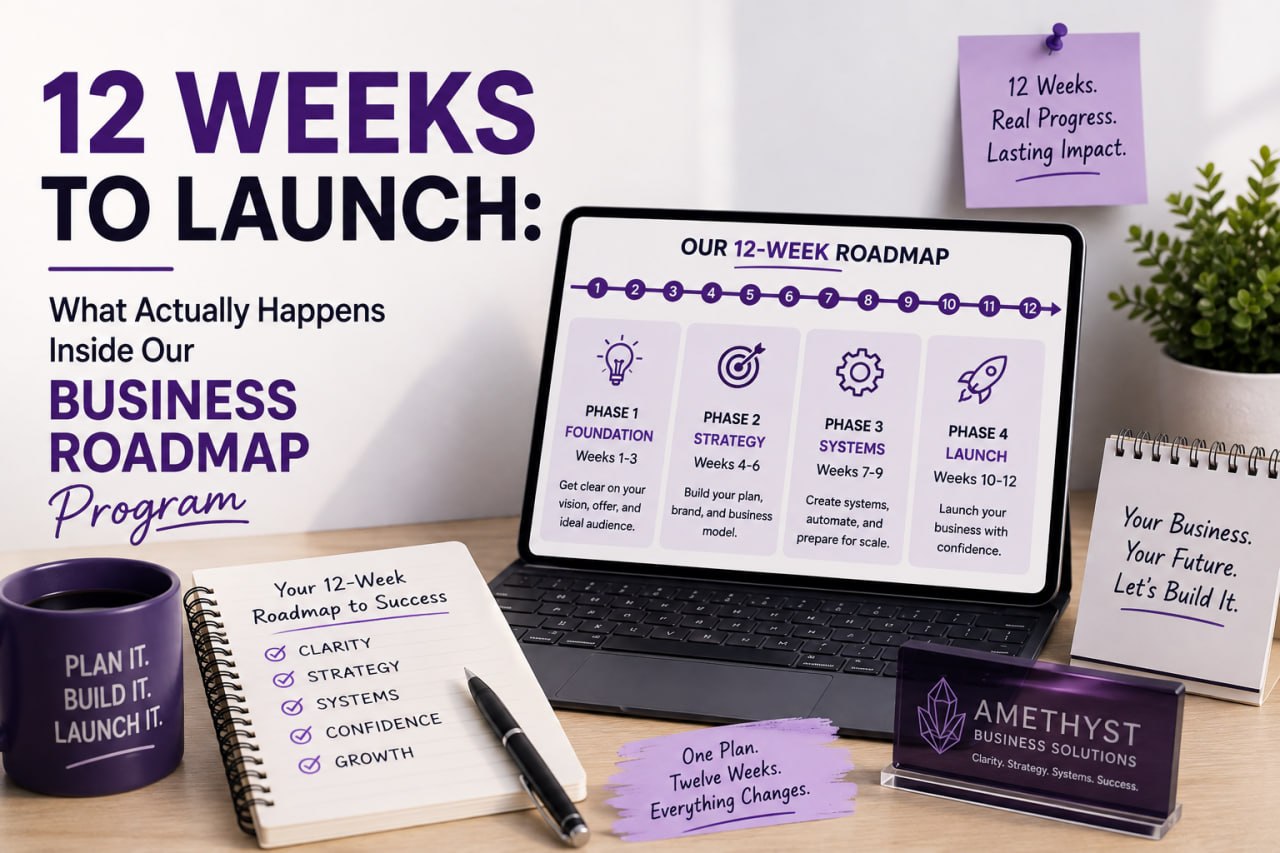
    12 Weeks to Launch: What Actually Happens Inside Our Business Roadmap Program

    “What does business coaching actually involve?”

    It’s one of the most common questions we get at Amethyst Business Solutions and a fair one. Before committing your time and trust to a program, you deserve to know exactly what happens inside it.

    So here it is: a full, honest breakdown of our 12-week business launch roadmap, step by step.

    Why 12 Weeks?

    Three months is long enough to build real business foundations, but short enough to keep momentum. Instead of a vague, open-ended “figure it out eventually” approach, our business roadmap program gives you a defined runway from idea to launch with a clear plan.

    Here’s how the 12 weeks break down.

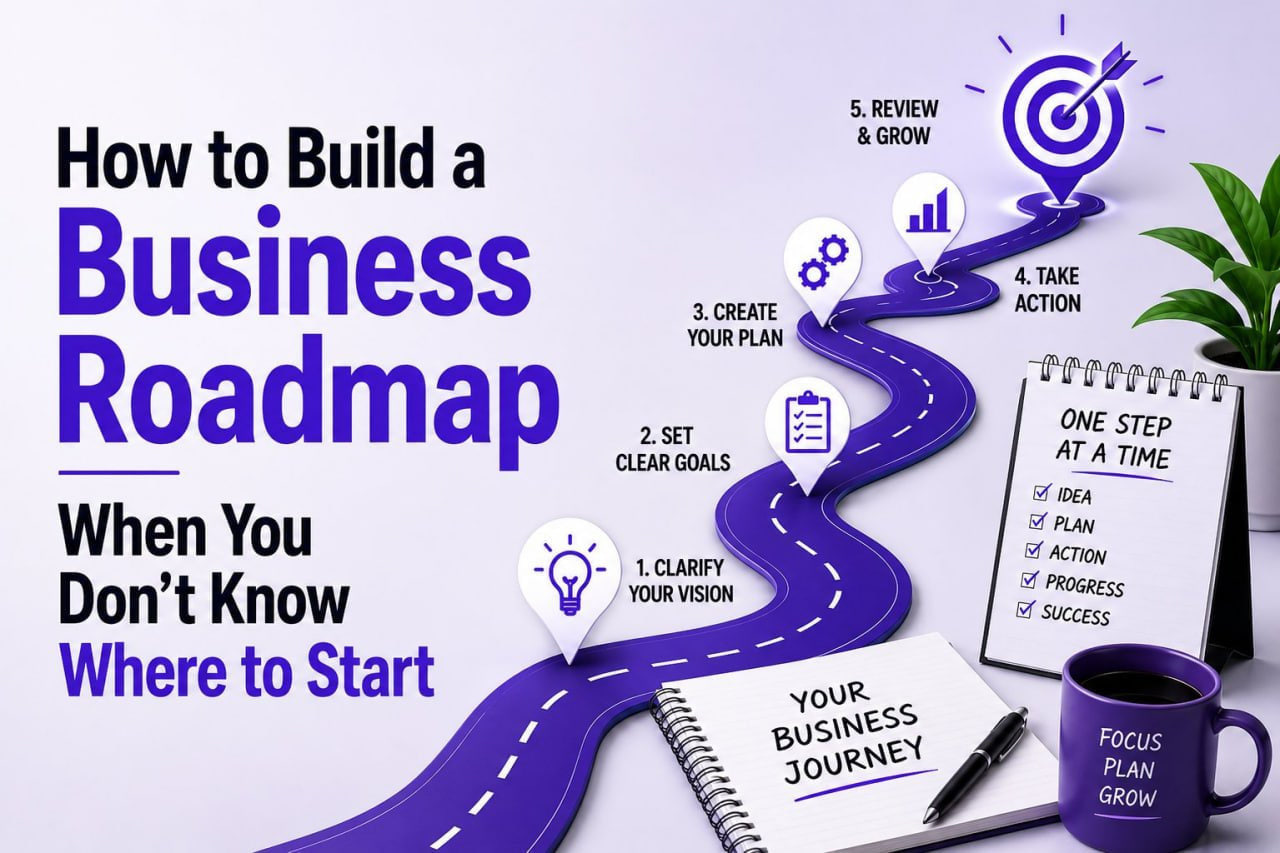
    Step 1: Deciding on the Destination

    Before any strategy or planning begins, we get clear on where you’re actually headed. This phase focuses on:

    • Defining your ultimate business goal
    • Getting clear on who you need to become to achieve it
    • Envisioning the lifestyle you’re building toward

    This isn’t a fluffy exercise it’s the foundation everything else is built on. Without a clear destination, no roadmap can guide you there.

    Step 2: Drawing Your Personalized MAP

    Next, we build your personalized business plan what we call your MAP. This is where we identify:

    • A profitable product or service
    • Your ideal market and niche
    • Your business model and overall plan

    This step alone is where many first-time entrepreneurs get stuck when going it alone. At Amethyst Business Solutions, we work through it with you, so your plan is grounded in what actually fits your skills and market not a generic template.

    Step 3: Planning the Route

    With your MAP in place, we move into strategy: branding, sales, pricing, and marketing. This is where your business starts to take real shape how it looks, how it’s priced, and how it will be sold.

    As Brian Tracy said, “A goal without a plan is just a dream.” This phase turns your goal into an actionable plan.

    Step 4: Hitting the Road

    Now it’s time to build. This phase covers:

    • Establishing your business foundations
    • Building your online presence
    • Solving technical setup issues
    • Building trust with your future clients and community
    • Setting up day-to-day management systems

    This is often the most hands-on phase of the 12-week business launch, and it’s where your business starts to feel real.

    Step 5: Arriving at the Destination

    In the final stretch, we focus on:

    • Acquiring your first clients
    • Hiring your first helpers, if needed
    • Understanding your finances
    • Mastering cash flow
    • Making confident, informed business decisions

    By the end of week 12, you’re not just holding a business plan you’re running an active business with real foundations in place.

    What Makes This Step-by-Step Business Coaching Different

    A lot of business courses hand you a library of videos and leave you to piece it together. Our program is different because it’s built around you specifically. Every step is guided, personalized, and designed for advisors, consultants, and service providers who want to turn their expertise into income without wasting months on the wrong strategy.

    Is the Business Roadmap Program Right for You?

    This program is a strong fit if you:

    • Are transitioning from employment into entrepreneurship
    • Have expertise you want to turn into a business
    • Want a structured plan instead of piecing together free advice
    • Are ready to take action, even if you don’t feel 100% ready yet

    If that sounds like you, the next step is simple.

    Ready to see your own 12-week roadmap? Book your free 30-minute consultation with Amethyst Business Solutions and let’s map out your path to launch.

  • Your Expertise Has Value: How to Position Yourself as the Go-To Expert

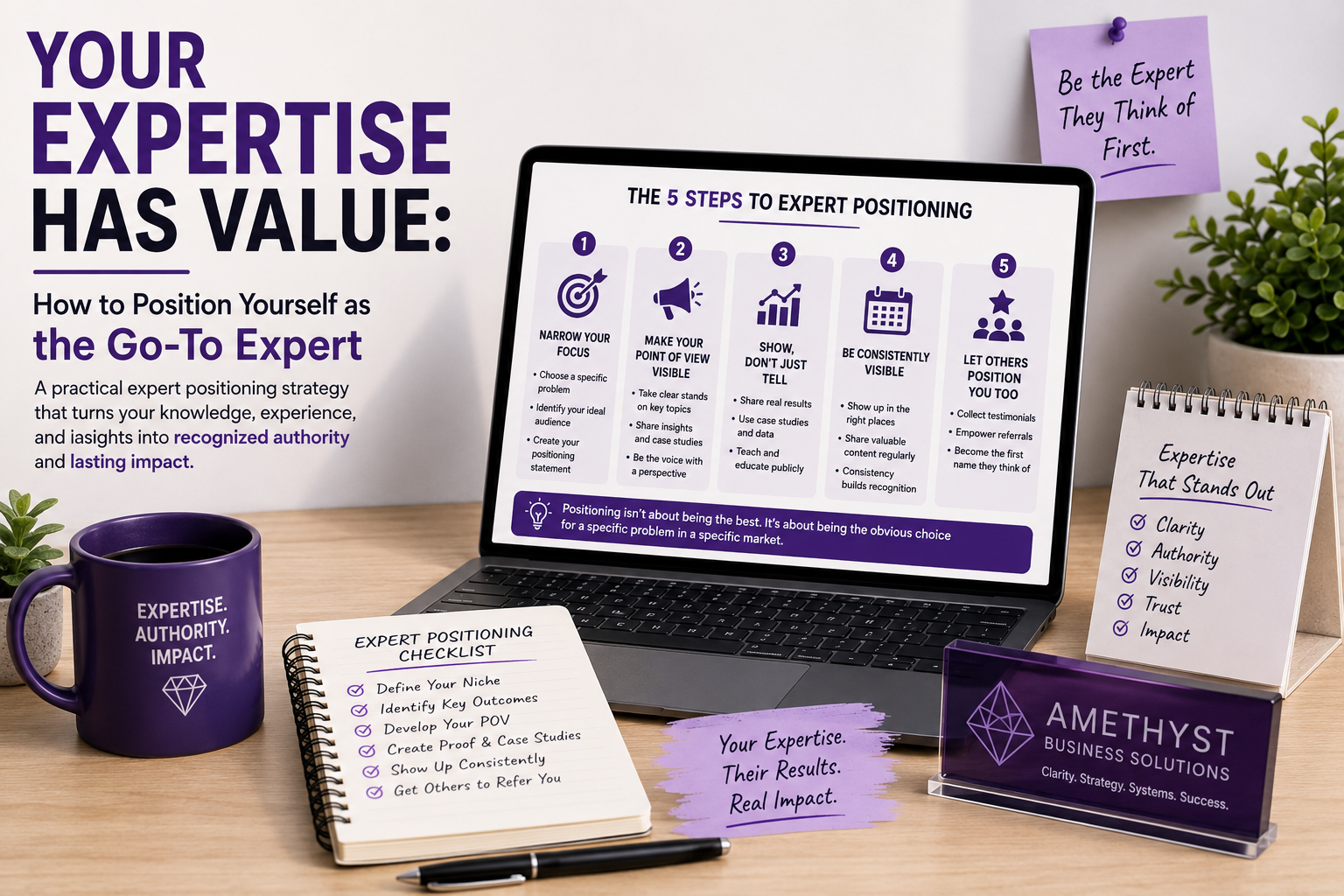
    Your Expertise Has Value: How to Position Yourself as the Go-To Expert

    To position yourself as an expert, narrow your focus to a specific problem and audience, make your point of view visible and consistent, and back it up with proof results, case studies, or public commentary on your topic. Expert positioning isn’t about credentials alone; it’s about being the name that comes to mind when someone has a specific problem, because you’ve consistently shown up as the person who solves it.

    Expertise doesn’t sell itself. Plenty of highly skilled professionals stay invisible in their market simply because they never translated deep knowledge into a recognizable position. Meanwhile, people with comparatively less experience often win more business, more speaking opportunities, and more press — because they’ve deliberately built authority around what they know.

    This guide breaks down a practical expert positioning strategy you can apply regardless of your industry or how long you’ve been in business.

    Why Being Good Isn’t Enough

    Competence is table stakes. Most people in any given field are competent. What separates the go-to expert from everyone else isn’t necessarily more skill it’s more visibility and clarity around that skill. This is the foundation of authority building for entrepreneurs: the market can’t value expertise it doesn’t know exists.

    Positioning solves this by making your expertise legible easy to recognize, describe, and refer to others instead of something buried in your resume or your head.

    Step 1: Narrow Before You Broadcast

    The biggest positioning mistake is trying to be known for too much. “I help businesses grow” doesn’t position you as an expert in anything specific. “I help SaaS companies fix churn in the first 90 days” does.

    To narrow effectively:

    • Identify the specific outcome you’re best known for delivering
    • Identify the specific type of client or industry where you’ve seen this work repeatedly
    • Combine the two into a single, sayable sentence

    This sentence becomes the anchor for everything else in your expert positioning strategy your content, your bio, your conversations at events, all of it.

    Step 2: Make Your Point of View Visible

    Experts aren’t just knowledgeable they have opinions. A go-to expert is someone who will say “most people get this wrong, and here’s why,” not just “it depends.”

    Ways to make your point of view visible:

    • Publish content that takes a clear stance on a debate in your field
    • Share case studies with specific numbers and specific decisions, not vague summaries
    • Comment publicly on industry trends, news, or common misconceptions

    This is where authority building for entrepreneurs actually compounds. A generic “helpful tips” post gets scrolled past. A confident, specific point of view gets remembered, shared, and referred to others.

    Step 3: Show, Don’t Just Tell

    Claiming expertise is easy. Demonstrating it is what actually builds trust. Ways to show your expertise instead of just stating it:

    • Case studies — specific problems, specific approaches, specific results
    • Original data or observations — patterns you’ve noticed that others haven’t articulated
    • Teaching publicly — writing, speaking, or answering questions in places your audience already spends time

    People trust demonstrated expertise far more than described expertise. A single detailed case study often does more for positioning than a dozen general claims about experience.

    Step 4: Be Consistently Visible in the Right Places

    Positioning isn’t a one-time announcement it’s a pattern the market recognizes over time. Pick a small number of channels where your ideal clients or referral sources already pay attention, and show up there consistently:

    • LinkedIn or industry-specific communities for B2B expertise
    • Guest appearances on podcasts or panels relevant to your niche
    • A regular newsletter or blog focused specifically on your area of authority

    Consistency matters more than volume. Being visible in one or two places regularly builds more recognition than posting everywhere sporadically.

    Step 5: Let Others Position You Too

    The strongest form of positioning isn’t self-description it’s what other people say about you. Encourage this by:

    • Asking satisfied clients for specific, detailed testimonials, not just star ratings
    • Making it easy for referral partners to describe exactly who you help and how
    • Being the person colleagues think of first when a specific problem comes up in conversation

    When your positioning statement starts showing up in other people’s words, not just your own, it has genuinely taken hold.

    Where Structured Support Helps

    Positioning is one of those things that’s genuinely difficult to see clearly from the inside — most experts underestimate how valuable their specific knowledge is, or struggle to narrow it into something sayable. Amethyst Business Solutions works with professionals and entrepreneurs to build clear, differentiated positioning strategies, so expertise translates into visible authority rather than staying invisible in the market.

    Common Mistakes That Undermine Expert Positioning

    • Staying too broad to avoid “limiting” opportunities, which limits recognition instead
    • Playing it safe with vague, hedge-everything content that never states a real point of view
    • Inconsistent visibility — showing up occasionally instead of building a recognizable pattern
    • Relying only on credentials, without demonstrated proof through case studies or results

    Frequently Asked Questions

    How long does it take to position yourself as an expert in a field? Meaningful positioning often takes 6–12 months of consistent, focused visibility, though initial traction can appear much sooner if the niche is well-defined and the content demonstrates real expertise rather than general commentary.

    Do I need a large following to be seen as a go-to expert? No. Authority building for entrepreneurs is often more about depth and specificity within a niche audience than follower count. A smaller, highly targeted audience that consistently sees clear, differentiated expertise can be more valuable than broad but shallow visibility.

    What’s the difference between expert positioning and personal branding? Personal branding is broader and can include tone, visual identity, and general reputation. Expert positioning strategy specifically focuses on being recognized for solving a defined problem for a defined audience it’s a subset of personal branding focused entirely on authority and trust.

    Final Thought

    Your expertise already has value positioning is simply what makes that value visible to the people who’d pay for it. By narrowing your focus, making your point of view clear, demonstrating results, and showing up consistently, you build an expert positioning strategy that turns deep knowledge into recognized authority.

    If you want help clarifying your positioning and building visibility around it, Amethyst Business Solutions works with entrepreneurs and professionals to turn expertise into a recognizable market position.

  • How to Move From “I Have an Idea” to a Business People Will Pay For

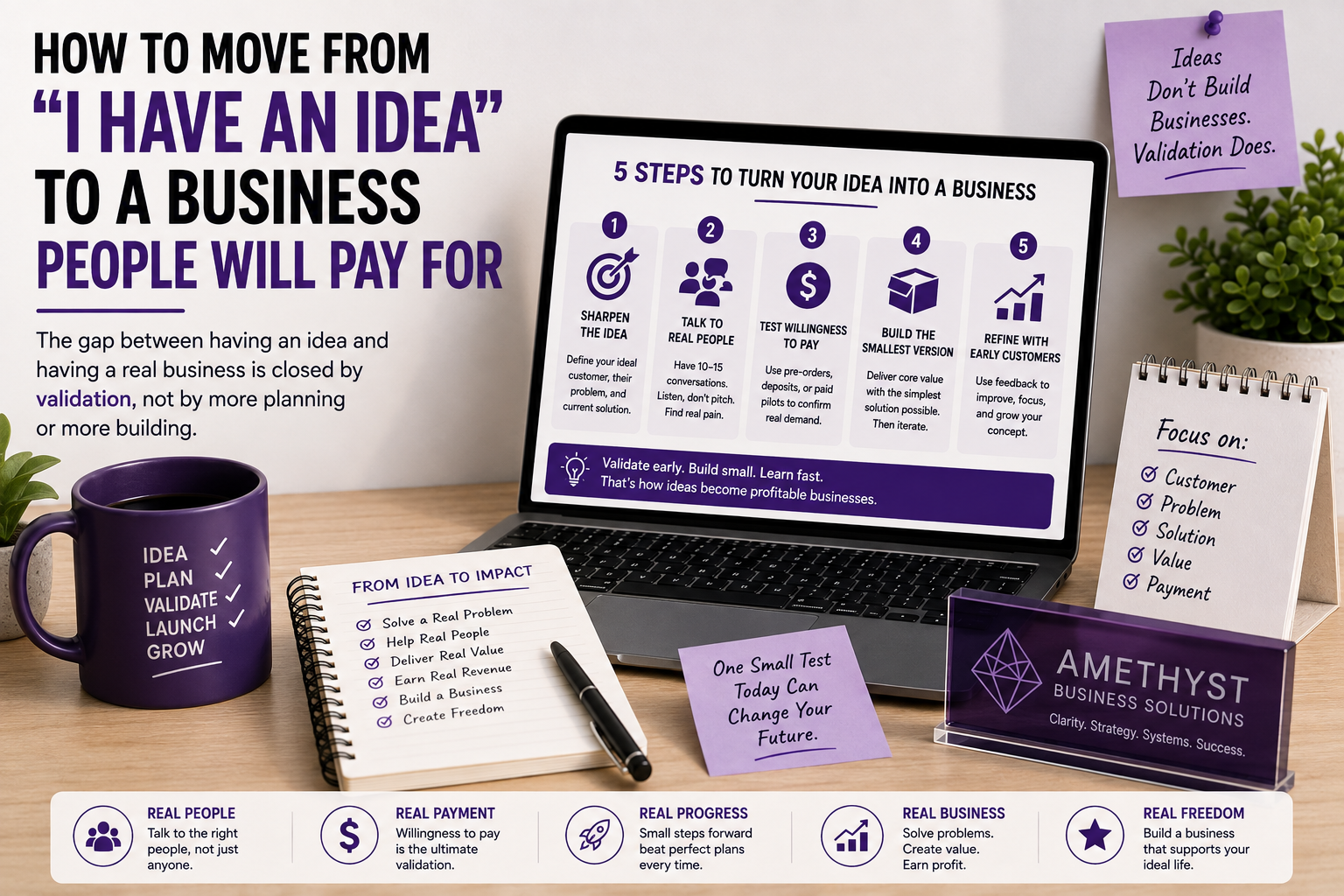
    How to Move From “I Have an Idea” to a Business People Will Pay For

    To turn a business idea into reality, move through three stages: sharpen the idea into a specific offer for a specific customer, validate it with real conversations and small paid tests, and only then build out the full product or service. The gap between “having an idea” and having a real business is almost always closed by validation, not by more planning or more building.

    Almost everyone has had a business idea. Very few people turn that idea into an actual business. The difference usually isn’t talent, luck, or even the quality of the idea itself — it’s whether the idea gets tested against real customers before serious time and money go into building it.

    This guide lays out the practical steps to validate a business idea and move it toward becoming a profitable business concept, rather than staying a permanent “someday” project.

    Why Most Ideas Never Become Businesses

    Ideas stay ideas for a predictable set of reasons:

    • The idea stays vague (“something in wellness,” “an app for X”) instead of becoming a specific offer
    • There’s no real customer feedback, just internal conviction that it’s a good idea
    • Building starts before validating, so months go into something nobody asked for
    • There’s no clear first step, so momentum never actually starts

    Closing each of these gaps is what actually moves you from “I have an idea” to a working business.

    Step 1: Sharpen the Idea Into a Specific Offer

    A vague idea can’t be tested. Before anything else, narrow it down to specifics:

    • Who exactly is this for? (Not “everyone,” a specific type of person or business)
    • What exact problem does it solve for them?
    • How would they currently solve this problem without you?

    The sharper this is, the easier it becomes to test. “A meal planning app” is vague. “A meal planning tool for busy parents managing multiple kids’ allergies” is testable.

    Step 2: Talk to Real People Before Building Anything

    This is the single most important step to validate a business idea, and the one most often skipped. Talk to 10–15 people who match your target customer. The goal isn’t to pitch your idea — it’s to understand their current reality:

    • What do they currently do to solve this problem?
    • What frustrates them about their current solution?
    • What would it be worth to them to solve it better?

    Listen for unprompted pain points and specific frustrations. If people struggle to describe a real problem in this area, the idea may need to shift toward something with more genuine urgency behind it.

    Step 3: Test Willingness to Pay, Not Just Interest

    Polite enthusiasm is common and mostly meaningless. Real validation comes from testing whether people will actually commit money, even in a small way:

    • Offer a pre-order or deposit for early access
    • Run a small paid pilot version of the service
    • Ask directly what they’d expect to pay, and gauge the reaction

    A profitable business concept isn’t defined by how much people like the idea — it’s defined by whether they’ll pay for it before it’s even fully built.

    Step 4: Build the Smallest Version That Delivers Real Value

    Once there’s evidence of demand, resist the urge to build the full, polished version right away. Instead, build the smallest version that still delivers genuine value to a real customer:

    • A limited service offer instead of a full productized system
    • A manual process instead of custom software, at first
    • A single, well-executed use case instead of every planned feature

    This smaller version lets you turn business idea into reality faster, with less capital at risk, while still gathering real feedback from paying customers.

    Step 5: Use Early Customers to Refine the Concept

    Your first customers are not just revenue — they’re the most valuable feedback source you’ll ever have. Pay close attention to:

    • What they use most, and what they ignore
    • Where they get confused or frustrated
    • What they’d tell a friend about the value, in their own words

    This feedback loop is what turns an initial concept into a genuinely profitable business concept, refined by real use rather than assumptions made in isolation.

    Common Mistakes When Turning an Idea Into a Business

    • Staying in planning mode indefinitely, mistaking research for progress
    • Building the full version first, before any real customer feedback
    • Confusing interest with commitment, and skipping the willingness-to-pay test
    • Ignoring early customer feedback because it doesn’t match the original vision

    Where Outside Perspective Helps

    Founders are often too close to their own idea to evaluate it objectively — that’s simply human nature when you’re personally invested. An outside perspective can spot gaps in the plan, challenge weak assumptions, and help structure a validation process that produces real evidence. Amethyst Business Solutions works with early-stage founders to pressure-test ideas and build a clear path from concept to a genuinely profitable business.

    Frequently Asked Questions

    How do I validate a business idea without spending a lot of money? Most validation can be done cheaply through direct customer conversations, small paid pilots, or pre-orders, rather than building a full product. The goal at this stage is gathering evidence of demand, not creating a polished final version.

    How long does it typically take to turn a business idea into reality? Timelines vary, but many ideas can move from concept to a validated, small-scale version within a few months of focused effort, particularly for service-based businesses. Product-based businesses with manufacturing or development requirements often take longer.

    What makes a business concept “profitable” versus just interesting? A profitable business concept has confirmed willingness to pay from real customers, not just expressed interest. Interesting ideas generate enthusiasm; profitable ones generate actual transactions, even at a small scale.

    Final Thought

    The distance between “I have an idea” and “I have a business” is almost always closed by validation, not by more planning. By sharpening your idea into a specific offer, testing it with real conversations and real payment, and building only the smallest version needed to deliver value, you can turn a business idea into reality with far less risk than most people assume.

    If you’re ready to pressure-test your idea and build a clear validation plan, Amethyst Business Solutions helps founders move from concept to a confirmed, profitable business concept.

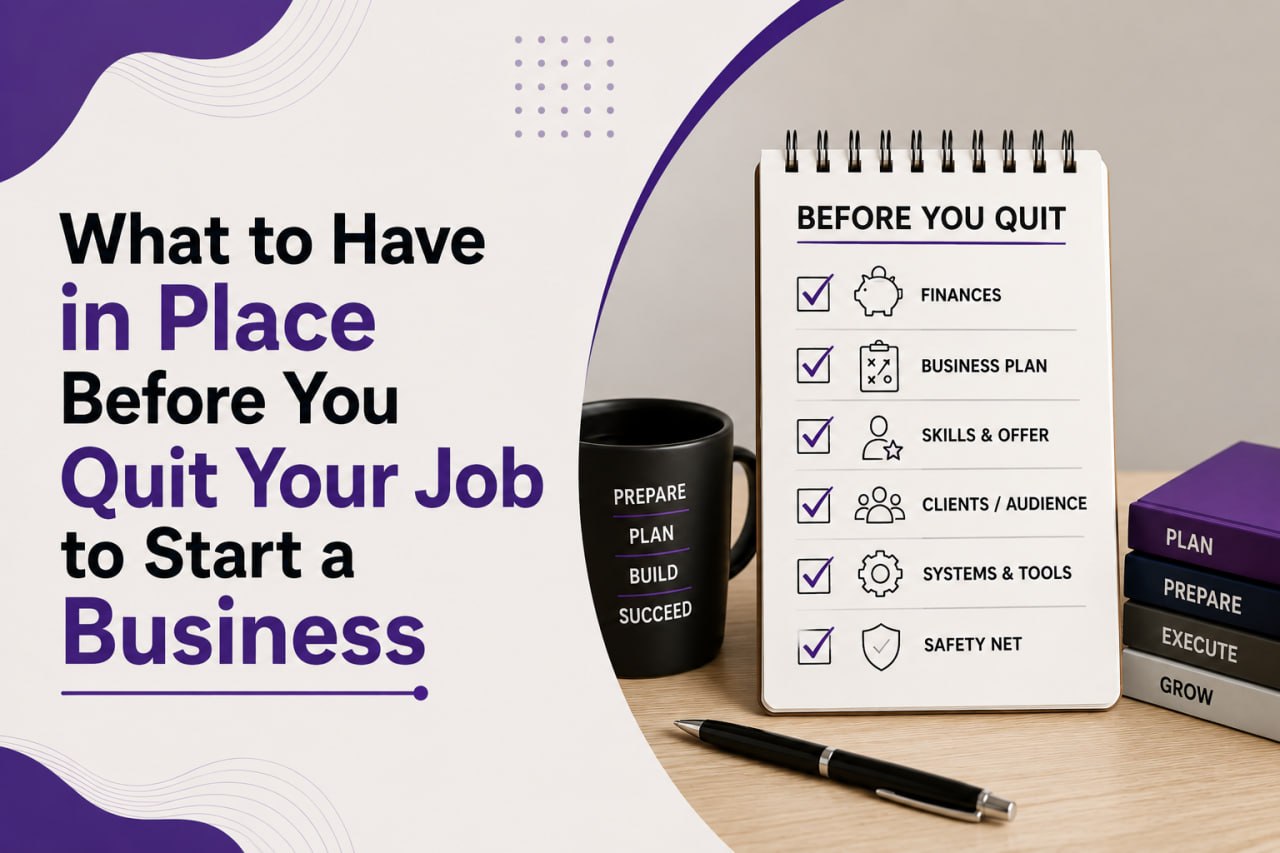
  • Build Before You Quit: A Smarter Approach to Starting Your Own Business

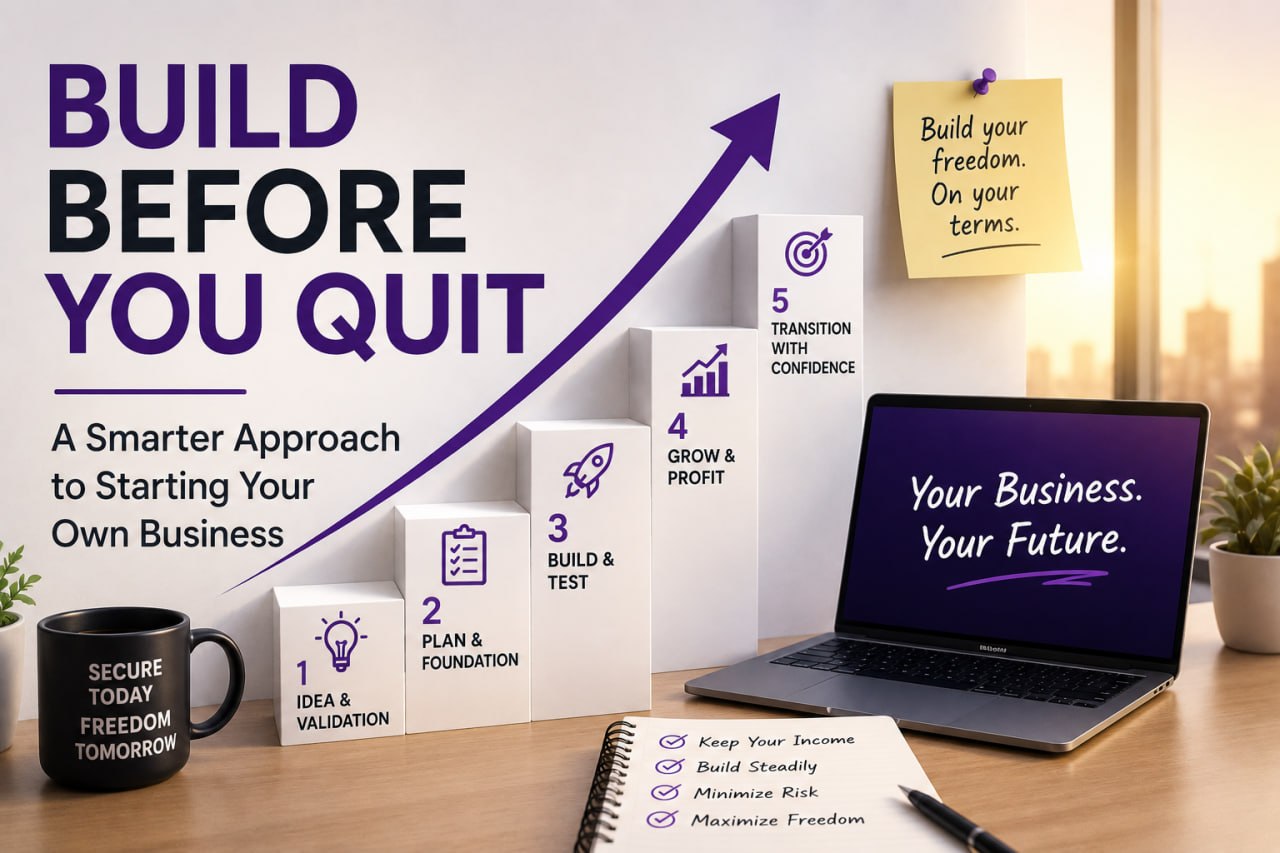
    Build Before You Quit: A Smarter Approach to Starting Your Own Business

    Quick answer: The smartest way to build a business before quitting your job is to treat the transition as a series of phases, not a single leap: validate the idea, build proof of demand on the side, hit specific financial and client milestones, then exit on your own terms. A clear entrepreneurship transition plan replaces guesswork with defined checkpoints, so the decision to leave is based on evidence, not just frustration or hope.

    Quitting a stable job to start a business is often framed as a single dramatic decision. In reality, the entrepreneurs who transition most successfully treat it as a phased process, with each phase reducing risk before the next one begins. This article breaks down that process into a practical business launch strategy you can start applying immediately, even while fully employed.

    Why a Phased Transition Beats a Single Leap

    Jumping straight from full-time employment to full-time entrepreneurship puts every kind of pressure on you at once: financial, emotional, and operational. A phased entrepreneurship transition plan spreads that pressure out, so you’re solving one problem at a time instead of all of them simultaneously, under a ticking clock.

    The goal isn’t to move slowly for its own sake. It’s to sequence the transition so that each step de-risks the next.

    Phase 1: Idea Validation (While Fully Employed)

    Before building anything, confirm the idea has real demand. This phase should cost time, not money:

    • Talk to 10–15 people who match your target customer
    • Identify the specific, recurring problem you’d solve
    • Listen for whether people describe this as something they’d pay to fix

    This phase can typically run alongside a full-time job with just a few hours a week, since it’s mostly conversations and research rather than building.

    Phase 2: Proof of Concept (Small, Paid, Real)

    Once the idea is validated, the next phase is proving people will actually pay for it, at a small scale. This might look like:

    • Taking on one or two paying clients or customers on the side
    • Running a small paid pilot of your product or service
    • Delivering real work, even if the systems around it are still informal

    This is the core of any credible business launch strategy — proof beats projection. A single paying client, delivered well, tells you more than any business plan spreadsheet.

    Phase 3: Financial and Operational Readiness

    With proof of concept established, shift focus to building the runway and structure needed to leave sustainably:

    • Savings runway — commonly 3–6 months of expenses, depending on your risk tolerance and industry
    • Legal and financial setup — business entity, separate banking, basic bookkeeping
    • A repeatable client acquisition method — not just one-off wins, but a process you can rely on

    This is where many people underestimate the time required. Structuring finances and legal foundations correctly the first time saves months of rework later, which is exactly why professionals like Amethyst Business Solutions work with soon-to-be founders during this exact phase, before they leave their job.

    Phase 4: Defining the Exit Trigger

    Rather than picking an arbitrary date, define a specific, measurable trigger for when you’ll leave. Common approaches include:

    • Revenue threshold — side income reaches a set percentage of your salary for two to three consecutive months
    • Client pipeline threshold — a defined number of committed clients or contracts secured
    • Runway plus momentum — savings goal reached, combined with consistent month-over-month traction

    Writing this down in advance, before emotions are running high, leads to far more rational decisions than deciding reactively in a moment of job frustration or burnout.

    Phase 5: The Exit and Early Full-Time Operation

    Once your trigger is hit, the transition itself should feel anticlimactic rather than dramatic — because the hard evidence-gathering work already happened in the phases before it. At this stage, focus shifts to:

    • Formalizing the business structure fully, if not already done
    • Scaling client acquisition beyond your original network
    • Building the systems needed to operate without a safety net

    Common Mistakes in the Transition Process

    • Skipping validation and jumping straight to building
    • No defined exit trigger, leading to either premature or indefinitely delayed departures
    • Underestimating runway needs, creating financial pressure that forces bad early decisions
    • Ignoring employment contract terms — always check for non-compete or moonlighting clauses before starting side work

    Frequently Asked Questions

    How long should an entrepreneurship transition plan take? Most phased transitions take anywhere from 6 to 18 months, depending on savings, the complexity of the business idea, and how much time can be dedicated outside of full-time employment. Service-based businesses tend to move faster than product-based ones.

    Is it risky to build a business while still employed? It carries some risk if not managed carefully, particularly around employment contract terms like non-compete or conflict-of-interest clauses. Reviewing your contract and being transparent about boundaries (time, resources, and client overlap) significantly reduces that risk.

    What’s the biggest difference between a business launch strategy and just quitting to “figure it out”? A defined business launch strategy replaces uncertainty with checkpoints: validated demand, proof of concept, financial runway, and a measurable exit trigger. Quitting without this structure often means making high-stakes decisions reactively, under financial pressure, rather than proactively.

    Final Thought

    You don’t have to choose between stability and starting a business. A phased entrepreneurship transition plan lets you build a business before quitting your job, using each phase to reduce risk before the next begins, so that by the time you leave, you’re scaling something proven rather than hoping something works.

    For structured support through each phase of this transition, Amethyst Business Solutions works with professionals building businesses on the side, from early validation through full-time launch.

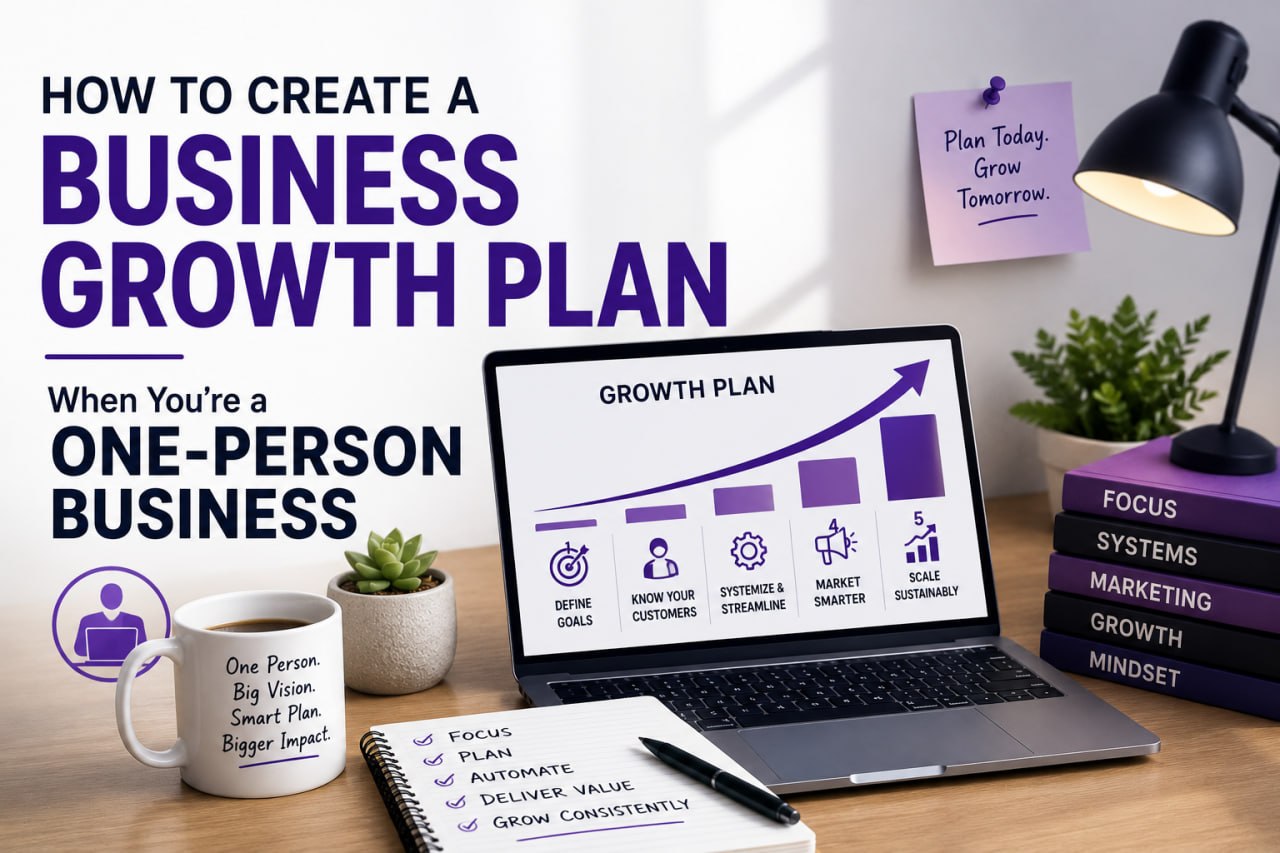
  • How to Create a Business Growth Plan When You’re a One-Person Business

    How to Create a Business Growth Plan When You’re a One-Person Business

    Quick answer: A business growth plan for a solo founder should focus on three levers: increasing what you charge, increasing what you deliver without increasing your hours, and deciding deliberately whether to stay solo or bring on support. Unlike a traditional growth plan built around headcount, a solid solopreneur growth strategy prioritizes leverage systems, pricing, and focus over simply doing more.

    Most growth plans are written for companies with teams, budgets, and departments. If you’re running a one-person business, that kind of plan doesn’t just fail to apply it can actively lead you toward burnout, chasing growth tactics designed for a completely different kind of business.

    This guide lays out a business growth plan built specifically for solo founders, where time is the scarcest resource and growth has to come from leverage, not headcount.

    Why Traditional Growth Plans Don’t Work for Solo Businesses

    Conventional growth strategy often assumes you can throw more people, more budget, or more hours at a problem. As a one-person business, none of those levers are freely available. Growth has to come from somewhere else:

    • Charging more for the same or similar work
    • Delivering more value per hour without working more hours
    • Choosing, deliberately, what NOT to do

    A real one person business growth plan is built around these constraints, not in spite of them.

    Lever 1: Pricing – The Fastest Path to Growth

    For most solo businesses, pricing is the highest-leverage growth lever available, because it doesn’t require more hours or more clients just better positioning of the value you already deliver.

    Questions to revisit regularly:

    • Are you pricing based on hours, or based on the outcome you deliver?
    • When was the last time you raised your rates?
    • Are your lowest-value clients taking up time that higher-value clients would pay more for?

    A solopreneur growth strategy that starts with pricing often produces faster, lower-risk growth than one that starts with finding more clients.

    Lever 2: Leverage – Doing More Without Doing More Hours

    Once pricing is optimized, the next lever is increasing what you can deliver without proportionally increasing your time. Common ways solo founders do this:

    • Productizing services — turning custom work into repeatable packages with defined scope
    • Systems and templates — reducing the time each new client or project takes to onboard and deliver
    • Selective automation — using tools for scheduling, invoicing, and follow-ups so admin time shrinks
    • Saying no strategically — turning down work that doesn’t fit your highest-value offer, even when it’s tempting

    This lever is where most sustainable growth in a one-person business actually comes from, since it increases capacity without increasing hours worked.

    Lever 3: The Decision to Stay Solo or Bring On Support

    At some point, most growing one-person businesses hit a ceiling where pricing and leverage alone aren’t enough. This is a deliberate decision point, not something that should happen by accident:

    • Stay solo — cap growth intentionally, optimize for income-per-hour and lifestyle over scale
    • Add contractors — bring in support for specific tasks (admin, delivery, marketing) without full-time hires
    • Build a small team — transition from doing the work to managing the business, if scale is genuinely the goal

    Neither path is inherently better. The mistake isn’t choosing to stay solo — it’s drifting into growth that requires a team without ever deciding that’s actually what you want.

    Building the Plan: A Practical Structure

    A workable business growth plan for a solo founder can be built around four simple sections:

    1. Current state — current pricing, capacity, and how your time is actually spent
    2. Growth lever priority — which of pricing, leverage, or support you’ll focus on first, and why
    3. Specific actions — the concrete changes you’ll make in the next 90 days (a new rate, a new template, a new tool)
    4. Review checkpoint — a set date to assess what worked and adjust

    Keeping the plan this simple matters. Solo founders don’t need a 20-page strategy document; they need a clear, current answer to “what am I actually doing next, and why.”

    Where Outside Support Helps Solo Founders Grow

    One of the ironies of running a one-person business is that growth decisions — pricing, structure, positioning — are often hardest to see clearly from inside the business. An outside perspective can identify leverage points a solo founder is too close to notice. Amethyst Business Solutions works with solo founders to build growth plans around real capacity and pricing data, rather than generic scaling advice built for larger companies.

    Common Mistakes Solo Founders Make With Growth

    • Chasing more clients before fixing pricing or capacity constraints
    • Underpricing indefinitely, treating rate increases as something for “later”
    • Building systems for a team they don’t have and may never need
    • Avoiding the solo-vs-team decision, drifting into overwhelm instead of choosing deliberately

    Frequently Asked Questions

    Can a one-person business actually keep growing without hiring? Yes. Many solo founders significantly grow revenue through pricing increases and leverage (systems, productized offers, selective automation) well before hiring becomes necessary. Hiring is one growth option, not a requirement.

    How often should a solopreneur revisit their business growth plan? A quarterly review works well for most solo founders — frequent enough to adjust based on real results, but not so frequent that it becomes a distraction from actually doing the work.

    What’s the first thing a solo founder should focus on for growth? For most solo businesses, pricing is the first lever worth examining, since it typically produces faster results with less added time or risk than finding new clients or building new systems.

    Final Thought

    Growing a one-person business doesn’t require becoming a bigger company by default. A focused business growth plan built around pricing, leverage, and a deliberate choice about team size lets solo founders grow sustainably, on their own terms, without the burnout that comes from chasing growth tactics built for a different kind of business.

    For a growth plan tailored to your specific capacity and business model, Amethyst Business Solutions helps solo founders identify the highest-leverage next steps for sustainable growth.

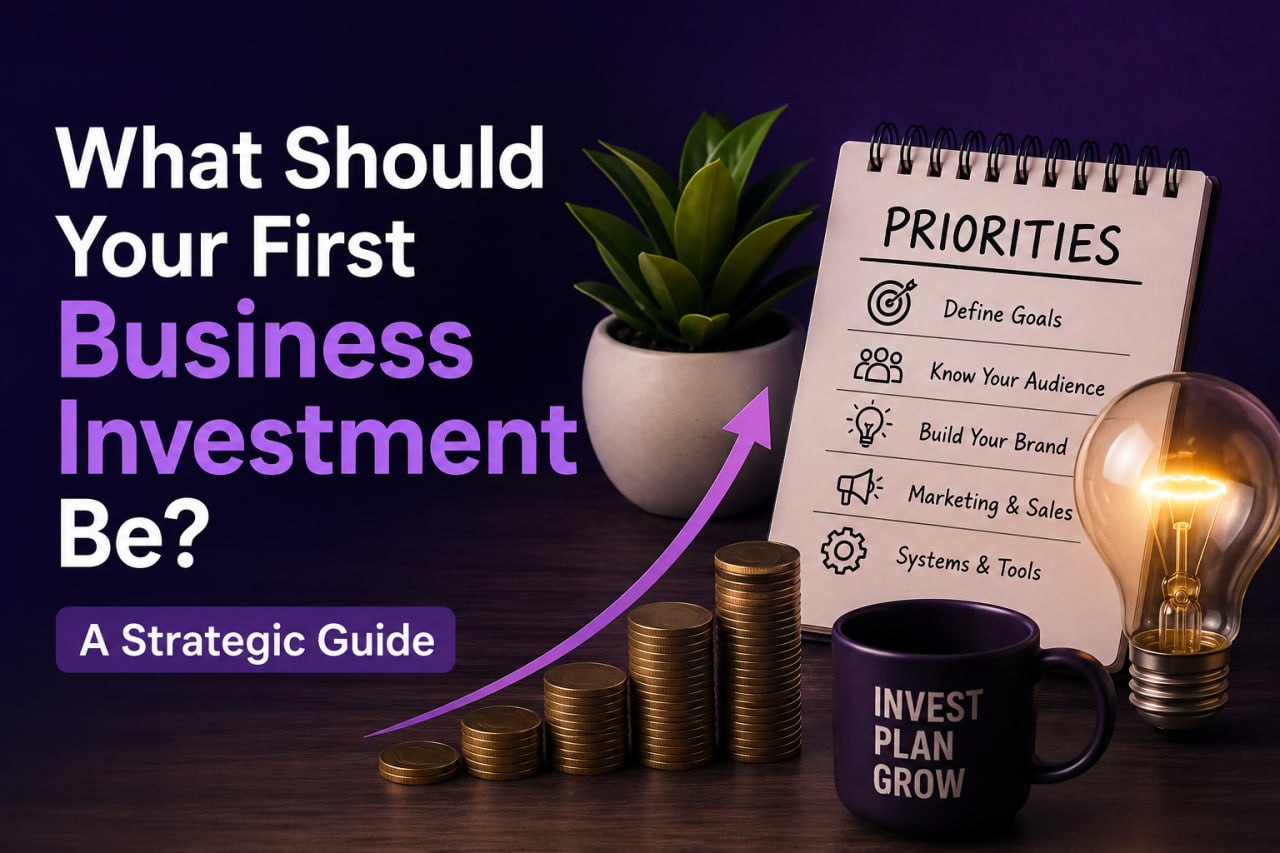
  • What Should Your First Business Investment Be? A Strategic Guide for New Entrepreneurs

    What Should Your First Business Investment Be? A Strategic Guide for New Entrepreneurs

    Quick answer: Your first business investment should go toward whatever directly gets you a paying client faster usually validation, a minimum viable offer, or basic legal/financial infrastructure not branding, a fancy website, or office space. The right investment strategy prioritizes revenue-generating activities first, and “nice to have” polish only after real client demand is proven.

    New entrepreneurs often ask the wrong first question. Instead of “what should I spend money on?” the better question is “what does this business need to prove before it deserves more investment?” Getting this sequence right is one of the biggest differentiators between businesses that gain traction quickly and those that burn cash before ever landing a client.

    This guide lays out a clear business investment strategy for deciding where your first dollars should go.

    Why the First Investment Matters So Much

    Early-stage capital, whether it’s $500 or $50,000, is the most valuable money your business will ever have — because it’s the money that has to prove the model works. Spend it in the wrong place, and you end up with a polished-looking business that still has no clients. Spend it well, and even a small budget can generate the evidence you need to justify further investment.

    This is the core idea behind smart startup business priorities: sequence spending around what reduces risk and generates revenue, not what looks impressive.

    Step 1: Separate “Must-Have” From “Feels Important”

    Most first-time entrepreneurs are tempted to invest first in the things that feel most like “having a real business”:

    • A custom logo and brand identity
    • A fully built website
    • Business cards, signage, office space
    • Paid ads before there’s even a defined offer

    These aren’t wrong investments they’re just premature ones. None of them are required to get your first paying client. What actually moves a business forward at the start is far more basic.

    Step 2: Prioritize Validation Before Anything Else

    Before spending on infrastructure, spend time and if necessary, a small amount of money confirming that people will actually pay for what you’re offering. This might mean:

    • Running a small paid pilot or beta offer
    • Talking directly to 10–15 potential customers
    • Testing a landing page with a simple offer, even before the product is fully built

    Validation is the highest-leverage first business investment because it prevents you from investing further in an idea the market doesn’t actually want.

    Step 3: Invest in the Business Foundation Next

    Once there’s real signal that people will pay, the next tier of startup business priorities should be foundational, not cosmetic:

    1. Legal structure — forming the right entity for liability protection and tax treatment
    2. Business banking — separating personal and business finances early
    3. Contracts and agreements — protecting you and setting clear expectations with early clients
    4. Basic bookkeeping — so you understand cash flow from day one, not a year in

    This is where many entrepreneurs benefit from outside expertise rather than trial and error. Amethyst Business Solutions works with early-stage business owners to get this foundational layer right the first time, so early capital goes toward a structure that scales instead of one that needs to be redone later.

    Step 4: Only Then Invest in Growth and Brand

    Once you have a validated offer, a working foundation, and at least a few paying clients, it’s time to consider:

    • A professional brand identity and website
    • Paid marketing and lead generation
    • Tools and software that scale delivery
    • Hiring support to handle growing demand

    Investing here too early is common and it’s also one of the most reversible mistakes, since it primarily costs money rather than time or client trust. Investing here too late, on the other hand, can cap growth once demand is already proven. The key is sequencing: validate, then build the foundation, then scale the brand and marketing.

    A Simple Framework for Any First Business Investment Decision

    Before spending, ask three questions:

    • Does this get me closer to a paying client? If not, it can likely wait.
    • Does this protect the business or the client relationship? (Legal, financial, contracts) If yes, it’s foundational and worth prioritizing early.
    • Does this only make the business look more established? If yes, it belongs later in the sequence, once revenue justifies it.

    Common Mistakes New Entrepreneurs Make With Early Capital

    • Overspending on branding before the offer is validated
    • Buying software or tools for a scale the business hasn’t reached yet
    • Skipping legal and financial basics, creating risk that surfaces later
    • Treating every dollar as equally urgent, instead of sequencing by what reduces the most risk

    Frequently Asked Questions

    What is usually the best first business investment for a new entrepreneur? For most new businesses, the best first investment is validation confirming through direct customer conversations or a small pilot offer that people will actually pay for the product or service, before spending on branding, tools, or infrastructure.

    Should legal and financial setup happen before or after the first sale? Basic legal and financial setup, such as choosing a business entity and separating finances, is generally worth prioritizing early because it protects both the owner and the client, even at a small scale. It doesn’t need to be elaborate at first, just in place.

    How much money is actually needed for a first business investment? The amount varies widely by industry, but many service-based businesses can validate an idea and land a first client with a very small budget, sometimes under a few hundred dollars, since the earliest priority is proving demand rather than building infrastructure.

    Final Thought

    The right first business investment isn’t the one that makes your business look the most established it’s the one that proves your business actually works. By prioritizing validation, then foundational structure, then growth and branding, you build a business investment strategy that protects your capital and accelerates real traction.

    If you want guidance sequencing your early investments and setting up the right business foundation, Amethyst Business Solutions works with new entrepreneurs to prioritize spending where it matters most, at every stage of growth.

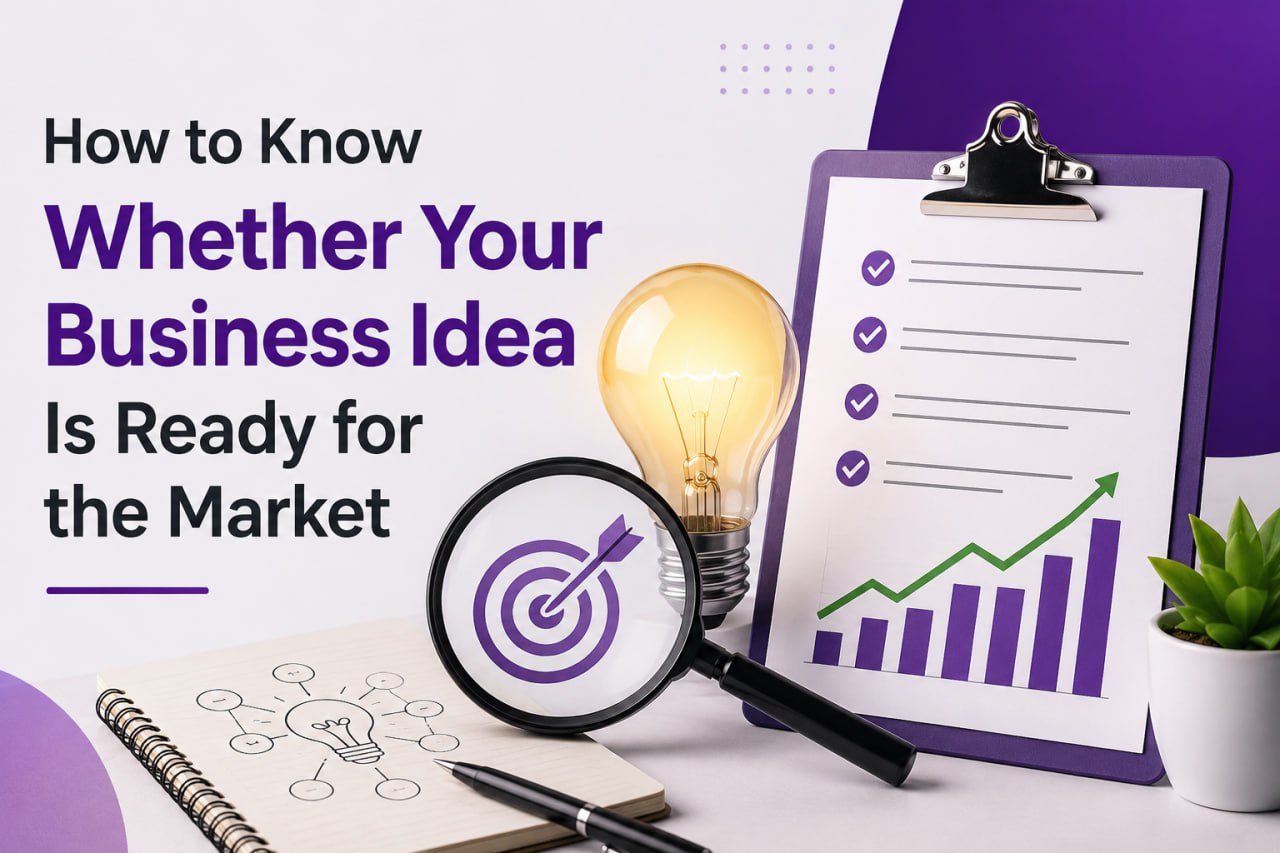
  • How to Know Whether Your Business Idea Is Ready for the Market

    How to Know Whether Your Business Idea Is Ready for the Market

    Quick answer: A business idea is ready for the market when you can point to real evidence not assumptions that a specific group of people has the problem, wants it solved, and will pay to solve it. A solid business idea assessment checks for a defined customer, a validated problem, willingness to pay, and a realistic path to reach that customer. If any of these are missing, the idea needs more validation before launch, not more building.

    Most business ideas don’t fail because the idea itself was bad. They fail because they launched before anyone confirmed the market actually wanted them. Knowing how to properly evaluate market readiness before investing serious time or money is one of the most valuable skills a new entrepreneur can develop.

    This guide walks through a practical business idea assessment framework you can apply to any concept, in any industry.

    Why Most Business Ideas Feel Ready Before They Actually Are

    Founders are naturally close to their own ideas. That closeness creates a common trap: mistaking personal conviction for market evidence. You might feel certain your idea solves a real problem, but feeling certain and having proof are two very different things.

    Business idea validation exists specifically to close that gap replacing internal confidence with external evidence before you commit real resources.

    The Four-Part Business Idea Assessment Framework

    A useful way to assess any business idea is to test it against four specific criteria. If any one of these is weak or unanswered, the idea isn’t market-ready yet.

    1. Is There a Clearly Defined Customer?

    “Everyone could use this” is a warning sign, not a strength. Market-ready ideas can name a specific type of customer: their industry, role, company size, or life stage. If you can’t describe your ideal customer in one or two sentences, the idea needs more focus before it can be properly tested.

    2. Is the Problem Real and Urgent?

    Not every inconvenience is worth solving commercially. Ask whether the problem is something people:

    • Actively complain about, unprompted
    • Have already tried (and paid) to solve in some way
    • Would prioritize fixing over other competing problems

    A problem that’s mildly annoying rarely gets budget. A problem that’s costly, painful, or urgent usually does.

    3. Will People Actually Pay to Solve It?

    This is where business idea validation becomes concrete. Interest is not the same as willingness to pay. Signs of real market readiness include:

    • Prospects asking how much it costs, unprompted
    • People willing to pre-order, put down a deposit, or commit to a pilot
    • Evidence that similar solutions already generate revenue in the market

    If people say “I love this idea” but hesitate the moment payment comes up, the idea likely needs refinement.

    4. Can You Actually Reach These Customers?

    A great solution to a real, painful problem can still fail if there’s no realistic way to reach the people who have it. Before launching, confirm:

    • Where your ideal customers already spend time or attention
    • Whether you have (or can build) access to that audience
    • Whether the cost of reaching them makes sense against what they’ll pay

    How to Actually Test Market Readiness

    Assessment shouldn’t happen only in your head. Here’s how to gather real evidence:

    1. Talk to 10–15 potential customers directly. Ask about their problems and current solutions, not your idea.
    2. Watch for unprompted pain points. If multiple people mention the same frustration without being asked, that’s a strong signal.
    3. Test willingness to pay. Offer a small paid pilot, a deposit, or a pre-sale before building the full solution.
    4. Look for existing competitors. Contrary to instinct, competition is often a good sign it means the problem is proven to have budget behind it.

    Signs Your Business Idea Is NOT Yet Market-Ready

    • You can’t clearly name who the customer is
    • Conversations are polite but vague no strong reactions either way
    • People are interested in concept but unwilling to pay or commit
    • You can’t identify a realistic way to reach your target customer
    • The idea depends heavily on behavior change that’s historically hard to achieve

    None of these mean the idea is dead. They mean it needs another round of refinement and testing before real investment.

    Where Professional Guidance Helps

    A structured business idea assessment can be difficult to do objectively on your own, since it’s natural to want validation for an idea you’re personally invested in. This is where outside perspective adds real value. Amethyst Business Solutions works with entrepreneurs to pressure-test business ideas against real market evidence, helping founders avoid the costly mistake of building before validating.

    Frequently Asked Questions

    What’s the difference between a business idea assessment and a business plan? A business idea assessment happens earlier and is narrower in scope it specifically tests whether the idea has real market demand. A business plan comes after, once the idea has been validated, and lays out how the business will operate, grow, and reach financial goals.

    How long does business idea validation usually take? For most ideas, a focused validation process of direct customer conversations and small market tests can be done in a few weeks. The timeline depends on how quickly you can reach real prospects in your target market, not how long you spend building.

    Can a business idea be market-ready without a finished product? Yes. Market readiness is about proven demand, not a finished product. Many ideas are validated through pilots, pre-sales, or paid trials of a minimum version, well before a fully built product or service exists.

    Final Thought

    A business idea assessment isn’t about second-guessing yourself endlessly it’s about replacing assumptions with evidence before you commit serious time and money. By testing for a defined customer, a real problem, genuine willingness to pay, and a realistic path to reach that customer, you can confidently determine market readiness before you launch.

    If you want an objective, structured evaluation of your business idea before you invest further, Amethyst Business Solutions helps entrepreneurs validate ideas against real market evidence, not assumptions.

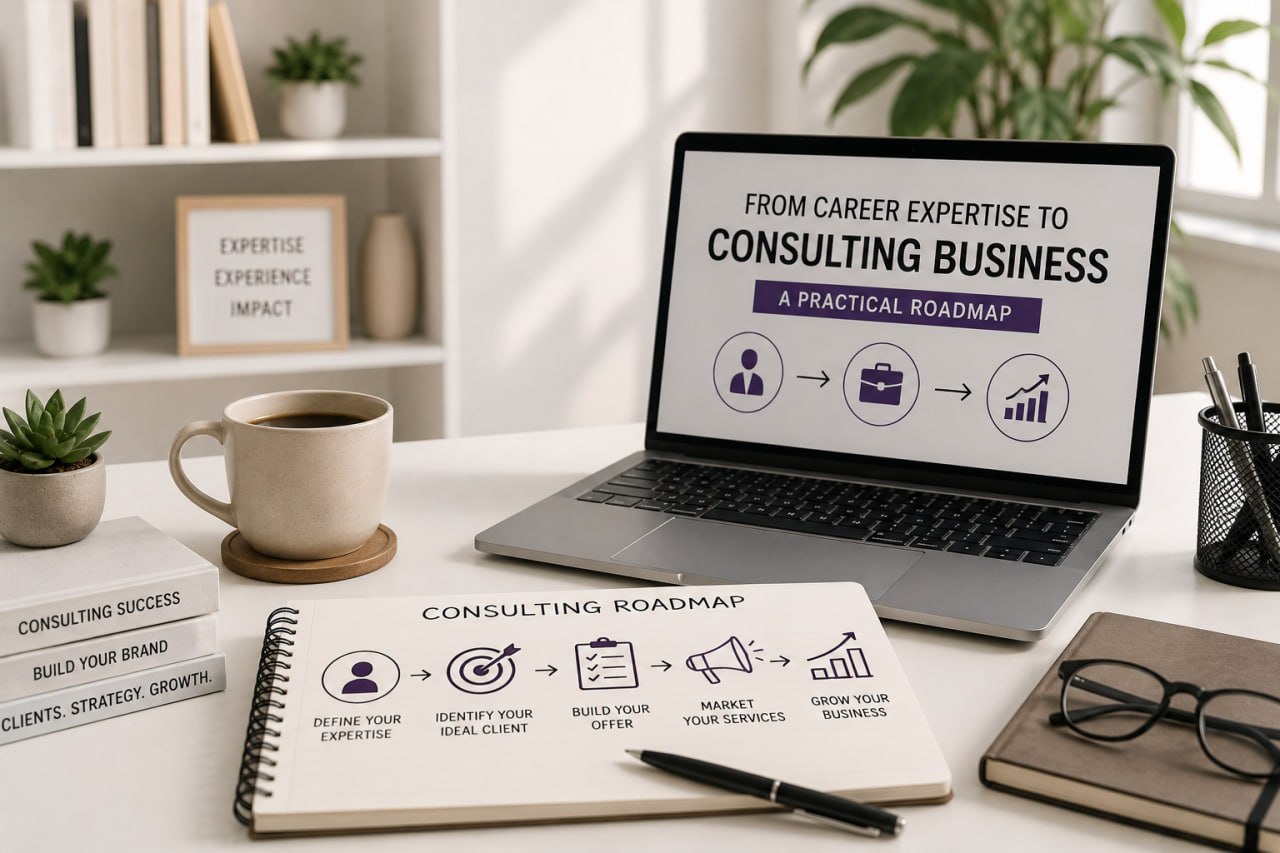
  • From Career Expertise to Consulting Business: A Practical Roadmap

    From Career Expertise to Consulting Business: A Practical Roadmap

    To start a consulting business from career expertise, you need to 

    (1) define a narrow niche around a problem you’ve solved repeatedly, 

    (2) validate demand with real prospects before quitting, 

    (3) build a simple legal, financial, and pricing foundation, and 

    (4) land your first paying clients through your existing network. 

    Most people can move from “expert employee” to “paid consultant” in 3–6 months with a focused plan rather than a vague one.

    If you’ve spent 10, 15, or 20 years building deep expertise in a field, you already have the hardest part of a consulting business figured out: the knowledge. What most professionals lack isn’t skill it’s a consulting business strategy for packaging that skill, pricing it, and selling it outside the walls of a single employer.

    This roadmap walks through exactly how to turn a career expertise business idea into a functioning, revenue-generating consultancy.

    Why Career Expertise Is the Best Starting Point for a Consulting Business

    Consulting businesses fail most often for one reason: the founder tries to be a generalist. When you start a consulting business built on years of career expertise, you avoid that trap entirely. You already know:

    • The specific problems your ideal clients face
    • The language they use to describe those problems
    • What “good” looks like when the problem is solved
    • Who else in the industry has budget to pay for solutions

    That’s a massive head start compared to someone building a consulting brand from scratch. The roadmap below simply structures that advantage into a repeatable business.

    Step 1: Turn Your Expertise Into a Sellable Niche

    A career and a consulting offer are not the same thing. A career is broad; a consulting offer needs to be narrow enough that a stranger can understand it in one sentence.

    Ask yourself:

    • What specific outcome did people repeatedly pay my employer for, because of me?
    • What’s the one problem I could solve in my sleep that others find genuinely hard?
    • Which part of my job would I happily do all day, for multiple clients, instead of one employer?

    The answer to these questions becomes your consulting business strategy foundation. For example, “20 years in HR” is a career. “I help mid-size manufacturing companies cut employee turnover by fixing broken onboarding” is a consulting offer.

    Step 2: Validate Before You Build Anything Formal

    Before spending money on a website, logo, or LLC, talk to 10–15 people in your target market. Not friends — actual potential buyers. Ask about their current challenges, what they’ve tried, and what they’d pay to fix it.

    This step separates people who successfully start a consulting business from people who spend a year building infrastructure nobody asked for. If prospects light up when you describe the problem, you have a business. If they shrug, refine the niche and try again.

    Step 3: Set Up the Business Foundation

    Once validated, put a lightweight structure in place:

    1. Legal entity — LLC or equivalent, depending on your location and risk exposure
    2. Business banking — separate from personal finances from day one
    3. Contracts and scope templates — protect both you and the client
    4. Pricing model — hourly, project-based, or retainer, matched to the value you deliver, not just the hours you spend

    This is also the stage where many career professionals bring in outside guidance. Firms like Amethyst Business Solutions specialize in helping subject-matter experts structure the business side — entity setup, pricing strategy, and go-to-market planning so the founder can focus on delivering expertise rather than untangling paperwork.

    Step 4: Build a Consulting Business Strategy, Not Just a Service List

    A list of services isn’t a strategy. A real consulting business strategy answers:

    • Who exactly you serve (industry, company size, role of the buyer)
    • What transformation you deliver, in outcome terms
    • How you’ll consistently find new clients (referrals, content, partnerships, outreach)
    • What the business looks like at 5, 10, and 20 clients does it stay solo, or grow into a team?

    Write this down. A one-page strategy document keeps you from chasing every opportunity that comes across your desk, which is one of the fastest ways new consultants burn out.

    Step 5: Land Your First Clients From Your Existing Network

    You do not need a large following to start a consulting business. Your first 3–5 clients almost always come from people who already know your work: former colleagues, managers, vendors, and industry contacts.

    A simple outreach approach works well:

    • Reach out personally, not with a mass email
    • Reference the specific problem you help solve
    • Offer a short, low-risk starting engagement (a paid audit or diagnostic) rather than asking for a large commitment upfront

    Once you’ve delivered strong results for those first clients, referrals and testimonials start doing the marketing for you.

    Common Mistakes When Moving From Employee to Consultant

    • Pricing too low out of fear, which attracts the wrong clients and caps your income
    • Staying too general because narrowing feels like leaving money on the table
    • Skipping validation and building a website before confirming anyone will pay
    • Ignoring the business fundamentals contracts, taxes, and cash flow until a problem forces attention

    Frequently Asked Questions

    How much career experience do I need to start a consulting business? There’s no fixed number of years. What matters is whether you’ve solved a specific problem repeatedly and can demonstrate measurable results. Some consultants launch successfully with 5 years of deep, focused experience; others wait until 15+ years even with broad backgrounds, because their expertise was never narrowed into a sellable offer.

    Do I need to quit my job before I start a consulting business? No. Many professionals validate demand and land early clients while still employed, then transition once income is steady. The key is checking your employment contract for non-compete or moonlighting restrictions first.

    What’s the difference between a career expertise business and freelancing? Freelancing typically means trading hours for tasks. A career expertise business is built around solving a defined problem for a defined client type, with pricing tied to outcomes — which allows it to scale beyond one person’s hours over time.

    Final Thought

    Turning career expertise into a consulting business isn’t about starting over — it’s about repackaging what you already know into something a market will pay for directly. With a validated niche, a clear consulting business strategy, and the right foundational support, the transition can happen faster than most professionals expect.

    If you want structured guidance through this process — from niche validation to business setup — Amethyst Business Solutions works specifically with professionals making this exact transition.

  • How to Build a Client-Ready Business Before You Leave Employment

    How to Build a Client-Ready Business Before You Leave Employment

    To build a business before quitting your job, focus on four things while still employed: validate demand with real prospects, set up minimal legal and financial infrastructure, land one or two paying clients on the side, and build a 3–6 month cash runway. This lets you make the employee to business owner transition based on evidence of demand, not just hope.

    The riskiest way to start a business is to quit first and figure it out second. The safer, more strategic path is to become “client-ready” while a paycheck is still coming in so that by the time you leave, you’re not starting from zero, you’re scaling something that already works.

    This is your pre launch business strategy for making that shift deliberately.

    Why Build Before You Quit

    Quitting first feels bold, but it front-loads all the risk: no income, no clients, no proof the idea works, and a ticking clock forcing decisions under pressure. Building first even slowly, in evenings and weekends lets you:

    • Test whether people will actually pay before you depend on it
    • Build a client base without desperation driving your pricing or decisions
    • Keep income stable while you learn what running a business actually requires
    • Leave on your own terms, with a plan, instead of reacting to burnout

    The goal isn’t to rush the employee to business owner transition. It’s to make it inevitable, because the evidence already supports it.

    Step 1: Get Honest About What “Client-Ready” Means

    Client-ready doesn’t mean a perfect website or a polished brand. It means you can say yes if a paying client showed up tomorrow. That requires:

    • A clear description of what you offer and who it’s for
    • A way to deliver the work (your time, tools, or process)
    • A way to get paid (invoicing, contracts, a business bank account)
    • A way for people to actually find and contact you

    Everything beyond that — logos, elaborate branding, a full suite of services — can wait. Overbuilding before you have a single client is one of the most common reasons people delay quitting for years without ever making progress.

    Step 2: Validate the Idea With Real Conversations

    Before committing serious time, talk to 10+ people who match your ideal client profile. Ask about their problems, not your idea. Listen for:

    • Problems they mention unprompted, multiple times
    • Evidence they’ve already tried (and paid for) other solutions
    • A visible reaction of relief when you describe how you’d help

    This step is the core of any solid pre launch business strategy — it replaces guessing with evidence before you invest more time or money.

    Step 3: Land Paying Clients While Still Employed

    This is the step most people skip, and it’s the one that matters most. Aim to land one or two paying clients — even small engagements — before you leave your job. This proves three things at once:

    • People will actually pay for what you offer
    • You can deliver it well, under real constraints
    • You can manage client work alongside existing responsibilities

    Be mindful of your current employment agreement. Check for non-compete clauses, conflict-of-interest policies, and moonlighting restrictions before taking on any side client work, especially if it overlaps with your employer’s industry.

    Step 4: Set Up Just Enough Business Infrastructure

    You don’t need a fully built-out company to serve early clients well, but a few basics protect you and make the business feel real:

    • A registered business entity appropriate to your situation
    • A separate business bank account
    • A simple contract or service agreement template
    • Basic bookkeeping, even a simple spreadsheet, from the first dollar earned

    Many people in the employee to business owner transition find this administrative layer to be the biggest time sink, since it’s unfamiliar territory outside their core expertise. This is exactly the kind of setup work that Amethyst Business Solutions helps professionals move through efficiently, so early energy goes toward serving clients rather than researching business logistics.

    Step 5: Build Your Runway and Set a Real Exit Trigger

    Rather than picking an arbitrary quit date, define a measurable trigger tied to the business itself. Common approaches:

    • Income replacement threshold — leave once side income reaches a set percentage of your salary for two or three consecutive months
    • Client pipeline threshold — leave once you have a set number of committed clients or contracts lined up
    • Runway-based — save 3–6 months of expenses, then leave once that cushion plus early revenue covers your needs

    Whichever trigger you choose, write it down in advance. Deciding the exit criteria before emotions are running high leads to far better decisions than deciding in the moment.

    Common Mistakes to Avoid

    • Waiting for “ready” instead of a defined trigger — this can stretch on indefinitely
    • Skipping client validation and building services no one asked for
    • Ignoring employment contract terms, risking legal or professional fallout
    • Underpricing early work just to get any client, which sets a hard-to-break pattern
    • No runway, forcing a rushed, financially stressful exit

    Frequently Asked Questions

    How long does it typically take to build a business before quitting? Timelines vary widely, but many people spend 3–12 months validating an idea, landing early clients, and building runway before leaving full-time employment. The right timeline depends on savings, client demand, and how much time you can dedicate outside your current job.

    Is it legal to build a business while still employed? In most cases, yes — but it depends on your employment contract. Check specifically for non-compete clauses, conflict-of-interest policies, and any clause about outside work or intellectual property, and consider consulting an employment attorney if anything is unclear.

    What’s the difference between a pre launch business strategy and just “having a side hustle”? A side hustle is often reactive and unstructured. A pre launch business strategy is a deliberate plan with validation steps, client acquisition targets, and a defined trigger for transitioning to full-time — designed specifically to lead to a sustainable, client-ready business.

    Final Thought

    The employee to business owner transition doesn’t have to be a leap of faith. With a clear pre launch business strategy validating demand, landing early clients, and setting a measurable exit trigger you can build a business before quitting that’s already proven to work by the time you leave.

    For professionals who want structured support through this process, Amethyst Business Solutions works specifically with people navigating the transition from employment to business ownership, from early validation through formal launch.

  • Stop Guessing: How Strategic Business Planning Can Change Your Growth

    Stop Guessing: How Strategic Business Planning Can Change Your Growth

    Introduction

    Running a business without a clear plan can feel like driving without a map. You may be moving constantly, completing tasks, responding to customers, launching marketing campaigns, and making daily decisions—but still feel unsure whether you are actually moving in the right direction.

    This is where strategic business planning can make a significant difference.

    Strategic planning helps you step away from day-to-day activities and look at the bigger picture. Instead of guessing what to do next, you can define your goals, understand your market, identify priorities, allocate resources, and create a practical path toward growth.

    At Amethyst Business Solutions, we believe effective business planning should be practical and action-oriented. Your strategy should not simply sit in a document. It should help you make better decisions and create measurable progress.

    In this guide, we will explore how strategic business planning can change the way you approach growth and why professional guidance may be valuable for your business.

    What Is Strategic Business Planning?

    Strategic business planning is the process of defining where your business wants to go and determining how it will get there.

    It typically includes:

    • Defining your business vision
    • Establishing measurable goals
    • Understanding your target market
    • Analyzing competitors
    • Identifying strengths and weaknesses
    • Developing your products or services
    • Creating a marketing and sales strategy
    • Allocating resources
    • Establishing performance indicators
    • Reviewing and adjusting your strategy

    The purpose is not to predict everything that will happen.

    Instead, strategic planning gives your business a framework for making decisions.

    Why Businesses Often Grow Without a Strategy

    Many entrepreneurs start businesses because they have a strong skill, product, service, or idea.

    Initially, growth may happen naturally through referrals, networking, existing relationships, or personal effort.

    But as the business grows, things become more complicated.

    You may suddenly need to make decisions about:

    • Hiring employees
    • Pricing
    • Marketing budgets
    • New services
    • Customer acquisition
    • Technology
    • Operations
    • Cash flow
    • Expansion

    Without a strategy, these decisions can become reactive.

    You may find yourself asking:

    “What should I focus on next?”

    Strategic business planning helps replace that uncertainty with a clearer direction.

    1. It Gives You a Clear Business Direction

    One of the biggest benefits of strategic planning is clarity.

    Without clear goals, every opportunity can appear important.

    For example, you may want to:

    • Launch a new product
    • Enter another market
    • Start paid advertising
    • Improve your website
    • Hire a team
    • Increase social media activity
    • Create more content

    The problem is not having opportunities.

    The problem is deciding which opportunity should come first.

    A strategic plan helps you identify your most important objectives and connect your daily activities to those objectives.

    Instead of asking:

    “What can I do?”

    you start asking:

    “What should I do to achieve my business goal?”

    That shift can significantly improve your focus.

    2. It Helps You Set Meaningful Goals

    “Grow the business” is not a strong strategic goal.

    A better goal might be:

    “Increase qualified leads by 30% within the next six months while maintaining a sustainable customer acquisition cost.”

    This goal gives you something measurable.

    Your strategic plan can divide larger objectives into smaller milestones.

    For example:

    Business Goal

    Increase revenue by 25%.

    Supporting Objectives

    • Increase qualified leads.
    • Improve conversion rates.
    • Increase average customer value.
    • Improve customer retention.

    Action Steps

    • Improve lead-generation campaigns.
    • Optimize the sales process.
    • Develop a customer retention strategy.
    • Introduce complementary services.

    This creates a connection between your goal and your actions.

    3. It Helps You Understand Your Customers

    Business growth depends heavily on understanding your customers.

    Strategic planning forces you to answer important questions:

    • Who is your ideal customer?
    • What problem are they trying to solve?
    • Why do they choose your business?
    • What alternatives do they have?
    • What prevents them from purchasing?
    • What does your ideal customer value most?

    Without these answers, marketing can become a guessing game.

    You may create content, run advertisements, or offer discounts without knowing whether those activities address the customer’s real needs.

    Customer insight gives your strategy a stronger foundation.

    4. It Helps You Identify Your Competitive Advantage

    Your customers have choices.

    Even if you offer an excellent product or service, competitors may offer something similar.

    Strategic planning helps you determine what makes your business different.

    Your advantage might be:

    • Specialized expertise
    • Better customer service
    • Faster delivery
    • Competitive pricing
    • Premium quality
    • Industry specialization
    • Convenience
    • Personalization
    • Strong relationships

    The goal is not necessarily to be better at everything.

    It is to become highly relevant to the customers you want to serve.

    5. It Makes Business Growth More Intentional

    Growth should not happen accidentally.

    You need to understand what is driving your current results.

    For example, if your revenue increases by 20%, ask:

    Why did it increase?

    Was it because of:

    • More customers?
    • Higher prices?
    • Repeat purchases?
    • A successful marketing campaign?
    • A new service?
    • Referrals?

    Understanding the cause of growth allows you to repeat successful activities.

    This is where business growth planning becomes important.

    Instead of simply hoping that growth continues, you can identify the activities, resources, and strategies required to support it.

    6. It Helps You Allocate Resources More Effectively

    Every business has limited resources.

    You may have limited:

    • Time
    • Money
    • Employees
    • Technology
    • Expertise
    • Marketing capacity

    Strategic planning helps you decide where those resources should go.

    For example, if your primary goal is generating qualified leads, spending excessive resources on activities that do not contribute to customer acquisition may not be the best decision.

    Your plan should connect resources with priorities.

    7. It Helps You Identify Risks Before They Become Problems

    No business is completely risk-free.

    Potential risks can involve:

    • Dependence on one major customer
    • Increasing competition
    • Cash flow problems
    • Operational inefficiencies
    • Employee turnover
    • Changing customer behavior
    • Technology changes
    • Market conditions

    Strategic planning gives you an opportunity to identify these risks before they become major problems.

    You can then develop contingency plans and alternative approaches.

    8. It Improves Decision-Making

    Entrepreneurs make hundreds of decisions.

    A strategic plan provides a framework for evaluating them.

    Suppose you are considering launching a new service.

    Instead of asking only:

    “Could this make money?”

    you can ask:

    • Does it support our business goals?
    • Is there customer demand?
    • Do we have the resources?
    • Is it profitable?
    • Does it strengthen our positioning?
    • Will it distract us from higher-priority initiatives?

    These questions help you make decisions based on strategy rather than excitement or pressure.

    9. It Creates Accountability

    A strategy is only useful when it is implemented.

    Your plan should identify:

    • What needs to be done
    • Who is responsible
    • When it should happen
    • What resources are required
    • How success will be measured

    This creates accountability.

    Instead of saying:

    “We need better marketing.”

    you might establish:

    “Increase qualified website leads by 20% over the next quarter through SEO improvements, targeted content, and optimized lead-generation campaigns.”

    Now the objective is measurable.

    10. It Helps You Adapt When Things Change

    Strategic planning does not mean creating a rigid five-year plan and never changing it.

    Markets change.

    Customer expectations change.

    Competitors change.

    Technology changes.

    Your business may change too.

    A strong strategy provides direction while leaving room for adaptation.

    Review your plan regularly and ask:

    • What is working?
    • What is not working?
    • What has changed?
    • What have we learned?
    • Should our priorities change?
    • Are our goals still realistic?

    This makes your strategy more useful over time.

    When Should You Work With a Business Planning Consultant?

    Some entrepreneurs can create their own basic business strategy. However, professional guidance can be valuable when your business situation is complex.

    You may benefit from a business planning consultant if:

    • You are unsure about your growth direction.
    • You have multiple opportunities but cannot prioritize them.
    • Your business has stopped growing.
    • You are entering a new market.
    • You are developing a new business model.
    • You need clearer financial or operational goals.
    • You want an objective outside perspective.
    • You are preparing for significant expansion.

    An experienced consultant can help you examine your business objectively and turn ideas into practical priorities.

    Strategic Planning vs. Simply Making a To-Do List

    A to-do list answers:

    “What tasks do I need to complete?”

    Strategic planning answers:

    “Why am I doing these tasks, and how will they help the business achieve its goals?”

    For example:

    To-Do List

    • Post on Instagram.
    • Update website.
    • Contact leads.
    • Write a blog.
    • Run advertisements.

    Strategic Plan

    Goal: Increase qualified leads by 25%.

    Strategy: Improve organic visibility and targeted paid acquisition.

    Actions:

    • Optimize high-intent website pages.
    • Create customer-focused content.
    • Improve lead forms.
    • Launch targeted campaigns.
    • Measure lead quality and conversion rate.

    The second approach provides context and direction.

    How Amethyst Business Solutions Can Help

    At Amethyst Business Solutions, we help entrepreneurs move from uncertainty to structured action.

    Our approach to strategic planning focuses on understanding your current business position, identifying opportunities, defining realistic goals, and developing actionable strategies.

    We can help you look at areas such as:

    • Business direction
    • Market positioning
    • Growth opportunities
    • Customer acquisition
    • Products and services
    • Business priorities
    • Operational challenges
    • Long-term objectives

    The goal is to create a strategy that is practical enough to use in your everyday business decisions.

    Final Thoughts

    Growth does not have to be a guessing game.

    With effective strategic business planning, you can create a clearer direction, prioritize your resources, understand your customers, identify opportunities, and make more informed decisions.

    The objective is not to create a perfect plan.

    The objective is to create a useful plan—and continuously improve it based on real-world results.

    If you feel like your business is busy but not moving forward, it may be time to step back and develop a more strategic approach.

    Amethyst Business Solutions can help you build a practical strategy designed around your business goals and growth opportunities. Contact us today to start planning your next stage of growth.

    Frequently Asked Questions

    What is strategic business planning?

    Strategic business planning is the process of defining business goals and creating strategies and action plans to achieve them.

    Why is strategic planning important for business growth?

    Strategic planning helps businesses focus their resources, understand customers, identify opportunities, manage risks, and make more informed decisions.

    What does a business planning consultant do?

    A business planning consultant provides objective guidance to help businesses define goals, develop strategies, identify opportunities, and create actionable plans for growth.

    How often should a business strategy be reviewed?

    Many businesses benefit from reviewing their strategy quarterly, with smaller performance reviews monthly. The ideal frequency depends on the business and market.

    Is strategic planning only for large businesses?

    No. Small businesses and startups can also benefit from strategic planning because it helps them prioritize limited time, money, and resources.

  • How to Create a Business Model That Supports the Life You Want

    How to Create a Business Model That Supports the Life You Want

    Introduction

    Many people start businesses because they want more than financial success.

    They want freedom.

    They want greater control over their schedule, more time with family, the ability to work from different locations, or the opportunity to focus on work they genuinely enjoy.

    But there is a common problem.

    Entrepreneurs sometimes build businesses that eventually become another demanding job.

    Instead of creating freedom, the business requires them to work longer hours, answer messages constantly, manage every customer, and handle every important decision.

    The problem may not be the entrepreneur.

    It may be the business model.

    A well-designed lifestyle business model starts with a different question:

    “What kind of life do I want my business to support?”

    Then you design the business around that vision.

    At Amethyst Business Solutions, we believe a successful business should be financially sustainable while also fitting the owner’s personal goals, priorities, and capacity.

    This guide explains how to create a business model that supports the life you actually want.

    What Is a Lifestyle Business Model?

    A lifestyle business model is a business structure designed to generate income while supporting the owner’s preferred lifestyle.

    The exact lifestyle will differ from person to person.

    For one entrepreneur, it may mean:

    • Working four days a week
    • Working remotely
    • Having flexible hours
    • Spending more time with family
    • Traveling regularly
    • Maintaining a small team
    • Avoiding excessive business debt

    For another, it may mean building a company that generates enough income to allow them to pursue creative projects or personal interests.

    The important point is that lifestyle goals become part of the business strategy.

    Why Your Business Model Matters

    Your business model determines how your company creates, delivers, and captures value.

    It influences:

    • How you make money
    • Who you serve
    • What you sell
    • How you deliver your services
    • How much time the business requires
    • What expenses you have
    • Whether you need employees
    • How easily the business can scale

    A business can be profitable and still be a poor fit for your desired lifestyle.

    For example, imagine a consultant who wants to work 25 hours per week.

    If their business model requires them to personally complete every client task, answer every customer message, and attend every meeting, reaching that lifestyle goal may be difficult.

    The solution may be to change the model—not simply work harder.

    Step 1: Define the Life You Want

    Before designing your business model, define your lifestyle goals.

    Ask yourself:

    How many hours do I want to work?

    Maybe you want 20, 30, or 40 hours per week.

    Where do I want to work?

    Do you want to work remotely, from an office, or use a combination?

    How much income do I need?

    Define a realistic income target rather than simply saying you want to “make more money.”

    What activities matter outside the business?

    Family, travel, hobbies, education, health, community, and personal projects may all influence your ideal schedule.

    What do I not want?

    This question is equally important.

    Maybe you do not want:

    • Employees
    • Frequent travel
    • Weekend work
    • Large financial commitments
    • Constant client meetings
    • A high-pressure growth environment

    Knowing what you want to avoid can help you design a better business.

    Step 2: Define Your Income Target

    Your lifestyle business needs financial sustainability.

    Start by calculating the income you need.

    Consider:

    • Personal income requirements
    • Business expenses
    • Taxes
    • Software costs
    • Marketing expenses
    • Contractor or employee costs
    • Emergency reserves
    • Savings goals

    Then determine how much revenue the business needs to generate.

    For example, if you need $6,000 per month personally and your business has $2,000 in monthly operating costs, your required revenue will be higher than $8,000 because taxes, savings, and unexpected expenses also need to be considered.

    Your income target should influence your pricing and business model.

    Step 3: Choose the Right Business Model

    There are many possible business models.

    Examples include:

    Service-Based Business

    You sell your expertise or services directly to clients.

    Examples include consulting, coaching, design, marketing, accounting, or development.

    Product-Based Business

    You sell physical products.

    Digital Products

    You create products such as courses, templates, guides, or software.

    Subscription Model

    Customers pay regularly for continued access to a product or service.

    Membership Model

    Customers pay for access to a community, resources, content, or support.

    Hybrid Model

    You combine multiple revenue streams.

    The right model depends on your skills, market, income goals, available time, and desired lifestyle.

    Step 4: Consider How Your Time Is Monetized

    One of the most important questions is:

    Does every dollar of revenue require more of my time?

    If the answer is yes, your business may have a natural capacity limit.

    For example, a consultant charging $100 per hour can only increase revenue by working more hours unless they change their pricing, offer structure, or delivery model.

    A sustainable business model should consider how revenue can grow without creating an unsustainable workload.

    Possible approaches include:

    • Increasing prices
    • Creating packages
    • Offering group programs
    • Introducing recurring revenue
    • Creating digital products
    • Outsourcing delivery
    • Hiring contractors
    • Automating repetitive processes

    Step 5: Create an Offer That Matches Your Lifestyle

    Your offer structure can have a major impact on your schedule.

    Consider a consultant who offers unlimited one-on-one support.

    That offer may generate revenue but create constant demands on their time.

    Instead, they might create:

    Package A: One strategic session per month.

    Package B: Monthly consulting with defined communication windows.

    Package C: Group coaching program with structured sessions.

    The goal is not simply to sell more.

    It is to create an offer that delivers value without creating a workload that conflicts with your lifestyle.

    Step 6: Choose Your Ideal Customers Carefully

    Not every customer is the right customer.

    A lifestyle-focused business should consider customer fit alongside revenue.

    Think about:

    • Communication expectations
    • Budget
    • Industry
    • Project complexity
    • Working style
    • Decision-making process
    • Respect for boundaries
    • Long-term potential

    A customer who pays well but constantly requires urgent work may not be the right fit for your lifestyle.

    Your ideal customer profile should consider both business value and lifestyle compatibility.

    Step 7: Establish Boundaries

    A lifestyle business requires boundaries.

    Without them, work can easily expand into every part of your day.

    Define:

    • Working hours
    • Communication hours
    • Meeting availability
    • Response times
    • Project scope
    • Revision limits
    • Emergency policies
    • Vacation periods

    For example:

    “Client communication is available Monday through Friday during business hours, with responses within one business day.”

    Clear expectations can improve both your client experience and your personal schedule.

    Step 8: Build Systems and Processes

    A business that depends entirely on you may eventually limit your freedom.

    Document important processes such as:

    • Client onboarding
    • Lead follow-up
    • Invoicing
    • Project delivery
    • Customer support
    • Content publishing
    • Reporting

    Standardized processes make it easier to delegate or automate work.

    This is an important part of building a sustainable business model.

    Step 9: Decide What You Should Do Yourself

    Entrepreneurs often try to control everything.

    But your time is limited.

    Identify activities where your personal involvement creates the most value.

    For example, you may personally handle:

    • Strategy
    • Sales conversations
    • Key client relationships
    • Product development

    You may outsource:

    • Administrative work
    • Bookkeeping
    • Graphic design
    • Customer support
    • Data entry
    • Routine marketing tasks

    Delegation allows you to protect your time for higher-value activities.

    Step 10: Create Multiple Revenue Streams Carefully

    Multiple revenue streams can reduce dependence on a single source of income.

    Possible revenue streams include:

    • Consulting
    • Coaching
    • Retainers
    • Digital products
    • Courses
    • Affiliate income
    • Memberships
    • Product sales

    However, more revenue streams do not automatically mean a better business.

    Too many offers can create complexity.

    Start with a strong core revenue stream and expand only when additional streams support your overall strategy.

    Step 11: Make Your Business Model Sustainable

    A sustainable business model needs to work financially and operationally.

    Ask:

    Can this business continue working without exhausting me?

    Evaluate:

    Financial Sustainability

    Does the business generate enough profit?

    Operational Sustainability

    Can the business deliver its products or services consistently?

    Personal Sustainability

    Can you maintain the workload without sacrificing everything else?

    Customer Sustainability

    Can you consistently attract and retain the right customers?

    All four matter.

    Step 12: Build a Business Model Strategy

    Your business model strategy should connect your lifestyle goals with your business decisions.

    For example:

    Lifestyle Goal: Work four days per week.

    ↓

    Business Requirement: Limit meetings and increase revenue per client.

    ↓

    Business Strategy: Create premium packages with clearly defined delivery.

    ↓

    Operational Strategy: Automate onboarding and outsource administration.

    ↓

    Financial Goal: Maintain a specific monthly revenue target.

    This creates alignment between business growth and personal freedom.

    Common Mistakes to Avoid

    Building a Business Around Revenue Alone

    More revenue is not always better if it comes with significantly more stress and workload.

    Saying Yes to Every Customer

    The wrong customers can consume disproportionate amounts of time.

    Underpricing Your Services

    Low prices can force you to take on too many clients to reach your income goals.

    Avoiding Delegation

    Doing everything yourself can create a business that cannot function without you.

    Creating Too Many Offers

    Complexity can make your business harder to manage.

    Ignoring Personal Goals

    Your lifestyle goals should influence your business decisions from the beginning.

    What Does a Successful Lifestyle Business Look Like?

    There is no single definition.

    A successful lifestyle business could be:

    • A solo consulting practice
    • A small agency
    • An online education business
    • A niche e-commerce company
    • A coaching practice
    • A digital product business
    • A subscription-based service

    The common factor is alignment.

    The business supports the owner’s financial and personal goals rather than constantly competing with them.

    How Amethyst Business Solutions Can Help

    At Amethyst Business Solutions, we believe business strategy should consider the entrepreneur behind the business.

    Our approach can help you think through:

    • Business model options
    • Revenue opportunities
    • Customer segments
    • Product and service structures
    • Pricing
    • Growth strategies
    • Operational requirements
    • Business systems
    • Long-term sustainability

    The objective is to create a business that can grow without losing sight of the lifestyle you originally wanted.

    Final Thoughts

    Building a business does not have to mean sacrificing the life you want.

    The right lifestyle business model can help you create a healthier relationship between income, work, freedom, and personal priorities.

    Start by defining the life you want.

    Then determine how much income you need, identify the right customers, choose an appropriate business model, design offers that fit your schedule, create systems, and establish boundaries.

    Your business should be designed intentionally.

    Amethyst Business Solutions can help you create a business model strategy that aligns your growth goals with the life you want to build. Contact us today to explore your next step.

    Frequently Asked Questions

    What is a lifestyle business model?

    A lifestyle business model is a business structure designed to generate income while supporting the owner’s desired lifestyle, schedule, flexibility, and personal priorities.

    Is a lifestyle business profitable?

    Yes. A lifestyle business can be highly profitable, but its primary focus is often sustainable income and lifestyle flexibility rather than maximum growth.

    What makes a sustainable business model?

    A sustainable business model generates sufficient revenue and profit while remaining manageable from financial, operational, and personal perspectives.

    How do I choose the right business model?

    Consider your skills, target customers, income goals, available time, financial resources, preferred workload, and long-term lifestyle objectives.

    Can a lifestyle business grow?

    Yes. A lifestyle business can grow, but growth should be intentional and aligned with the owner’s goals. Growth does not always need to mean building a large company.

    Should I hire employees for a lifestyle business?

    Not necessarily. Some lifestyle businesses remain solo, while others use contractors, virtual assistants, or small teams. The right choice depends on your workload, revenue, and desired level of control.

  • When Should You Hire a Business Coach? 8 Situations to Consider

    When Should You Hire a Business Coach? 8 Situations to Consider

    Introduction

    Running a business can be exciting, rewarding, and challenging at the same time. Whether you are launching your first company, trying to grow an established business, or feeling stuck with your current results, there may come a point when you realize that you cannot solve every challenge on your own.

    This is where knowing when to hire a business coach becomes important.

    A business coach can provide an outside perspective, help you clarify your goals, identify obstacles, create practical strategies, and hold you accountable for taking action. While a coach does not run your business for you, the right coach can help you make better decisions and move forward with greater confidence.

    At Amethyst Business Solutions, we believe business coaching should be practical, personalized, and focused on helping entrepreneurs turn ideas into sustainable business growth.

    So, how do you know if business coaching is right for you?

    Here are eight situations when hiring a business coach may be worth considering.

    1. You Have a Business Idea but Don’t Know Where to Start

    Having a great business idea is only the beginning.

    Many aspiring entrepreneurs know what they want to offer but struggle to answer important questions:

    • Who exactly is my target customer?
    • What problem does my business solve?
    • What should I charge?
    • How should I position my brand?
    • Which marketing channels should I use?
    • What should I do first?
    • How can I turn my idea into a profitable business?

    If you are asking these questions repeatedly, professional entrepreneur support can help you move from uncertainty to action.

    A business coach can help you organize your thoughts, evaluate your idea, define priorities, and create a realistic starting strategy.

    Instead of trying to do everything at once, you can focus on the activities that matter most during the early stages.

    2. You Feel Stuck and Don’t Know What to Do Next

    Business growth is rarely a straight line.

    You may reach a point where your revenue has stopped growing, your marketing is no longer producing the same results, or you simply cannot determine what your next move should be.

    This is one of the strongest situations to consider when to hire a business coach.

    Sometimes the problem is not a lack of ideas. You may actually have too many ideas.

    A coach can help you step back and look at your business objectively. They can help you identify the difference between:

    • Important tasks and distractions
    • Short-term problems and long-term challenges
    • Revenue-generating activities and busywork
    • Strategic opportunities and unnecessary risks

    This clarity can make it easier to decide what deserves your attention next.

    3. You Are Struggling to Make Important Business Decisions

    Entrepreneurs make decisions every day.

    Some decisions are relatively small, while others can significantly affect the future of the business.

    You may be deciding whether to:

    • Launch a new service
    • Hire your first employee
    • Change your pricing
    • Enter a new market
    • Invest in marketing
    • Rebrand your company
    • Outsource certain tasks
    • Focus on a particular customer segment

    When several options appear equally attractive, making a decision can become difficult.

    A business coach can act as an objective sounding board. Rather than telling you exactly what to do, a good coach helps you evaluate your options, understand potential consequences, and make a decision based on your goals and available resources.

    This type of guidance can make your business coaching decision especially valuable when the stakes are high.

    4. Your Business Is Growing but You Are Overwhelmed

    Growth sounds like a good problem to have—and it is—but rapid growth can create new challenges.

    More customers can mean:

    • More emails
    • More projects
    • More employees
    • More meetings
    • More operational responsibilities
    • More financial decisions
    • More customer service issues

    You may find yourself working longer hours while becoming less focused on the strategic side of your business.

    A business coach can help you identify what needs to change as your company grows.

    This could include improving your processes, defining responsibilities, delegating work, prioritizing strategic activities, or developing a clearer leadership approach.

    The goal is not simply to work harder. It is to build a business that can grow without requiring you to personally manage every detail.

    5. You Need Help Creating a Clear Business Strategy

    Many entrepreneurs operate based on short-term decisions.

    They respond to customer requests, experiment with marketing campaigns, create new offers, and solve immediate problems. While flexibility is useful, constantly operating this way can make it difficult to build a long-term strategy.

    If you do not have a clear answer to questions such as:

    Where do I want my business to be in the next one, three, or five years?

    you may benefit from business coaching.

    A coach can help you connect your long-term vision with practical objectives.

    For example, your strategy may involve:

    1. Defining your ideal customer.
    2. Clarifying your unique value proposition.
    3. Developing profitable products or services.
    4. Establishing realistic revenue goals.
    5. Creating a marketing strategy.
    6. Improving customer acquisition.
    7. Building repeatable business processes.
    8. Tracking meaningful performance indicators.

    A strategy gives your daily activities a clear direction.

    6. You Are Having Trouble With Confidence and Accountability

    Entrepreneurship often involves uncertainty.

    You may know what you should do but continue postponing it. You may hesitate to launch a service, contact potential customers, increase your prices, or invest in your business.

    Sometimes the issue is not knowledge—it is confidence and accountability.

    Working with a coach creates a structured environment where you can discuss challenges, establish goals, review progress, and identify the actions you need to take.

    Accountability can be particularly useful for entrepreneurs who work alone.

    When someone regularly asks, “What did you accomplish?” and “What will you do next?”, it becomes easier to stay committed to your priorities.

    7. Your Marketing and Sales Efforts Are Not Producing Consistent Results

    You may have a strong product or service but still struggle to generate consistent leads and sales.

    Perhaps you are posting on social media without seeing meaningful results. Maybe your website receives traffic but generates few inquiries. Or perhaps you receive leads but struggle to convert them into customers.

    A business coach can help you examine the larger business picture.

    You may need to revisit:

    • Your target audience
    • Your positioning
    • Your offer
    • Your pricing
    • Your sales process
    • Your customer journey
    • Your marketing channels
    • Your follow-up process

    The purpose of coaching is not simply to “do more marketing.” It is to understand whether your overall strategy is aligned with the customers you want to attract.

    8. You Want to Grow but Need an Objective Outside Perspective

    As a business owner, it can be difficult to objectively evaluate your own business.

    You are emotionally connected to your brand, your ideas, and the work you have invested in building the company.

    An outside perspective can reveal opportunities or weaknesses that may be difficult to see from inside the business.

    This is one of the most valuable reasons to consider when to hire a business coach.

    A coach can ask questions that challenge your assumptions and encourage you to think differently.

    Sometimes one conversation can help you recognize that a problem you have been trying to solve for months requires a completely different approach.

    How to Know If You Are Ready for Business Coaching

    You do not need to have a failing business to work with a coach.

    Business coaching can be useful at different stages of entrepreneurship.

    You may be ready if:

    • You have a clear desire to improve your business.
    • You are willing to take action.
    • You want greater clarity about your direction.
    • You are open to constructive feedback.
    • You want accountability.
    • You are facing a significant business decision.
    • You are experiencing growth-related challenges.
    • You want to build a more structured business.

    The most important factor is your willingness to implement what you learn.

    A coach can provide guidance, but you are still responsible for making decisions and taking action.

    Business Coach vs. Consultant: What’s the Difference?

    Business coaches and consultants can both support entrepreneurs, but their roles are often different.

    A business coach typically focuses on helping you clarify goals, develop your thinking, overcome obstacles, improve decision-making, and stay accountable.

    A consultant is generally brought in to provide specialized expertise and recommendations for a particular business problem.

    For example, you might hire a marketing consultant to develop a marketing strategy, while a business coach may help you determine how marketing fits into your overall business goals.

    Depending on your situation, you may benefit from one or both.

    How to Make the Right Business Coaching Decision

    Before hiring a business coach, ask yourself a few important questions:

    What specific problem am I trying to solve?

    The clearer your challenge, the easier it will be to determine whether coaching can help.

    What outcome do I want?

    Your goal could be increasing revenue, improving confidence, developing a strategy, launching a business, or creating better systems.

    Am I willing to take action?

    Coaching requires participation. If you are not prepared to implement changes, coaching may not provide the value you expect.

    Does the coach understand my goals?

    Look for someone whose experience and approach align with your needs.

    Is the coaching approach practical?

    You should leave coaching sessions with greater clarity and actionable next steps—not simply motivation.

    Why Entrepreneur Support Matters

    Entrepreneurship can sometimes feel lonely.

    Friends and family may support you emotionally, but they may not understand the complexities of running a business.

    Professional entrepreneur support provides a structured environment where you can discuss business challenges without feeling that you have to figure everything out alone.

    The right support can help you move from:

    Confusion → Clarity

    Ideas → Strategy

    Strategy → Action

    Action → Progress

    That progression is often what entrepreneurs need when they feel stuck.

    How Amethyst Business Solutions Can Help

    At Amethyst Business Solutions, we understand that every entrepreneur is at a different stage of their journey.

    Some business owners need help turning an idea into a structured business. Others need a roadmap for growth, clearer positioning, stronger marketing, or support with strategic decisions.

    Our approach focuses on understanding your current situation, identifying your priorities, and creating practical steps that move your business forward.

    Instead of following a generic formula, the goal is to build a strategy that fits your business, goals, resources, and vision.

    Final Thoughts

    Knowing when to hire a business coach is ultimately about recognizing when additional perspective, structure, and accountability could help you move forward.

    You might need support because you are starting from scratch, feeling stuck, making a major decision, experiencing rapid growth, struggling with marketing, or simply wanting a clearer path.

    You do not have to wait until your business is in trouble to seek support.

    The right business coaching relationship can help you clarify your direction, make more informed decisions, and take consistent action toward your goals.

    If you are ready to explore your next step, Amethyst Business Solutions can help you turn uncertainty into a clearer business direction.

    Ready to gain clarity and move your business forward? Contact Amethyst Business Solutions today to explore how personalized business coaching can support your goals.

    Frequently Asked Questions

    When should you hire a business coach?

    You should consider hiring a business coach when you need greater clarity, accountability, strategic direction, or support with important business decisions. Coaching can be useful during both the startup and growth stages.

    Is business coaching worth it for a small business?

    Business coaching can be valuable for small businesses when the owner has specific goals and is willing to implement recommendations. The value depends on the coach, the business challenge, and the entrepreneur’s commitment to action.

    Can a business coach help a startup?

    Yes. A business coach can help startup founders clarify their target market, business model, goals, positioning, priorities, and initial growth strategy.

    What does a business coach actually do?

    A business coach helps entrepreneurs clarify goals, identify challenges, improve decision-making, develop strategies, create accountability, and stay focused on meaningful business objectives.

    How do I choose the right business coach?

    Look for a coach who understands your stage of business, has a practical approach, communicates clearly, and can demonstrate relevant experience. You should also feel comfortable discussing your challenges openly.

  • How to Build a Business Roadmap When You Don’t Know Where to Start

    How to Build a Business Roadmap When You Don’t Know Where to Start

    Introduction

    Starting or growing a business can feel overwhelming when you do not know what to do first.

    You may have a business idea, a product, professional skills, or a strong desire to become an entrepreneur—but turning that vision into a successful business requires more than motivation.

    You need direction.

    That is where a business roadmap can help.

    A business roadmap gives you a structured view of where your business is today, where you want it to go, and what steps you need to take to get there. It helps transform a collection of ideas into a practical plan.

    At Amethyst Business Solutions, we help entrepreneurs create clarity around their goals, priorities, positioning, and growth strategies so they can move forward with greater confidence.

    If you are wondering where to start, this guide will walk you through the essential steps for creating your own business roadmap.

    What Is a Business Roadmap?

    A business roadmap is a strategic plan that outlines your business direction, major goals, priorities, and key actions over a specific period.

    Think of it as a high-level guide for your business.

    A roadmap can help answer questions such as:

    • What am I trying to achieve?
    • Who are my customers?
    • What problem am I solving?
    • What should I sell?
    • How will I generate revenue?
    • How will customers find me?
    • What resources do I need?
    • What should I prioritize first?
    • How will I measure progress?

    Unlike a rigid business plan, a roadmap can remain flexible.

    Your business may change as you learn more about your customers, market, competitors, and financial performance. Therefore, your roadmap should be reviewed and updated regularly.

    Why Do You Need a Business Roadmap?

    Without a clear roadmap, entrepreneurs often fall into the “busy but not productive” trap.

    You might spend hours designing a logo, posting on social media, researching competitors, or creating a website without knowing whether those activities are helping you achieve your primary business goals.

    A roadmap helps you prioritize.

    It can help you:

    • Focus on your most important goals
    • Organize business activities
    • Reduce unnecessary distractions
    • Identify potential challenges
    • Allocate resources more effectively
    • Create measurable milestones
    • Make better business decisions
    • Track your progress

    Most importantly, it gives you a clear answer to one important question:

    What should I do next?

    Step 1: Start With Your Business Vision

    Before creating detailed tasks, define the bigger picture.

    Ask yourself:

    What do I want this business to become?

    Your vision could involve building a profitable small business, creating a scalable company, replacing your employment income, serving a specific customer group, or eventually building a team.

    Your vision does not need to be perfect.

    It simply needs to provide direction.

    For example:

    “I want to build a profitable consulting business that helps small businesses improve their marketing and eventually create a team that can serve clients across multiple markets.”

    This vision can influence the decisions you make throughout your roadmap.

    Step 2: Define Your Business Goals

    Once you have a vision, turn it into specific goals.

    Avoid vague goals such as:

    “I want my business to grow.”

    Instead, make your objectives measurable.

    For example:

    • Generate 20 qualified leads per month.
    • Reach $10,000 in monthly revenue.
    • Launch a new service within 90 days.
    • Acquire the first 10 paying customers.
    • Build an email list of 1,000 subscribers.
    • Expand into a new market within 12 months.

    Your goals should be realistic but meaningful.

    You can organize them into:

    Short-Term Goals

    Usually focused on the next 30–90 days.

    Mid-Term Goals

    Usually focused on the next 3–12 months.

    Long-Term Goals

    Usually focused on one year or beyond.

    This structure prevents you from focusing only on immediate tasks while ignoring the bigger picture.

    Step 3: Identify Your Ideal Customer

    A business cannot effectively serve everyone.

    One of the most important parts of your startup roadmap is identifying who you want to serve.

    Ask:

    • Who has the problem I solve?
    • What type of customer is most likely to buy?
    • What are their biggest challenges?
    • What motivates their purchasing decisions?
    • Where do they search for solutions?
    • What alternatives are they currently using?

    Create a simple customer profile that includes demographics, business characteristics where relevant, challenges, goals, buying behavior, and expectations.

    The more clearly you understand your customer, the easier it becomes to develop your offer and marketing strategy.

    Step 4: Clarify the Problem You Solve

    Customers generally do not buy products or services simply because they exist.

    They buy solutions to problems.

    Your roadmap should clearly define:

    What problem does my business solve?

    For example, instead of saying:

    “We provide marketing services.”

    A clearer positioning statement could be:

    “We help small businesses build predictable lead-generation systems through strategic marketing.”

    This distinction matters because customers need to understand the value you provide.

    Step 5: Define Your Products or Services

    Now determine exactly what you are selling.

    List your core products or services and identify:

    • What is included?
    • Who is it for?
    • What problem does it solve?
    • How is it different?
    • How much will you charge?
    • How will customers purchase it?
    • Can it be delivered profitably?

    Avoid creating too many offers at the beginning.

    A focused offer can make your marketing, sales, operations, and customer experience easier to manage.

    Step 6: Develop Your Business Model

    Your business roadmap should explain how your company will make money.

    Consider:

    Revenue

    Where will your income come from?

    Pricing

    How much will customers pay?

    Costs

    What expenses are required to deliver your product or service?

    Profitability

    Will your pricing and costs allow the business to generate a sustainable profit?

    Customer Acquisition

    How will you attract potential customers?

    Customer Retention

    How will you encourage customers to continue buying from you?

    You do not need a complicated financial model initially. However, you should understand the basic economics of your business before investing significant resources.

    Step 7: Create a Marketing and Sales Strategy

    A business roadmap should connect your business goals with your customer acquisition strategy.

    Start by identifying where your target customers spend their time.

    Potential channels may include:

    • Google Search
    • Social media
    • Email marketing
    • Content marketing
    • SEO
    • Paid advertising
    • Networking
    • Partnerships
    • Referrals
    • Events

    You do not necessarily need to use every channel.

    Choose the channels that make sense for your audience, budget, industry, and business stage.

    Then define how a person moves from:

    Awareness → Interest → Consideration → Purchase → Retention

    This gives you a basic customer journey that your marketing and sales activities can support.

    Step 8: Establish Your Brand Positioning

    Your brand should communicate why customers should choose you.

    Your roadmap should include basic positioning elements such as:

    • Brand purpose
    • Target audience
    • Core offer
    • Unique value proposition
    • Brand personality
    • Key messages
    • Competitive differentiation

    Strong positioning helps you avoid becoming another generic business in a crowded market.

    Customers should be able to understand what you do, who you help, and why your solution is valuable.

    Step 9: Break the Roadmap Into Milestones

    A large business goal can feel overwhelming.

    Breaking it into milestones makes it easier to execute.

    For example:

    Month 1

    • Finalize business idea.
    • Research target customers.
    • Define service offering.
    • Establish pricing.
    • Develop basic brand positioning.

    Month 2

    • Build website.
    • Create marketing assets.
    • Set up social profiles.
    • Create lead-generation process.
    • Begin outreach and content marketing.

    Month 3

    • Launch campaigns.
    • Generate initial leads.
    • Track results.
    • Collect customer feedback.
    • Improve the offer.

    The exact timeline will vary by business, but the principle remains the same:

    Big goals become manageable when divided into smaller milestones.

    Step 10: Decide What to Do First

    This is where many entrepreneurs struggle.

    Everything may appear important.

    But everything cannot be the first priority.

    Use three questions to prioritize:

    1. Does this directly support my current goal?

    If not, it may be possible to delay it.

    2. Will this help generate revenue or validate my idea?

    Prioritize activities that create meaningful learning, customer conversations, leads, or revenue.

    3. Is this necessary right now?

    Some tasks are useful but not urgent.

    For example, spending weeks perfecting your logo may not be the best first priority if you have not yet validated your offer.

    Step 11: Set KPIs to Measure Progress

    Your roadmap should include measurable indicators.

    Depending on your business, useful KPIs may include:

    • Revenue
    • Profit margin
    • Leads
    • Conversion rate
    • Customer acquisition cost
    • Average order value
    • Website traffic
    • Email subscribers
    • Customer retention
    • Repeat purchases

    Do not track dozens of metrics simply because they are available.

    Choose the numbers that directly connect to your business objectives.

    Step 12: Review and Update Your Roadmap

    A business roadmap is not a document you create once and forget.

    Your assumptions may change.

    Customers may provide unexpected feedback. Competitors may change their positioning. Marketing channels may perform differently than expected.

    Review your roadmap regularly—monthly or quarterly depending on your business stage.

    Ask:

    • What worked?
    • What did not work?
    • What did we learn?
    • Which goals have been achieved?
    • What has changed?
    • What should we prioritize next?

    This keeps your strategy relevant.

    Common Mistakes When Creating a Business Roadmap

    Trying to Do Everything at Once

    Trying to launch a website, create social media content, run ads, develop multiple products, build an email list, and enter new markets simultaneously can quickly create overwhelm.

    Start with your highest-impact priorities.

    Creating Goals Without a Strategy

    A goal such as “increase revenue” is not enough.

    You need to determine how you will achieve it.

    Ignoring Your Customers

    Your roadmap should be based on customer needs—not only your personal assumptions.

    Focusing Only on Branding

    Branding matters, but a beautiful logo does not automatically create a profitable business.

    Failing to Track Results

    Without measurement, you cannot determine whether your strategy is working.

    Refusing to Change the Plan

    A roadmap provides direction, not a prison.

    If your data tells you that something is not working, adjust your strategy.

    When Should You Get Business Planning Support?

    You do not need to build your entire roadmap alone.

    Professional business planning support can be especially useful when:

    • You have multiple business ideas.
    • You are unsure which opportunity to pursue.
    • You cannot clearly define your target customer.
    • You need help developing your offer.
    • You struggle with pricing.
    • You do not know which marketing channels to prioritize.
    • You want to create measurable business goals.
    • You are preparing for business growth.
    • You feel overwhelmed by competing priorities.

    An experienced business advisor or coach can provide an outside perspective and help turn scattered ideas into a structured direction.

    How Amethyst Business Solutions Can Help

    At Amethyst Business Solutions, we understand that many entrepreneurs do not need more information—they need clarity.

    Our approach focuses on helping business owners understand where they are today, define where they want to go, and identify the practical steps required to move forward.

    From business planning and positioning to strategy and growth planning, we can help you create a roadmap that reflects your specific business goals.

    Rather than following a one-size-fits-all formula, the focus is on developing a practical strategy that you can actually implement.

    Final Thoughts

    Creating a business roadmap does not mean predicting everything that will happen in your business.

    It means creating a clear direction.

    When you know your destination, understand your customer, define your offer, establish measurable goals, and prioritize the right actions, running a business becomes much more manageable.

    You may not know exactly what the next three years will look like—and that is okay.

    Start with the next important step.

    Then the next one.

    Your roadmap can evolve as your business grows.

    If you are unsure where to start or need professional business planning support, Amethyst Business Solutions can help you turn your business vision into a practical roadmap.

    Ready to create a clearer path for your business? Contact Amethyst Business Solutions and take the first step toward building a focused, strategic, and sustainable business.

    Frequently Asked Questions

    What is a business roadmap?

    A business roadmap is a strategic guide that outlines a company’s goals, priorities, milestones, and key actions over a specific period.

    How do I create a business roadmap?

    Start by defining your vision, goals, target customer, problem, products or services, business model, marketing strategy, milestones, and KPIs. Then prioritize the actions that are most important for your current stage.

    What is the difference between a business plan and a business roadmap?

    A business plan is typically a more detailed document covering areas such as market analysis, operations, finances, and strategy. A business roadmap provides a higher-level view of goals, priorities, milestones, and direction.

    Do startups need a business roadmap?

    Yes. A startup roadmap can help founders prioritize important activities, validate their ideas, understand their customers, and avoid wasting resources on low-priority tasks.

    Can a business roadmap change?

    Absolutely. A roadmap should evolve as your business, customers, market conditions, and goals change. Regular reviews help keep it useful and realistic.

    Can Amethyst Business Solutions help create a business roadmap?

    Yes. Amethyst Business Solutions can provide strategic guidance and business planning support to help entrepreneurs clarify their goals, priorities, positioning, and next steps.
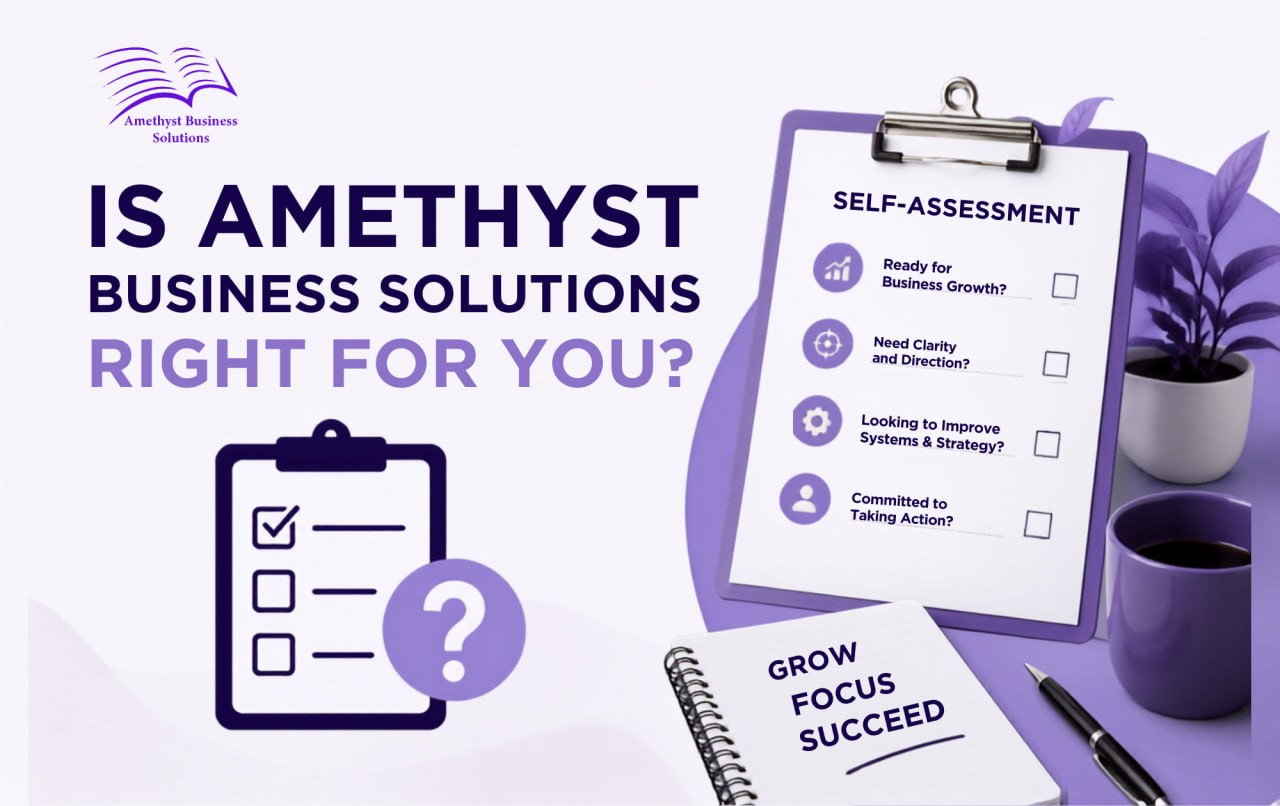
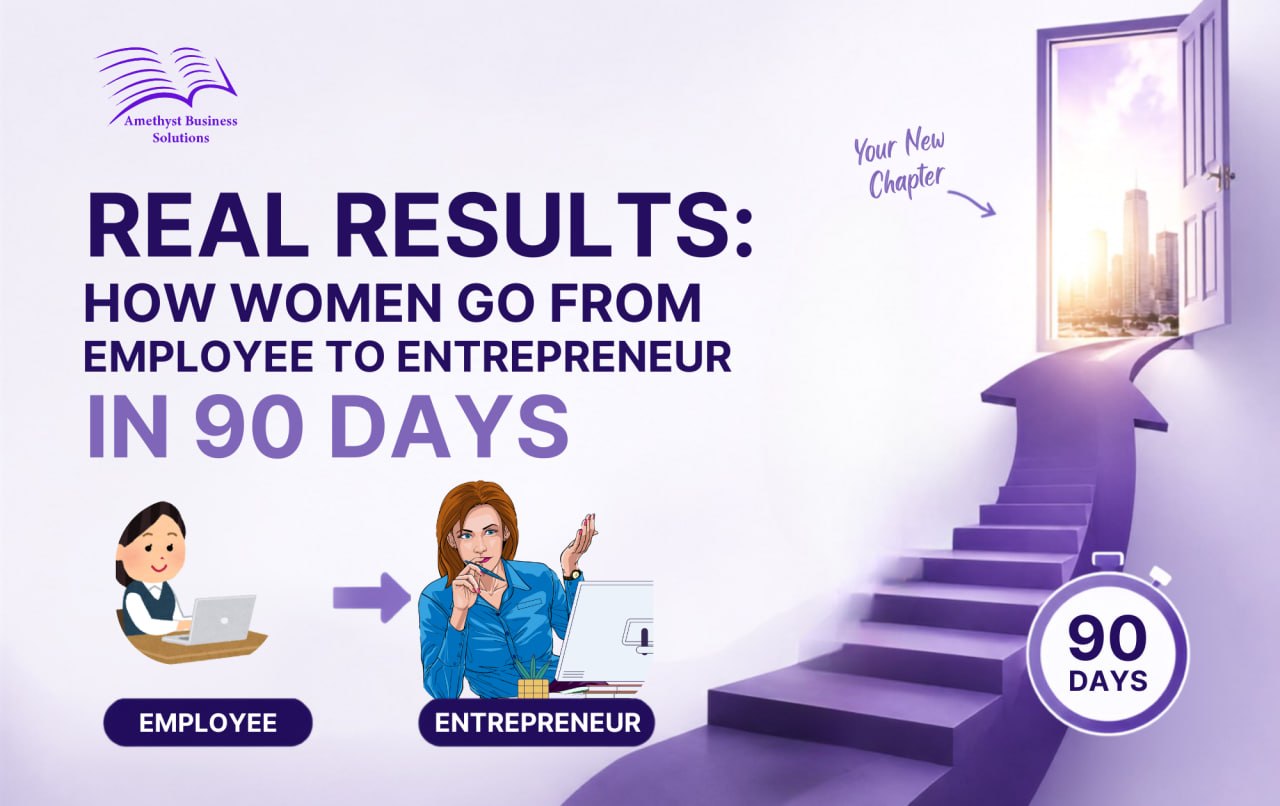
     

  • How to Turn Your Knowledge Into a High-Value Service Offer

    How to Turn Your Knowledge Into a High-Value Service Offer

    Introduction

    Knowledge on its own doesn’t have a price tag, offers do. Two people with identical expertise can generate very different revenue depending entirely on how that knowledge is packaged, positioned, and priced. Learning how to build a high value service offer is the specific skill of converting what you know into something a client can clearly evaluate, trust, and pay a premium for.

    At Amethyst Business Solutions, we help experts package your expertise into offers that command real value rather than getting compared to the cheapest available option. Here’s the exact approach we use.

    Why Knowledge Alone Rarely Commands a Premium Price

    Undifferentiated expertise gets compared on price, because there’s nothing else to compare it on. A high-value offer avoids this trap by making the specific outcome, method, and experience clear enough that price comparison against generic alternatives no longer feels relevant to the buyer.

    1. Anchor the Offer to a High-Stakes Outcome

    The foundation of any effective service offer strategy is choosing an outcome significant enough that the client’s stakes justify a premium price. Compare:

    •     Lower perceived value: “Marketing advice for small businesses.”

    •     Higher perceived value: “A 90-day plan to fill your sales pipeline before a critical fundraising round.”

    The second example ties directly to a specific, high-stakes moment, which naturally supports a higher price than generic advice.

    2. Package Your Expertise Around a Named Method

    Generic advice-giving is hard to price highly because it’s hard to differentiate. When you package your expertise into a named framework or process, even an internally-developed one, it signals a repeatable system behind the results, not just improvised guidance. This alone is one of the most effective ways to shift perceived value upward.

    3. Build in Depth, Not Just Duration

    A common mistake is equating value with more hours or a longer engagement. High-value offers are often defined less by how long they last and more by how thoroughly they solve a specific, well-defined problem, depth of outcome matters more than volume of time.

    4. Reduce the Client’s Perceived Risk

    Premium pricing requires premium confidence from the buyer. Reduce perceived risk through:

    •     Specific, named proof: case studies and results with real numbers, not vague testimonials.

    •     A clearly defined scope, so the client knows precisely what they’re purchasing.

    •     A built-in checkpoint or milestone so results are visible before the engagement fully concludes.

    5. Price the Transformation, Not the Time

    A core principle of service offer strategy is pricing based on the value of the outcome to the client, not the number of hours the work takes you. Ask what the problem is actually costing the client (in lost revenue, wasted time, or risk) and what solving it is genuinely worth, then price accordingly.

    6. Make the Offer Easy to Say Yes To, Without Discounting It

    High-value doesn’t mean high-friction. Clear communication, a straightforward sales process, and confident presentation of the offer all make it easier for a qualified buyer to say yes, without needing to lower the price to compensate for confusion or hesitation.

    A Simple Framework for Packaging a High-Value Offer

    1.   Identify a specific, high-stakes outcome your expertise can deliver.

    2.   Name your method or approach, even if it’s never been formally labeled before.

    3.   Define a clear, bounded scope, not an open-ended engagement.

    4.   Gather specific proof (results, case studies, numbers) that reduces perceived risk.

    5.   Price based on the value of the outcome, then present it with confidence.

    Common Mistakes That Undercut Offer Value

    •     Describing the offer in terms of activities (“weekly calls”) instead of outcomes.

    •     Failing to name a distinct method, leaving the offer indistinguishable from generic advice.

    •     Over-explaining or apologizing for the price instead of anchoring it to the outcome’s value.

    •     Making the scope too broad or vague, which increases perceived risk for the buyer.

    Frequently Asked Questions

    Q: What makes a service offer ‘high value’ rather than just expensive?

    A: A high-value offer ties directly to a significant, well-defined outcome and reduces the buyer’s perceived risk through proof and clear scope, expensive alone, without that justification, just invites price comparison.

    Q: How do I package my expertise if I don’t have a formal certification?

    A: Results and a clearly articulated method matter more to most buyers than formal credentials. Naming your process and showing specific outcomes is often more persuasive than a certification alone.

    Q: What’s the difference between a service offer strategy and just setting a price?

    A: Pricing is one output of a broader strategy that also includes outcome positioning, scope definition, and risk reduction. A strong strategy makes the price feel justified rather than arbitrary.

    Q: Can a brand-new business command a high-value service offer price?

    A: Yes, provided the offer is anchored to a specific, credible outcome and backed by relevant proof, even if that proof comes from prior professional experience rather than the new business itself.

    Final Thoughts

    A high value service offer isn’t created by charging more for the same generic advice, it’s built by anchoring your expertise to a specific outcome, naming your method, and reducing the risk a buyer feels in saying yes. Get the service offer strategy right, and the price becomes a natural reflection of real value, not a number you have to defend.

    At Amethyst Business Solutions, we help experts package their knowledge into offers that reflect what it’s actually worth. If you’re ready to build yours, our team can help you design it.

  • Ready to Quit Your Job? What to Have in Place Before Becoming an Entrepreneur

    Ready to Quit Your Job? What to Have in Place Before Becoming an Entrepreneur

    Introduction

    Deciding to quit your job to start a business is rarely just one decision, it’s a series of smaller ones about timing, finances, and readiness that determine whether the leap lands safely or turns into a scramble. The founders who make this transition well aren’t necessarily braver than everyone else; they’ve simply done the preparation that makes the leap calculated instead of reckless.

    At Amethyst Business Solutions, we’ve guided professionals through this exact career to entrepreneurship shift. Here’s what a realistic employee transition plan actually includes before handing in notice.

    Why Timing the Jump Matters More Than the Decision Itself

    Almost everyone eventually decides they want to leave; far fewer plan the transition itself with the same care. The difference between a stressful, reactive exit and a controlled one usually comes down to what’s already in place before the resignation, not the resignation itself.

    1. A Validated Revenue Signal, Not Just an Idea

    Before leaving a paycheck behind, there should be some real evidence the business idea works: early paying clients, a tested offer, or consistent demand, not just enthusiasm and a business plan. Even modest proof of concept dramatically reduces the risk of the transition.

    2. A Financial Runway You’ve Actually Calculated

    Vague confidence in “having some savings” isn’t a plan. A real employee transition plan includes specific numbers:

    •     Monthly essential expenses, calculated honestly, not optimistically.

    •     A savings buffer, commonly 3–6 months of expenses, set aside specifically for this transition.

    •     A realistic minimum revenue threshold the business needs to hit before the runway runs out.

    3. A Plan for Benefits You’re Currently Getting Through Employment

    Health insurance, retirement contributions, and other benefits often go unaccounted for until the transition is already underway. Research replacement costs and options before leaving, since these expenses can meaningfully change the actual financial picture.

    4. A Specific, Not Vague, First 90-Day Plan

    “Figure it out once I’m free to focus on it” is a common but risky plan. A concrete first-90-days outline, target clients, specific outreach activities, weekly milestones, gives the transition direction from day one rather than a disorienting period of open-ended freedom.

    5. Early Proof You Can Sell, Not Just Deliver

    Many professionals are confident in their ability to do the work but untested in their ability to sell it independently, without a company brand or existing pipeline behind them. Testing sales ability before leaving, through side projects, freelance work, or informal client conversations, is one of the most protective steps in the entire transition.

    6. A Support System Independent of Your Current Job

    Leaving a role often means losing built-in professional community: colleagues, structure, and a sense of shared purpose. Part of a thoughtful career to entrepreneurship transition is proactively building a replacement, a mastermind, a coach, a peer group, before that structure disappears, not scrambling to find it after.

    7. A Legal and Administrative Foundation

    Before officially launching, most founders need at minimum a business entity, basic contracts or service agreements, and clarity on tax obligations as a self-employed individual. These are unglamorous but foundational; retrofitting them after the fact is more complicated than setting them up first.

    8. An Honest Conversation With Whoever Shares Your Financial Life

    If you have a partner, family, or shared financial obligations, this transition affects them too. A candid conversation about risk tolerance and expectations before quitting prevents a source of stress that has nothing to do with the business itself but can derail it anyway.

    A Simple Pre-Quit Checklist

    1.   Validated demand: real interest or early paying clients, not just an idea.

    2.   Calculated financial runway and a specific minimum revenue trigger.

    3.   A plan for replacing employer-provided benefits.

    4.   A concrete first-90-days plan, not just a general direction.

    5.   Tested sales ability, independent of your current employer’s brand.

    6.   A support system already in place outside of work.

    7.   Basic legal and administrative setup underway or complete.

    8.   An honest conversation with anyone financially affected by the decision.

    Frequently Asked Questions

    Q: How much savings should I have before I quit my job to start a business?

    A: A common, conservative benchmark is 3–6 months of essential living expenses set aside specifically for the transition, though the right number depends on how validated your revenue already is.

    Q: Do I need paying clients before I quit, or can I build the business after?

    A: Having at least some validated demand or early clients before quitting significantly reduces risk. Many successful transitions include testing the business alongside employment before making it full-time.

    Q: What’s the biggest mistake people make in a career to entrepreneurship transition?

    A: Underestimating both the financial runway needed and the time it takes to replicate a stable income independently, often compounded by not testing sales ability before leaving.

    Q: Should I create an employee transition plan even if I already know I want to quit?

    A: Yes. Even a firm decision benefits from a structured plan, since the specifics of timing, financial buffer, and first steps significantly affect how smoothly the transition goes.

    Final Thoughts

    The decision to quit your job to start a business is rarely the risky part, the risky part is doing it without the groundwork in place. A thoughtful employee transition plan turns a leap of faith into a calculated, well-supported move, one that gives the new business its best possible chance from day one.

    At Amethyst Business Solutions, we help professionals plan this transition with clarity instead of guesswork. If you’re weighing this decision, our team can help you build a realistic plan before you make the leap.

  • What Does a Business Strategy Consultant Actually Help You With?

    What Does a Business Strategy Consultant Actually Help You With?

    Introduction

    The title “consultant” gets used broadly enough that it’s often unclear what someone actually does day to day. A business strategy consultant in particular is easy to confuse with a coach, a marketing consultant, or a generalist advisor, when the role actually covers a specific, well-defined set of work centered on how a business grows and where it focuses its resources.

    At Amethyst Business Solutions, we work as strategy consultants with founders across stages, and the confusion about what that actually involves comes up often enough that it’s worth answering directly. Here’s a clear breakdown of what strategic business planning support really looks like in practice.

    Strategy Consulting vs. Other Types of Business Support

    Before getting into specifics, it helps to distinguish strategy consulting from adjacent roles it’s often confused with:

    •     A business coach often focuses on the founder’s habits, mindset, and accountability over time.

    •     A marketing consultant focuses specifically on visibility, channels, and demand generation.

    •     A business strategy consultant focuses on the overall direction of the business: where to focus, what to prioritize, and how resources should be allocated to get there.

    In practice, these roles often overlap, and many founders benefit from more than one at different points, but strategy work specifically centers on the big-picture architecture of the business, not just one function within it.

    1. Clarifying What the Business Should Actually Be Optimizing For

    Many founders pursue growth, revenue, visibility, and expansion simultaneously without a clear sense of which matters most right now. A strategy consultant helps identify the single most important objective for the current stage of the business, so decisions across the organization can align around it.

    2. Diagnosing the Real Constraint on Growth

    Founders often assume the constraint on growth is marketing, when it’s actually pricing, delivery capacity, or an unclear offer, or vice versa. A core part of business growth strategy work is correctly diagnosing which constraint is actually limiting progress before prescribing a fix.

    3. Building a Prioritized, Sequenced Plan

    Rather than a long list of everything that could be improved, effective strategic planning identifies the two or three highest-leverage initiatives and sequences them logically, so effort compounds instead of scattering across too many priorities at once.

    4. Evaluating Major Decisions Before They’re Made

    Consultants are frequently brought in for a specific, high-stakes decision: entering a new market, launching a new offer, restructuring pricing, or considering a significant hire. Strategic business planning at this level means stress-testing the decision against the broader direction of the business before it’s finalized, not just executing it once it’s been decided.

    5. Building Systems for Ongoing Strategic Review

    Beyond a single plan, good strategy consulting often leaves behind a repeatable process, a quarterly review rhythm, a simple set of metrics to track, a framework for evaluating new opportunities, so the business doesn’t need outside strategic support for every future decision.

    6. Providing an Outside, Unbiased Perspective

    Founders are inevitably close to their own business, which makes certain blind spots difficult to see from the inside. A consultant’s objectivity, informed by pattern recognition across other businesses, often surfaces issues or opportunities that internal teams miss entirely.

    What Working With a Business Strategy Consultant Typically Looks Like

    1.   An initial diagnostic phase reviewing the current state of the business across key areas (offer, pricing, marketing, operations).

    2.   Identification of the core constraint or opportunity to prioritize.

    3.   Development of a specific, sequenced strategic plan with clear milestones.

    4.   Ongoing check-ins (weekly, biweekly, or monthly depending on the engagement) to track progress and adjust as needed.

    5.   A defined end point or transition to a lighter-touch advisory relationship.

    When to Bring in a Strategy Consultant vs. Other Types of Support

    •     If the core issue is a lack of clear direction or a specific high-stakes decision — strategy consulting.

    •     If the core issue is follow-through, habits, or confidence — coaching may be a better fit.

    •     If the core issue is visibility or lead generation specifically — a marketing consultant may be more targeted.

    •     If you’re unsure which applies, a strategy consultant can often help diagnose that as a starting point.

    Frequently Asked Questions

    Q: What’s the difference between a business strategy consultant and a business coach?

    A: A strategy consultant typically focuses on the overall direction and resource allocation of the business, while a coach focuses more on the founder’s habits, accountability, and follow-through. The two roles often work well together.

    Q: How long does a typical strategic business planning engagement last?

    A: Engagements vary, but many run 8–12 weeks for an initial diagnostic and plan, with some founders continuing at a lighter cadence for ongoing strategic check-ins.

    Q: Do I need a business strategy consultant if my business is already growing?

    A: Growth doesn’t rule out the need for strategy support. Many founders bring in a consultant specifically at growth inflection points, to make sure scaling happens deliberately rather than reactively.

    Q: What does a business growth strategy engagement typically produce?

    A: A well-run engagement typically produces a clear, prioritized plan with specific milestones, along with a repeatable framework the founder can use for future strategic decisions independently.

    Final Thoughts

    A business strategy consultant isn’t there to run the business for you, they’re there to bring clarity, sequencing, and objectivity to decisions that are hard to make well from the inside. Whether the need is a single high-stakes decision or a full business growth strategy reset, the right engagement leaves you with both a clear plan and a better process for making the next decision on your own.

    At Amethyst Business Solutions, we provide exactly this kind of strategic clarity for founders navigating pivotal decisions. If you’re not sure what type of support your business needs right now, our team is happy to help you figure that out.

  • How to Build a Business Around Your Expertise Without Starting From Scratch

    How to Build a Business Around Your Expertise Without Starting From Scratch

    Introduction

    Starting a business is often described as starting from zero, but for professionals with real experience, that framing is misleading. If you’ve spent years developing expertise, you’re not starting from scratch, you’re starting from an asset most founders spend years trying to build. Learning how to build a business around your expertise is fundamentally about structuring what you already know into something a client can hire, not inventing something new.

    At Amethyst Business Solutions, we help experienced professionals design a professional service business around the expertise they already have, without pretending the slate is blank. Here’s the approach that consistently works.

    Why Starting “From Scratch” Is the Wrong Mental Model

    Treating a new business as a blank slate leads founders to second-guess expertise they’ve already validated in a previous role, and to spend unnecessary time building credibility they arguably already have. The more accurate framing: you’re not building a business from nothing, you’re building the container that lets your existing expertise be sold directly instead of through an employer.

    Step 1: Audit What You Actually Bring, Beyond Just the Skill

    Expertise built inside an organization often includes more than the core skill itself. Before designing the business, take stock of:

    •     The specific skill or knowledge itself.

    •     Adjacent experience — industries you understand, types of organizations you’ve worked within, problems you’ve seen repeatedly.

    •     Existing relationships and reputation that can act as an early distribution channel.

    •     Any proprietary frameworks, methods, or processes you’ve developed, even informally.

    Step 2: Choose the Right Expertise-Based Business Model

    Not every expertise-based business model looks the same. A few common structures, each with different trade-offs:

    1:1 Consulting or Advisory

    Highest personal involvement, fastest to launch, but capped by your available hours. Often the natural starting point.

    Productized Service

    A defined, repeatable deliverable at a fixed price and scope. Easier to market and sell than open-ended consulting, and a natural next step once you understand the most common client need.

    Group Programs or Cohort-Based Offerings

    Delivers your expertise to multiple clients simultaneously, increasing revenue per hour, but requires a more structured curriculum and stronger marketing to fill cohorts.

    Licensed or Training-Based Models

    Teaching your method to others (internal teams, other practitioners) rather than applying it directly yourself. Highest leverage, but usually requires an already-established reputation to sell effectively.

    Step 3: Translate Expertise Into a Specific Offer

    A professional service business needs a defined offer, not just an open-ended description of your background. Define:

    1.   The specific outcome the engagement delivers.

    2.   The scope and format (duration, deliverables, level of access).

    3.   The ideal client profile who has this problem and can pay to solve it.

    Step 4: Use Existing Relationships as Your First Distribution Channel

    Former colleagues, industry contacts, and past collaborators are typically the fastest path to first clients, since the trust-building work is already partially done. Reach out directly and specifically rather than broadly announcing the new business and hoping for inbound interest.

    Step 5: Build New Proof Independent of Your Former Title

    Once you’re outside the credibility of an employer’s name, independently earned proof (case studies, testimonials, specific results) becomes essential. Prioritize gathering this early, even from smaller or discounted initial engagements, since it becomes the foundation your business’s credibility rests on going forward.

    Common Mistakes When Building an Expertise-Based Business

    •     Undervaluing the expertise because it feels routine after years of practicing it.

    •     Trying to serve too broad a range of client types instead of the specific one you’re best positioned to help.

    •     Delaying launch while waiting to feel “expert enough,” rather than starting with the credible experience already in hand.

    •     Choosing a business model (like group programs) that doesn’t match current capacity or audience size.

    Frequently Asked Questions

    Q: Do I need to develop new skills to build a business around my expertise?

    A: Usually not. The primary work is packaging and positioning existing expertise into a specific, sellable offer, not acquiring entirely new skills before starting.

    Q: What’s the best expertise-based business model to start with?

    A: 1:1 consulting or advisory work is often the fastest starting point, since it requires the least additional infrastructure. Other models, like productized services or group programs, can be layered in once demand is validated.

    Q: How is a professional service business different from a typical consulting practice?

    A: The terms overlap significantly. “Professional service business” is often used more broadly to include productized or scaled offerings, while “consulting” can imply a more traditional 1:1 advisory structure, though usage varies.

    Q: How do I price my expertise if I’ve never sold it independently before?

    A: Anchor pricing to the value and outcome the expertise delivers for a client, not your former salary. Researching what comparable independent providers charge in your space is also a useful starting benchmark.

    Final Thoughts

    You don’t need to start from scratch to build a business around your expertise, you need to structure what you already know into something a client can clearly understand, trust, and buy. Choosing the right expertise-based business model and packaging your experience deliberately turns years of professional knowledge into a real professional service business, not a reinvention from zero.

    At Amethyst Business Solutions, we help experienced professionals structure their expertise into a business that reflects the value they already bring. If you’re ready to make that shift, our team can help you build the plan.